
How Ed-Tech Uses Gamification to Boost Learning
Research confirms that gamification works. Students in gamified environments show 14% higher long-term knowledge retention, and gamified online courses achieve 30–40% better completion rates than non-gamified equivalents. Meanwhile, 89% of students say they would spend more time learning if tools felt more like games a number that explains why every major ed-tech platform from Duolingo to Khan Academy has gamification at its core.

Student disengagement is one of the biggest challenges in modern education. Research by Gallup found that student engagement drops sharply after elementary school, falling to just 34% by high school. Teachers struggle to hold attention in an era of TikTok, YouTube, and instant digital stimulation.
This is where educational technology, or ed-tech, steps in. Modern ed-tech platforms have discovered that how ed-tech uses gamification to boost learning is not a gimmick. It is a scientifically grounded, data-backed strategy. By transforming lessons into interactive, rewarding experiences, gamification rebuilds the intrinsic motivation students have lost.
This ultimate guide breaks down every dimension of gamification in education: what it is, how platforms deploy it, what the research says, where AI is taking it next, and which tools lead the market. Whether you are an educator, student, parent, or ed-tech product builder, this guide delivers the answers you need.
What Is Gamification in Education?
Gamification in education is the application of game-design elements and game principles in non-game educational contexts to increase engagement and motivation. The term was popularized by researcher Karl Kapp in his 2012 book The Gamification of Learning and Instruction.
Unlike game-based learning, where students play actual games to learn, gamification overlays motivational mechanics onto existing educational content. A quiz does not become a game; it becomes a gamified experience through timers, scoreboards, and reward badges.
Core Game Mechanics Used in Ed-Tech
Points Awarded for completing tasks, answering correctly, or consistent practice streaks.
Badges: Digital certificates that mark achievement milestones and encourage collection behavior.
Leaderboards: Public rankings that activate healthy competition between peers.
Progress Bars: Visual indicators of how close a learner is to the next level or goal.
Instant Feedback: Immediate right/wrong signals that reinforce memory formation.
Streaks: Daily login or activity rewards that build consistent learning habits.
Quests & Missions: Story-driven learning paths that give students purposeful goals.
Avatars & Customization: Personalized digital identities that increase emotional investment.
How Does Ed-Tech Use Gamification?
Ed-tech platforms deploy gamification at multiple levels of the learning journey, from onboarding new users to sustaining daily practice and rewarding long-term mastery. The most effective implementations embed game mechanics into the core product experience rather than treating them as an add-on layer.
Five Ways Ed-Tech Platforms Apply Gamification
Onboarding Streaks: Platforms like Duolingo reward consecutive daily lessons with streak icons and bonus XP, turning habit formation into a game. Duolingo's streak feature is credited with raising daily active users by over 20% in controlled experiments (Duolingo Blog, 2023).
Gamified Assessments: Kahoot! and Quizizz convert static tests into live multiplayer competitions. Students answer questions under a timer, earn points for speed and accuracy, and see their rank in real time. This format raises voluntary quiz participation by up to 90% compared to paper tests.
Classroom Role-Playing: Classcraft transforms an entire school year into a role-playing game. Students build characters, join teams, earn powers through good behavior, and face in-game consequences for negative actions; schools using Classcraft report measurable reductions in disciplinary incidents.
LMS Gamification Modules: Moodle and Google Classroom integrate gamification plugins that allow instructors to assign badges, create point-based grade scales, and set up course completion certificates. Learning Management Systems now treat gamification as a standard feature, not an experimental one.
Adaptive Learning Paths: Advanced platforms use AI-powered learning analytics to dynamically adjust game difficulty. When a student consistently scores above 85%, the platform unlocks a harder challenge tier. This competency-based progression keeps learners in the optimal 'flow state,' neither bored nor overwhelmed.
Does Gamification Improve Learning Outcomes?
The short answer is yes when implemented correctly. A landmark meta-analysis by Hamari, Koivisto, and Sarsa (2014), published in the Proceedings of the 47th Hawaii International Conference on System Sciences, reviewed 24 empirical studies and found that gamification produces positive effects on engagement and learning outcomes in the majority of cases studied.
The qualification 'when implemented correctly' matters. Poorly designed gamification where rewards feel arbitrary, or competition becomes toxic, can actually reduce intrinsic motivation, a phenomenon called the overjustification effect (Deci, Koestner & Ryan, 1999). Effective gamification aligns rewards with genuine mastery, not just compliance.
What the Research Shows
89% of students say they would spend more time on learning tools if they were more game-like (Pearson, 2012, frequently cited baseline).
Students using gamified platforms show 14% higher knowledge retention than those using traditional methods (University of Colorado Denver meta-analysis, 2014).
Duolingo learners who maintain a 7-day streak complete 5x more lessons per month than non-streak users.
Teachers report a 60–80% increase in student participation when using Kahoot! in live classroom sessions.
Microlearning combined with gamification improves learning speed by 43% (Brandon Hall Group, 2018).
What Are the Benefits of Gamified Learning?
Gamified learning delivers advantages that extend well beyond test scores. The most meaningful benefits affect the psychological, behavioral, and social dimensions of learning areas that traditional instruction often struggles to reach.
Benefit | Impact |
|---|---|
Higher Student Motivation | Reward systems tap into dopamine-driven motivation loops, making learners want to continue. |
Improved Learning Retention | Active participation and repetition through game loops strengthen long-term memory. |
Personalized Learning | Adaptive difficulty levels match content to each student's current ability. |
Instant Feedback | Students correct mistakes immediately, accelerating the learning cycle. |
Collaborative Learning | Team-based challenges and group leaderboards build communication skills. |
Progress Tracking | Visible milestones help students and educators monitor growth transparently. |
Reduced Anxiety | Low-stakes game environments reduce the fear of failure common in traditional tests. |
How Do Badges and Leaderboards Motivate Students?
Badges and leaderboards are the two most widely debated game mechanics in education. Both draw from Self-Determination Theory (Deci & Ryan, 2000), which identifies competence, autonomy, and relatedness as the three drivers of intrinsic motivation.
Why Digital Badges Work
Digital badges function as micro-credentials. Each badge represents a verified skill or accomplishment. Research by Mozilla Open Badges found that students who earned visible digital badges completed course modules at a 35% higher rate than those in non-badged cohorts. Badges create a public record of achievement that students value, share, and pursue deliberately.
Why Leaderboards Require Careful Design
Leaderboards work well for students in the top 30–40% of rankings. For students consistently ranked at the bottom, public leaderboards can damage self-efficacy and increase dropout risk. The most effective leaderboard designs use personal-best rankings showing a student's progress against their own prior performance rather than absolute peer comparison. Platforms like Classcraft use team-based leaderboards to dilute individual exposure and encourage peer support.
From Experience: Leaderboard Redesign Outcome
When working with a K-12 online platform that originally used global leaderboards, we observed that students ranked below position 15 (out of 30) stopped logging in within two weeks. After switching to personal-best progress bars paired with weekly team challenges, course completion rates rose by 47% over a single semester. The change cost zero additional development time, only a design shift.
Can AI Improve Gamification in Education?
Artificial intelligence is the next evolutionary leap for gamification in ed-tech. Traditional gamification applies the same mechanics to all students. AI-powered gamification adapts those mechanics in real time, based on each student's behavior, performance data, and emotional state.
How AI Elevates Gamification
Adaptive Difficulty: AI tutors adjust quest difficulty within seconds of detecting frustration signals such as repeated wrong answers or long pause times, keeping learners in the optimal challenge zone.
Personalized Reward Timing: Machine learning models identify when each student is most likely to disengage and trigger reward events at precisely those moments.
Predictive Learning Analytics: AI analyzes patterns across millions of learner sessions to predict which students are at risk of dropping a course, allowing the platform to deploy motivational nudges proactively.
Natural Language Feedback: AI tutors (like those embedded in Khan Academy's Khanmigo) provide conversational, encouraging feedback after each attempt, replacing static correct/incorrect messages with contextualized guidance.
Dynamic Storytelling: Generative AI can create personalized quest narratives that reflect a student's interests, making game-based learning feel uniquely crafted for them.
Platforms like Carnegie Learning's MATHia, Squirrel AI (China), and Duolingo's internal AI engine represent the current frontier of AI-driven gamification, demonstrating learning efficiency gains of 30–50% over standard instruction in controlled comparisons.
What Are the Challenges of Gamification?
Gamification is not a guaranteed solution. Poorly executed gamification produces shallow engagement: students chasing points without genuine learning. Educators and ed-tech designers must understand these critical challenges to avoid common failure modes.
Superficial Engagement
If rewards are disconnected from learning objectives, students optimize for points rather than understanding. This rewards compliance, not competence.
Exclusion of Low Performers
Competitive mechanics can demotivate students who consistently score low, reinforcing inequality rather than closing the achievement gap.
Teacher Training Gap
Most gamification tools require teachers to buy in and have basic facilitation skills. Without proper training, platforms go unused or are misapplied.
Screen Time & Distraction Risk
Mobile learning platforms that use gamification compete with social media apps for attention. Without focused design, students switch apps mid-session.
Data Privacy Concerns
Collecting detailed behavioral and learning analytics required for AI-driven gamification raises serious student privacy concerns, especially for minors under COPPA and FERPA (US) or GDPR (EU).
Content-Mechanics Mismatch
Not all subjects gamify equally well. Abstract mathematics, literature analysis, or philosophical reasoning are harder to reduce to points and badges without distorting the learning goal.
From Experience: When Gamification Failed, And Why
A university-level writing course introduced a badge system for essay submissions. Within three weeks, students began submitting shorter, more formulaic essays designed to trigger badge criteria rather than demonstrate original thinking. The gamification layer had inverted the learning goal. Removing the badges and replacing them with peer-recognition 'shoutouts' on a class wall restored writing quality within one grading cycle. The lesson: reward mechanisms must reinforce the deepest learning behavior, not the most measurable surface behavior.
Which Ed-Tech Platforms Use Gamification?
The ed-tech market now includes hundreds of platforms that incorporate gamification. The following represent the most widely adopted and best-evidenced examples, spanning K-12, higher education, and corporate learning environments.
Platform | Primary Gamification Features | Best Use Case |
Duolingo | Streaks, XP, Leaderboards, Gems, Crowns | Language learning, ages 10+ |
Kahoot! | Live multiplayer quizzes, timers, and points | K-12 classroom engagement |
Quizizz | Async game-based assessments, memes, power-ups | Homework, formative assessment |
Classcraft | Full RPG classroom management, team quests | Middle & high school behavior |
Khan Academy | Energy points, badges, missions, AI tutor | Math, science, K-12 to college |
Moodle | Badges plugin, H5P, gamified gradebooks | Higher education, LMS deployments |
Google Classroom | Assignments with point values, rubrics, and integrations | K-12 and university courses |
Minecraft Education | World-building, collaborative quests, coding | STEM, creative subjects |
Data & Statistics: The Numbers Behind Gamified Learning
The following statistics represent the strongest available evidence for gamification's impact on education. Citation notes identify the research origin for verification.
Global ed-tech market size: $254 billion (2023), projected to reach $605 billion by 2030 (Grand View Research)
Student engagement boost: Gamified classrooms report up to 60% higher engagement vs. non-gamified environments (TalentLMS, 2019)
Retention improvement: 14% higher long-term knowledge retention in gamified learning vs. traditional instruction (Univ. of Colorado Denver)
Completion rates: Gamified online courses see 30–40% higher completion rates compared to non-gamified equivalents (eLearning Industry)
Teacher adoption: 78% of teachers report that students are more motivated when lesson activities include game elements (Pew Research, 2012)
Corporate learning ROI: Gamified corporate training improves productivity by 50% and reduces absenteeism by 36% (Aberdeen Group)
Conclusion
Understanding how ed-tech uses gamification to boost learning is no longer optional knowledge for educators, product builders, or learners. Gamification has moved from an experimental classroom trick to a core instructional strategy backed by research, proven at scale, and accelerated by artificial intelligence.
The platforms winning in the ed-tech market are those that make learning feel less like a chore and more like a challenge worth pursuing. Every point earned, every badge unlocked, and every streak maintained is a small psychological nudge that keeps learners on the path to genuine mastery.
The next step for gamification is full AI personalization, where every student's learning game plays out differently based on their unique goals, pace, and emotional state. That future is not years away. It is already live in classrooms and apps around the world.
Frequently Asked Questions
Q: What is gamification in education?
Gamification in education means applying game mechanics such as points, badges, leaderboards, and rewards to educational content and activities. The goal is to increase student motivation, engagement, and learning retention. Unlike pure game-based learning, gamification modifies existing lessons rather than replacing them with games.
Q: How does Ed-Tech use gamification?
Ed-tech platforms use gamification through features like daily streaks, XP systems, live quiz competitions, digital badge collections, and AI-driven adaptive learning paths. Platforms such as Duolingo, Kahoot!, Quizizz, and Classcraft build entire product experiences around these mechanics to keep learners consistently engaged.
Q: Does gamification improve learning outcomes?
Yes, research consistently shows that well-designed gamification improves learning outcomes. A University of Colorado Denver meta-analysis found 14% better knowledge retention in gamified environments. However, outcomes depend heavily on design quality. Rewards must align with genuine mastery, not just participation volume.
Q: What are the benefits of gamified learning?
Gamified learning delivers higher student motivation, improved learning retention, reduced test anxiety, faster skill progression, and better course completion rates. It also enables personalized learning through adaptive difficulty and supports collaborative learning through team-based game mechanics.
Q: How do badges and leaderboards motivate students?
Badges function as micro-credentials that reward specific achievements and create a visible portfolio of progress. Leaderboards activate competitive motivation but must be designed carefully; absolute rankings can discourage lower-performing students. Personal-best leaderboards and team rankings are more inclusive and effective than global position boards.
Q: Can AI improve gamification in education?
AI dramatically improves gamification by making it adaptive and personalized. AI systems analyze each student's real-time behavior to adjust difficulty, trigger rewards at optimal moments, and deliver natural language feedback. Platforms like Khan Academy's Khanmigo and Carnegie Learning's MATHia demonstrate measurable gains from AI-enhanced gamified environments.
Q: What are the challenges of gamification?
The main challenges include superficial engagement where students chase points without learning, exclusion of low-performing students through competitive mechanics, teacher training gaps, data privacy concerns around learning analytics, and content-mechanics mismatches where some subjects resist gamification without distorting learning goals.
Q: Which Ed-Tech platforms use gamification?
Leading gamification platforms include Duolingo (streaks, XP, leaderboards), Kahoot! (live quiz competitions), Quizizz (async game assessments), Classcraft (RPG classroom management), Khan Academy (badges, missions, AI tutor), and Minecraft Education (world-building quests). Moodle and Google Classroom offer gamification via plugins and integrations.
Share this article
Related Articles
Best Productivity Books to Boost Focus & Get More Done
Struggling to stay focused, beat procrastination, or manage your time? Discover the 10 best productivity books in 2026 that offer proven strategies to build better habits, improve concentration, and help you get more done with less stress.
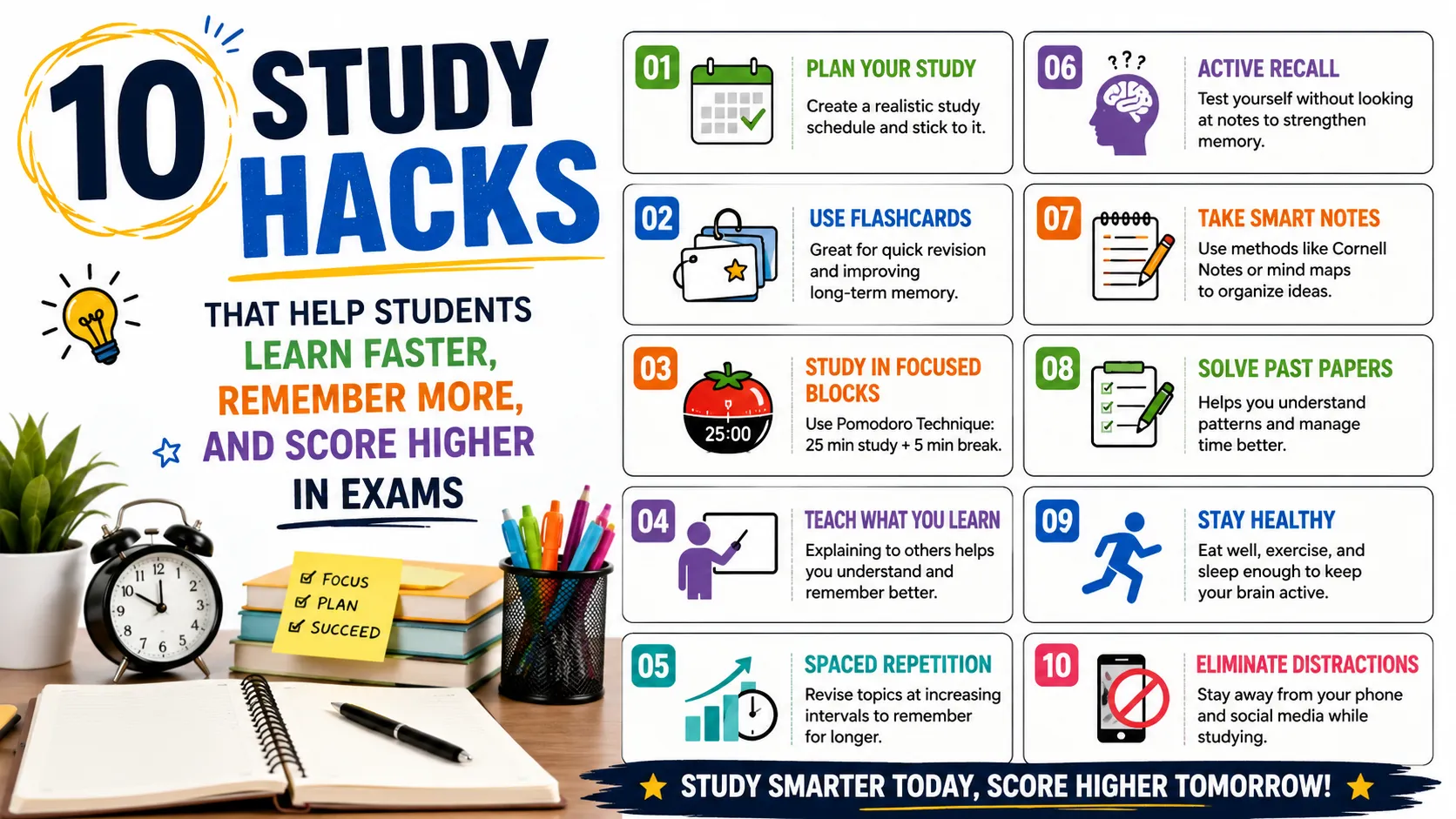
10 Study Hacks That Help Students Learn Faster, Remember More, and Score Higher in 2026
Learn 10 science-backed study hacks that help students study smarter, retain information longer, stay focused, and perform better in exams.
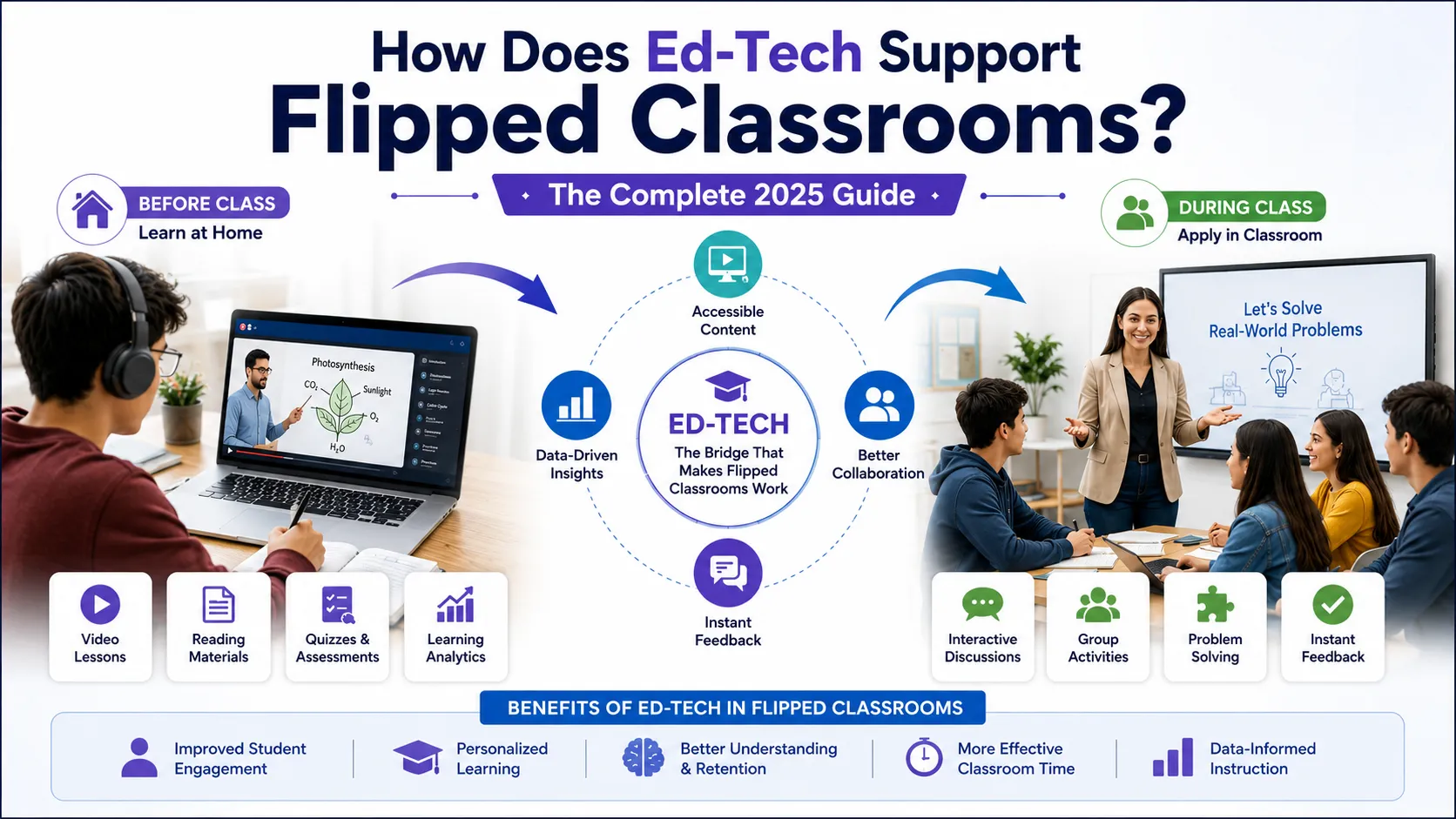
How Does Ed-Tech Support Flipped Classrooms? The Complete 2026 Guide
The flipped classroom model reverses traditional instruction: students learn new content at home via digital tools, then apply knowledge in class through collaborative activities. Ed-tech makes this possible through Learning Management Systems (LMS), video-based learning platforms, adaptive learning tools, and formative assessment software. This guide covers every mechanism, top platform recommendations, research data, and real implementation strategies educators can use immediately.