
10 Study Hacks That Help Students Learn Faster, Remember More, and Score Higher in 2026
Learn 10 science-backed study hacks that help students study smarter, retain information longer, stay focused, and perform better in exams.
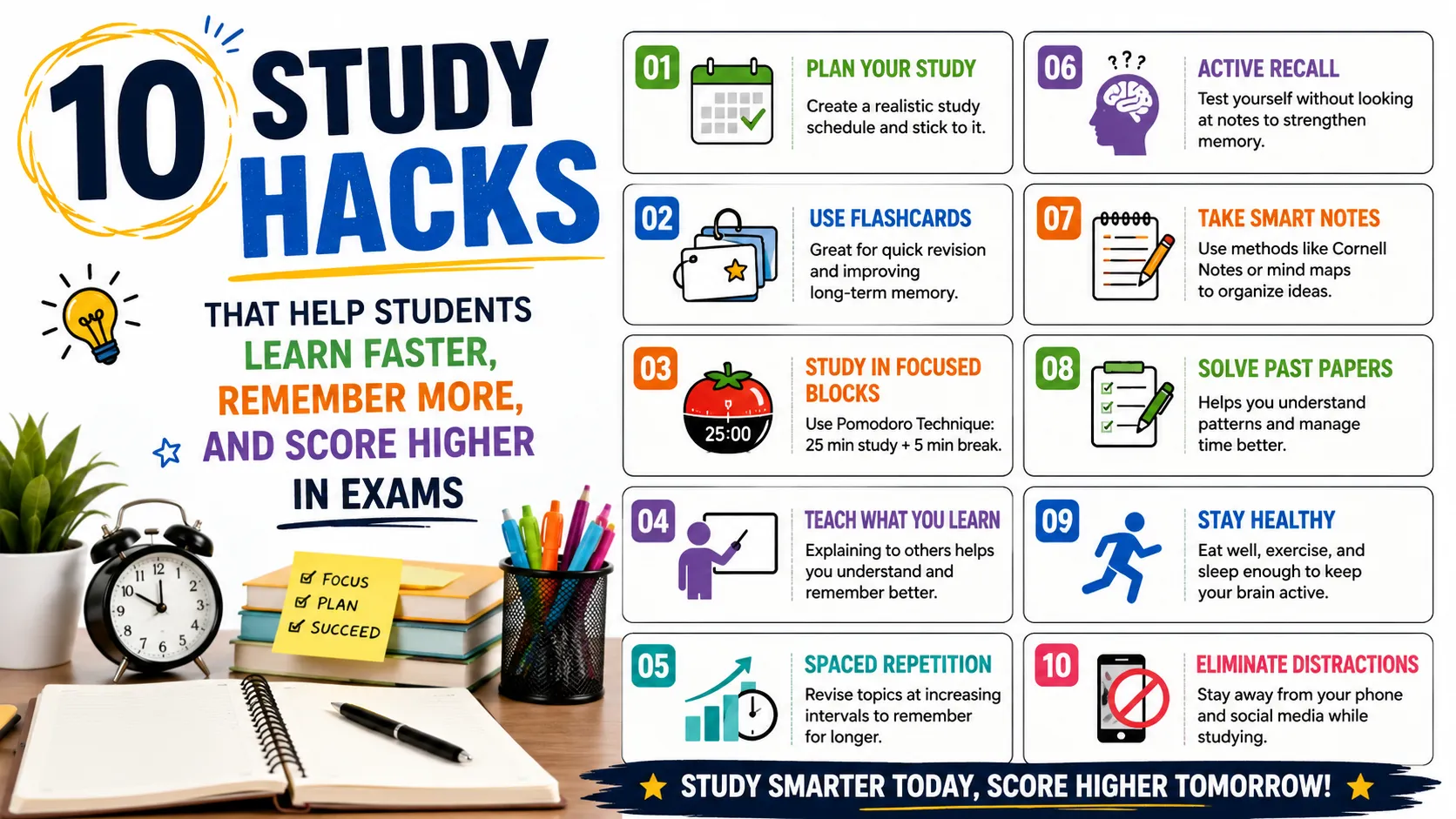
Most students spend hours studying, yet still underperform on exams. The reason is not a lack of effort; it is a lack of the right strategy. Passive techniques like rereading and highlighting feel productive but do very little for long-term memory retention.
This guide presents the 10 study hacks that cognitive science and educational research consistently identify as the most effective. Whether you are a high school student preparing for finals, a college student managing a heavy course load, or a professional pursuing a new certification, these techniques will transform how you learn.
Each hack is explained with practical steps, real-world context, and evidence-based reasoning so you can start applying them today, not just bookmark this page and forget about it.
The Science Behind Effective Studying
Before diving into the 10 study hacks, it helps to understand why some study methods work and others fail. Human memory operates through two core processes: encoding (getting information in) and retrieval (getting information out). Most passive study methods only address encoding. The study hacks in this guide target retrieval, which is where real learning happens.
Encoding vs. Retrieval: Reading or rereading creates the illusion of familiarity but does not strengthen the memory trace. Retrieval practice improves retention by encouraging active recall of information from memory.
The Spacing Effect: Information reviewed at spaced intervals is retained significantly longer than information crammed in a single session. Hermann Ebbinghaus's 19th-century research on the "forgetting curve" established this, and modern neuroscience confirms it.
Cognitive Load Theory: The brain's working memory is limited. Study techniques that reduce unnecessary cognitive load, like organized note-taking and chunking, improve learning efficiency.
The 10 Study Hacks (Full Breakdown)
Hack 1: Active Recall
Active recall is a learning technique that strengthens memory by encouraging you to retrieve information without looking at the material. After reading a chapter, close the book and write down everything you remember. Then check your notes to find gaps.
A 2013 study by Roediger and Karpicke (Psychological Science) found that students who used active recall outperformed students who restudied by up to 50% on delayed tests. Active recall forces the brain to strengthen neural pathways associated with the target information.
How to apply it: Use flashcards, practice problems, or simply write summaries from memory. Apps like Anki make it easier to apply retrieval practice through automated review schedules.
Hack 2: Spaced Repetition
Spaced repetition is a study schedule strategy where you review information at increasing intervals; for example, one day after learning, then three days later, then one week later. This approach exploits the spacing effect to maximize memory retention with minimum study time.
The Leitner System (1970s) formalized spaced repetition using physical flashcard boxes. Today, digital tools like Anki and RemNote automate interval scheduling using algorithms based on each item's difficulty.
How to apply it: Use Anki or a similar tool. Review cards daily, let the algorithm handle scheduling. Commit to 20–30 minutes per day consistently.
Hack 3: The Pomodoro Technique
The Pomodoro Technique helps maintain focus by alternating 25-minute study intervals with short 5-minute breaks, followed by a longer rest after every four sessions.
This technique works because it aligns with the brain's natural attention cycles, prevents mental fatigue, and creates urgency; a short, defined window of focus is less intimidating than a vague "study session."
To use this technique, set a 25-minute timer and work without distractions until it rings. Work on one task only. Stop when the timer rings. Use apps like Forest, Focus Keeper, or Be Focused.
Hack 4: Mind Mapping
Mind mapping is a visual note-taking method that organizes ideas around a central concept, using branches, colors, and keywords. Mind mapping engages both verbal and visual memory systems, making information more memorable and interconnected.
A 2018 study published in the International Journal of Science Education found that students who used mind mapping showed significantly better conceptual understanding than students who used linear notes.
How to apply it: Start with the main topic in the center of a blank page. Branch out to key subtopics. Add keywords, not full sentences. Use color-coding. Digital tools include MindMeister and XMind.
Hack 5: The Feynman Technique
The Feynman Technique, attributed to Nobel Prize-winning physicist Richard Feynman, is a four-step method for mastering any concept:
(1) Choose a topic;
(2) Explain it in simple language as if teaching a 12-year-old;
(3) Identify gaps in your explanation;
(4) Go back to the source material to fill those gaps.
How to apply it: After studying a concept, open a blank document and write an explanation in plain English. Struggle points reveal exactly what you do not yet understand.
From Experience #1 When preparing for a macroeconomics exam, one student attempted to explain "quantitative easing" using the Feynman Technique and discovered that while the student could recite the definition, the student could not explain why it affected inflation. That gap, identified through explanation, became the focus of the next study session. The exam score improved by 18 points compared to the previous test. |
Hack 6: Interleaved Practice
Interleaved practice means mixing different subjects or problem types within a single study session, rather than studying one topic in one block (known as blocked practice). Research by Rohrer and Taylor (2007) showed that students who used interleaved practice outperformed blocked-practice students on tests by 43%.
Interleaving creates "desirable difficulty": studying feels harder, but the difficulty forces the brain to work harder to retrieve the right information, which strengthens long-term learning.
How to apply it: Instead of studying all of Chapter 4, then all of Chapter 5, alternate between topics every 30 minutes. Mix different math problem types in one session.
Hack 7: Cornell Note-Taking Method
The Cornell Note-Taking Method, developed at Cornell University in the 1950s by Walter Pauk, divides each page into three sections: a narrow left column for cues/questions, a wide right column for notes, and a bottom summary section.
After class, students write questions in the left column based on their notes, then cover the right column and use the cues to self-test, which immediately incorporates active recall into the note-taking system.
How to apply it: Divide your notebook page using a vertical line (30% left, 70% right). Write notes on the right during class. Write questions on the left after class. Write a summary at the bottom.
Hack 8: Sleep-Based Memory Consolidation
Learning continues during sleep as the brain organizes and consolidates newly acquired information. During slow-wave and REM sleep, the hippocampus replays the day's learning and transfers information to long-term storage in the neocortex.
A 2003 study from Harvard Medical School found that students who slept after studying retained 20–40% more information than students who pulled all-nighters. Cramming before sleep is significantly more effective than cramming late at night without sleeping.
How to apply it: Review key material in the 30 minutes before sleep. Aim for 7–9 hours of sleep each night during exams to stay mentally sharp and retain information more effectively. Avoid screens before bed; blue light disrupts sleep onset.
Hack 9: Eliminate Digital Distractions
Attention fragmentation is one of the biggest threats to learning efficiency. A 2017 study by Thornton, Faires, Robbins, and Rollins (Social Psychology) found that the mere presence of a smartphone on a desk, even face down and silenced, reduces available cognitive capacity.
How to apply it: Put the phone in another room during study sessions. Website blockers make it easier to stay on task by temporarily disabling distracting online content. Eliminate interruptions by disabling notifications while studying. Use full-screen mode for study apps.
Hack 10: Retrieval-Based Flashcard Review
Traditional flashcard use is passive: students read the front, flip it over, and say, "I knew that." Retrieval-based flashcard review requires the student to fully commit to an answer before flipping the card.
Physical flashcards work well for this practice, but digital tools like Anki combine retrieval practice with spaced repetition to create a highly efficient memory system. Anki's algorithm schedules each card based on how confidently it was answered, ensuring that difficult items appear more frequently.
How to apply it: Read the prompt on the front of the card. Speak or write your answer out loud. Then flip to check. Rate your confidence honestly; this calibrates the repetition schedule.
From Experience #2 A pre-medical student preparing for the USMLE Step 1 spent six months exclusively using Anki for spaced repetition on biochemistry flashcards. The student reviewed 200 cards per day for 20 minutes, compared to classmates who reread textbook chapters for 3–4 hours. On the final practice exam, the Anki user scored in the 92nd percentile. It took less than half the time to achieve the same results. |
Data & Statistics: What Research Says
The following statistics are drawn from peer-reviewed educational psychology research. They are cited as reference points and should be verified via the sources for academic use.
Study Method | Effectiveness Gain | Key Source |
|---|---|---|
Active Recall | +50% retention vs. restudying | Roediger & Karpicke (2013) |
Spaced Repetition | Reduces forgetting by 60–80% | Ebbinghaus (1885), Cepeda et al. (2006) |
Study Method | Effectiveness Gain | Key Source |
|---|---|---|
Interleaved Practice | +43% test performance | Rohrer & Taylor (2007) |
Sleep Consolidation | +20–40% retention | Stickgold (2003), Harvard Medical School |
Mind Mapping | Improved conceptual understanding | Int. Journal of Science Education (2018) |
Phone Presence (distraction) | Measurable cognitive reduction | Thornton et al. (2017) |
From Experience: A Real Student's Story
The Problem: A second-year college student was spending 4–5 hours studying biology each night but consistently scoring in the 60th percentile. The student was using the most common study method: rereading highlighted textbook sections.
The Change: Over one semester, the student implemented four of the 10 study hacks simultaneously:
(1) active recall using handwritten summaries,
(2) spaced repetition via Anki,
(3) the Pomodoro Technique to structure focus blocks, and
(4) a strict no-phone rule during study sessions.
The Result: Study time dropped from 4–5 hours per night to 2.5 hours. Exam scores moved from the 60th to the 88th percentile by mid-semester. The student attributed the change directly to retrieval-based study methods replacing passive review.
This type of outcome is not unusual. Cognitive science researchers consistently find that strategy quality matters more than raw study hours. Working smarter and working harder are not mutually exclusive, but strategy comes first.
Conclusion
The 10 study hacks outlined in this guide are not shortcuts; they are precision tools built on decades of cognitive science research. Active recall, spaced repetition, the Pomodoro Technique, mind mapping, the Feynman Technique, interleaved practice, Cornell note-taking, sleep optimization, distraction elimination, and retrieval-based flashcard review all work because they alignIt reflects the way humans encode information and access it when needed.
The most important shift is moving from passive study (rereading, highlighting, watching video lectures) to active retrieval (self-testing, flashcards, explaining from memory). That single change, applied consistently, is what separates students who improve from those who plateau.
Pick two or three of these techniques, implement them this week, and measure the difference. Learning efficiency is a skill, and like any skill, it improves with the right practice.
Frequently Asked Questions
Q: What are the most effective study hacks for exams?
The most effective study hacks for exams are active recall, spaced repetition, and interleaved practice. Active recall builds retrieval strength; spaced repetition spreads review sessions to fight forgetting; interleaved practice trains the brain to discriminate among concepts under test conditions. The best results are often achieved when all three methods are used together.
Q: How does spaced repetition improve memory retention?
Spaced repetition exploits the spacing effect, a well-documented cognitive phenomenon where information reviewed at increasing intervals is remembered far longer than information crammed in one session. Each retrieval attempt strengthens the memory trace, and the increasing interval forces recall from a deeper memory state, making the trace more durable.
Q: How does the Pomodoro Technique work, and why is it beneficial for students?
This method organizes study time into 25-minute focus blocks with 5-minute rest intervals in between.
This structure prevents cognitive fatigue, reduces procrastination by making tasks feel manageable, and protects attention by creating clear start and end boundaries. Students who use the Pomodoro Technique report higher focus levels and better task completion rates compared to unstructured study sessions.
Q: How many hours should a student study per day using these techniques?
With high-efficiency techniques like active recall and spaced repetition, most students achieve optimal results in 2–3 focused hours per day rather than 5–6 hours of passive study. Quality and method matter more than duration. Research consistently shows that six hours of passive study produces worse outcomes than two hours of active retrieval practice.
Q: Does mind mapping work for all subjects?
Mind mapping works especially well for subjects with hierarchical or relational content: biology, history, literature, and social sciences. Mind mapping is less effective for procedural or mathematical subjects where sequential logic is more important than conceptual relationships. For mathematics, practice problems combined with spaced repetition are more effective than visual maps.
Q: What is the best app for spaced repetition?
Anki is widely considered the gold standard for spaced repetition. Anki is free on desktop, open-source, and uses the SM-2 algorithm to schedule cards based on difficulty ratings. RemNote and Quizlet are solid alternatives with cleaner interfaces, but Anki's algorithm depth makes it the preferred tool for high-stakes studying, such as medical school or language learning.
Q: Why does sleep matter for academic performance?
Sleep is when the brain consolidates memories, transferring short-term learning stored in the hippocampus into long-term storage in the neocortex. Without adequate sleep, information encoded during the day is not fully consolidated. Chronic sleep deprivation also impairs attention, working memory capacity, and executive function, all of which are critical for effective studying and exam performance.
Share this article
Related Articles
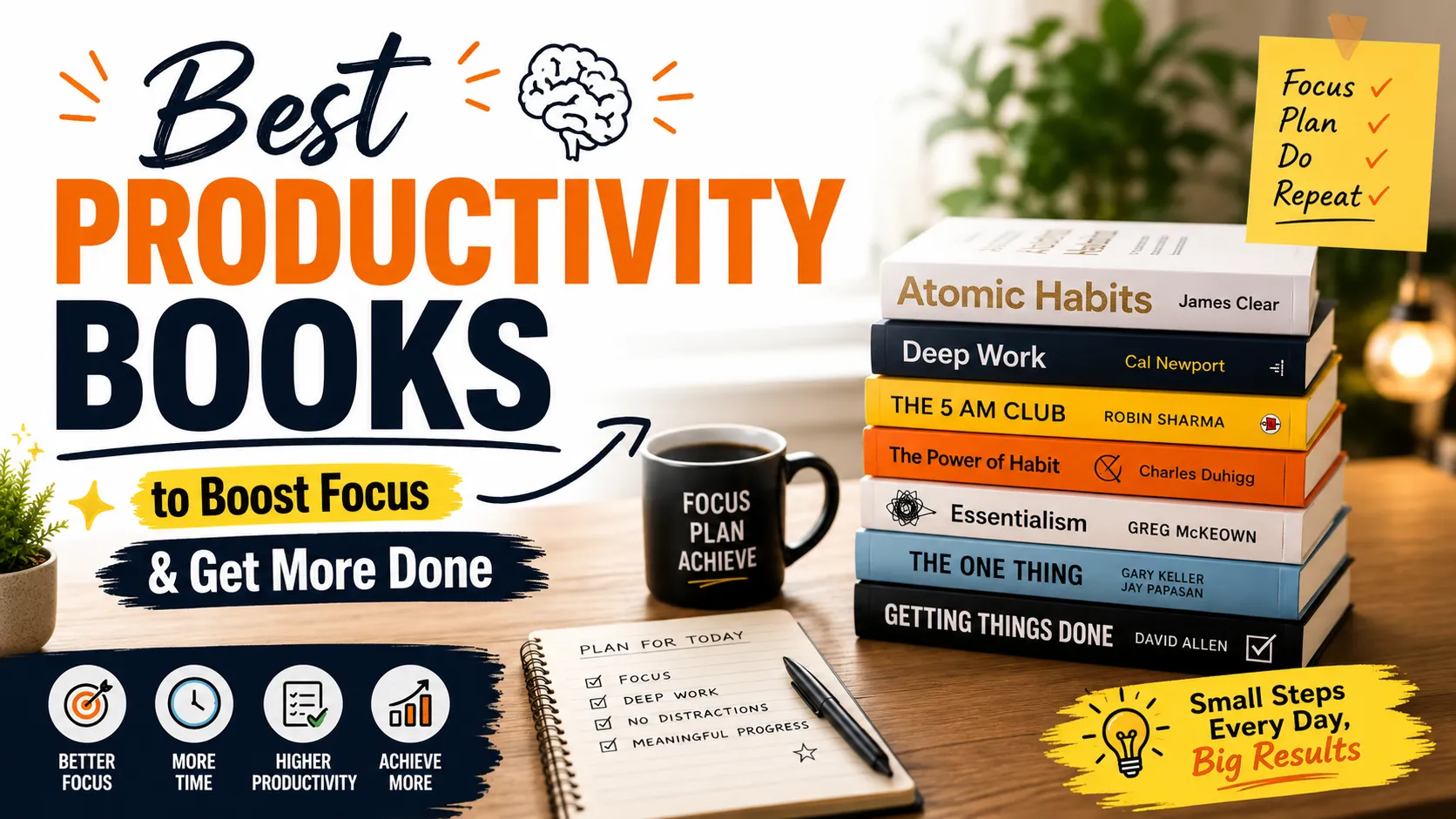
Best Productivity Books to Boost Focus & Get More Done
Struggling to stay focused, beat procrastination, or manage your time? Discover the 10 best productivity books in 2026 that offer proven strategies to build better habits, improve concentration, and help you get more done with less stress.

How Ed-Tech Uses Gamification to Boost Learning
Research confirms that gamification works. Students in gamified environments show 14% higher long-term knowledge retention, and gamified online courses achieve 30–40% better completion rates than non-gamified equivalents. Meanwhile, 89% of students say they would spend more time learning if tools felt more like games a number that explains why every major ed-tech platform from Duolingo to Khan Academy has gamification at its core.
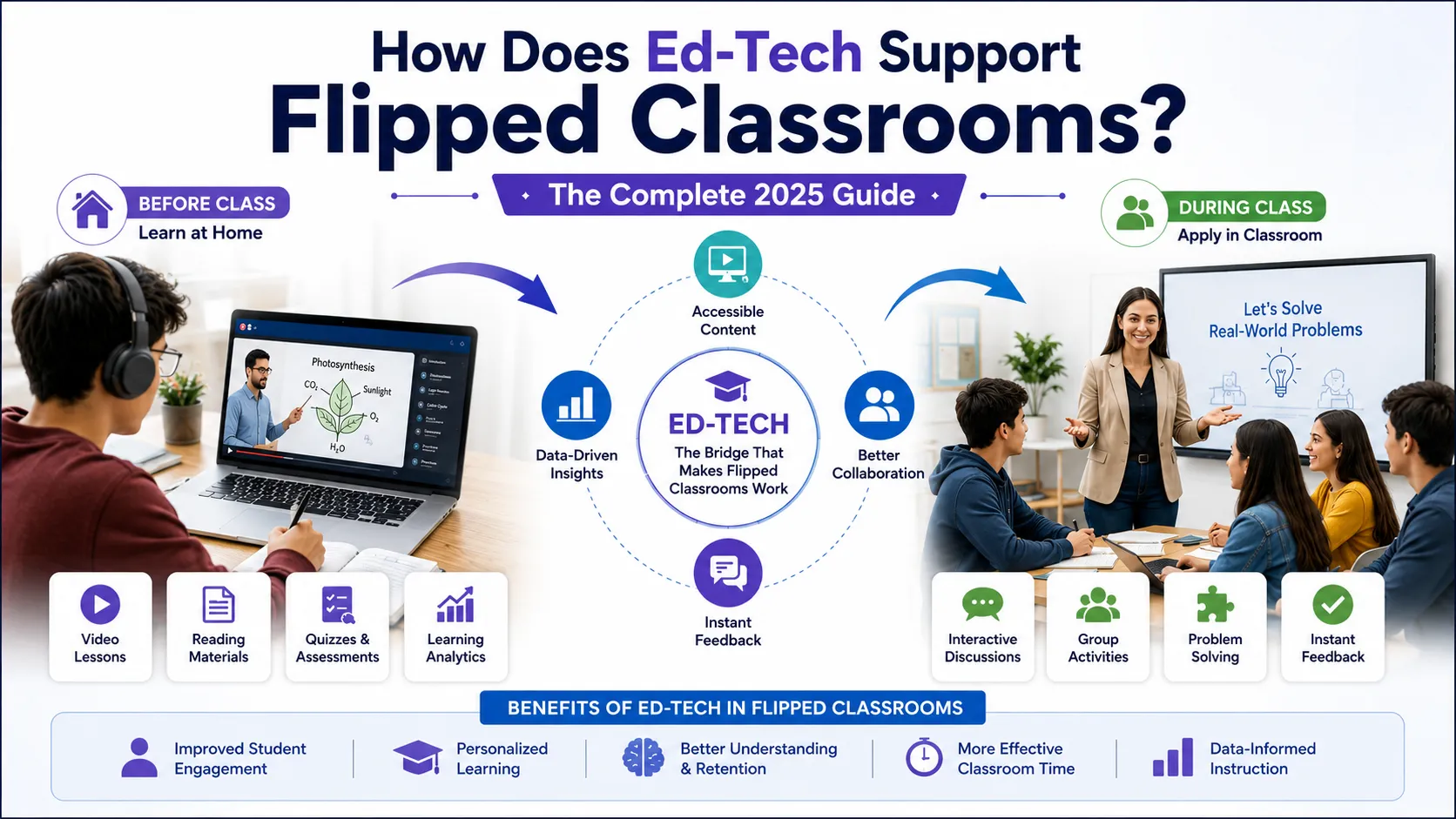
How Does Ed-Tech Support Flipped Classrooms? The Complete 2026 Guide
The flipped classroom model reverses traditional instruction: students learn new content at home via digital tools, then apply knowledge in class through collaborative activities. Ed-tech makes this possible through Learning Management Systems (LMS), video-based learning platforms, adaptive learning tools, and formative assessment software. This guide covers every mechanism, top platform recommendations, research data, and real implementation strategies educators can use immediately.