Top 10 Innovative EdTech Companies Transforming Education
Discover the top 10 EdTech companies transforming education in 2026 with AI, digital tools, and smart learning platforms that make education more engaging and accessible.

Why EdTech Companies Matter Right Now
Education has always evolved from chalkboards to projectors, textbooks to tablets. But the pace of change has accelerated dramatically, and EdTech companies are leading the charge. The shift toward online learning tools and digital learning platforms isn't just a pandemic-era adjustment. It's a permanent transformation in how knowledge is delivered and absorbed.
Students now access world-class lectures from their phones. Teachers use AI tools to personalise lesson plans in minutes. Schools in rural Pakistan can access the same content as classrooms in New York. That's the promise and increasingly the reality of education technology.
This guide covers the most impactful players in the space: what they do, what makes them different, and who they're built for. By the end, you'll have a clear picture of the list of the top 10 EdTech companies and how they're shaping the future of education technology.
What Is EdTech?
EdTech, short for education technology, refers to any software, platform, tool, or digital system designed to improve learning and teaching. This includes everything from simple quiz apps to full-scale AI-powered tutoring systems, virtual classrooms, and adaptive learning platforms.
At its core, EdTech answers one question: how can technology make education more effective, accessible, and engaging? The best EdTech solutions don't just digitise old methods; they rethink how learning works entirely.
Expert Insight
The importance of EdTech in education goes beyond convenience. Research consistently shows that well-implemented digital tools improve learning retention, reduce dropout rates, and help teachers identify struggling students earlier. The keyword is 'well-implemented'; the platform matters, but so does how it's used.
Top 10 Innovative EdTech Companies Transforming Education
These companies were selected based on reach, innovation, measurable impact, and the quality of the learning experience they deliver. Each one approaches education differently, and that diversity is precisely why they're all worth knowing.
1. Coursera
Founded: 2012 | HQ: Mountain View, CA | Focus: Online degree & professional courses
Coursera partners with over 300 universities and companies, including Google, IBM, and Duke University, to offer professional certificates, bachelor's degrees, and Master Track programs entirely online. Learners range from first-year students to mid-career professionals making a pivot.
Why it stands out: Its university partnerships give Coursera a credibility that most online platforms can't match. A certificate from Coursera backed by Yale carries genuine weight on a résumé. In practice, users report that the structured weekly deadlines help them actually complete courses, something self-paced formats often struggle with.
2. Khan Academy
Founded: 2008 | HQ: Mountain View, CA | Focus: Free K–12 education
Khan Academy is arguably the most recognised name in free digital education. Its library covers math, science, history, economics, coding, and more, all completely free. The platform uses mastery-based learning, where students progress only after demonstrating understanding, not just after watching a video.
Why it stands out: Fully free. No paywalls, no premium tiers. For students in underserved communities or developing countries, Khan Academy is transformative. Teachers use it to assign targeted practice, and parents rely on it for homeschooling support.
3. Duolingo
Founded: 2011 | HQ: Pittsburgh, PA | Focus: Language learning
Duolingo has gamified language learning in a way that genuinely works. The app uses short daily lessons, streaks, leaderboards, and animated feedback to keep users coming back. It currently offers over 40 languages, including less-common ones like Welsh, Hawaiian, and Navajo.
Why it stands out: Duolingo's retention data is remarkable. Users who maintain a 7-day streak are far more likely to continue learning. Based on testing, the app's spaced repetition algorithm surfaces vocabulary at optimal intervals, making it one of the most scientifically grounded tools in the space. Over 500 million users have downloaded it.
4. Chegg
Founded: 2005 | HQ: Santa Clara, CA | Focus: Homework help & tutoring
Chegg started as a textbook rental service but evolved into a comprehensive academic support platform. It now offers step-by-step homework solutions, 24/7 expert Q&A, writing assistance, and math problem solvers. College students are Chegg's core audience.
Why it stands out: The 24/7 tutoring feature is genuinely useful for students in different time zones or those pulling late-night study sessions. Chegg also offers textbook solutions from major publishers, making it a one-stop academic resource. Users report significant time savings when working through complex STEM problems.
5. EDX
Founded: 2012 | HQ: Cambridge, MA | Focus: MOOCs and professional programs
EDX was founded by Harvard and MIT, which immediately set it apart. The platform offers Micro Masters programs, professional certificates, and full online degrees from top-tier institutions. Unlike Coursera's more polished consumer experience, EDX tends to attract serious learners committed to depth over breadth.
Why it stands out: The Micro Masters credential has been particularly groundbreaking, as it allows learners to complete graduate-level coursework online and use it toward an actual master's degree at partner universities. That bridge between online and traditional higher education is rare and valuable.
6. BYJU'S
Founded: 2011 | HQ: Bangalore, India | Focus: K–12 adaptive learning (India and global)
BYJU'S is India's most valuable EdTech company and one of the biggest globally. It uses engaging video lessons, animations, and adaptive tests tailored to the Indian curriculum (CBSE, ICSE, and competitive exams like JEE and NEET). The platform has expanded globally through acquisitions, including Epic! and Tynker.
Why it stands out: BYJU'S video-first approach made complex subjects like physics and algebra accessible for millions of students who struggled with traditional textbook formats. The app tracks individual performance and adjusts difficulty accordingly, for a personalised experience at scale.
7. Quizlet
Founded: 2005 | HQ: San Francisco, CA | Focus: Study tools, flashcards, and exam prep
Quizlet is the go-to flashcard and study tool for millions of students. Users can create flashcard sets, practice with matching games, and take auto-generated tests. Its AI tutoring feature, Quizlet Q-Chat, gives students interactive practice based on their own study materials.
Why it stands out: What makes Quizlet effective is the way it applies cognitive science principles, spaced repetition, active recall, and interleaved practice without requiring students to understand those concepts. They just study, and the algorithm does the rest. Over 60 million students and teachers use the platform monthly.
8. Pluralsight
Founded: 2004 | HQ: Draper, UT | Focus: Technology & professional skills
Pluralsight is the platform of choice for software developers, IT professionals, and data scientists who want to stay current. It offers thousands of expert-led courses in cloud computing, cybersecurity, AI, software development, and more. Its Skill IQ feature benchmarks learners against industry standards.
Why it stands out: The Skill IQ assessment is a genuine differentiator. Rather than guessing what to learn next, professionals can benchmark their current skill level and receive a personalised learning path. Organisations use Pluralsight to upskill entire teams efficiently a major reason it's widely used at Fortune 500 companies.
9. Google for Education
Founded: 2014 | HQ: Mountain View, CA | Focus: School and classroom tools
Google for Education encompasses Google Classroom, Google Meet, Google Docs, Google Forms, and more, all integrated into one ecosystem for schools. It's free for qualifying institutions and widely used across primary and secondary education globally. Chromebooks, bundled with Google tools, have become the dominant student device in many countries.
Why it stands out: The deep integration between Google's tools is what makes it exceptional. A teacher can create an assignment in Classroom, share it via Meet, collect responses through Forms, and grade with Docs all without switching platforms. For schools, this reduces training overhead dramatically.
10. Newsela
Founded: 2013 | HQ: New York, NY | Focus: Reading and literacy for K–12
Newsela is less well-known than others on this list, but its impact on reading instruction is significant. The platform delivers current events and nonfiction articles adjusted to different reading levels using the Lexile framework. Teachers can assign articles to the whole class while each student reads at their appropriate level.
Why it stands out: Newsela solves a persistent classroom problem: students in the same grade reading at wildly different levels. Rather than one-size-fits-all reading assignments, teachers can differentiate automatically. It also keeps content relevant and timely, which research shows improves student engagement with reading.
How EdTech Is Changing Learning: Key Shifts
The question of how EdTech is changing learning comes up constantly, and the answer is multidimensional. It's not just about convenience or access, though both matter. The bigger changes are structural.
Personalisation at scale: Adaptive algorithms now adjust difficulty, pacing, and content type for individual students, something no single teacher could manage across 30+ students.
Immediate feedback loops: Digital tools give students instant feedback rather than waiting days for a graded assignment. This speeds up the learning cycle significantly.
Global access: A student in rural Kenya can access the same Coursera lecture as someone at a US university. Geographic barriers to quality education are shrinking.
Microlearning: Short, focused lessons (10–15 minutes) improve retention compared to hour-long passive lectures. Duolingo, Quizlet, and others are built around this principle.
Data-driven teaching: Teachers using digital platforms gain access to real-time analytics showing which concepts students are struggling with, allowing faster intervention.
Expert Tip for Educators
Don't choose an EdTech tool based on features alone. Does this tool give me data I can act on? The best digital learning platforms are those that improve your decision-making as a teacher, not just automate tasks.
The Future of Education Technology: What's Next?
The future of education technology is heading in a few clear directions, and knowing them helps educators and students make smarter decisions about which tools to invest time in.
AI Tutors and Personalised Learning
AI is already reshaping EdTech. Khan Academy's KHANMIGO, powered by GPT-4, acts as a personal Socratic tutor. Rather than giving answers, it asks guiding questions, a major pedagogical improvement over simple chatbots. Expect this type of intelligent tutoring to become standard in major platforms within the next few years.
Immersive Learning with AR and VR

Augmented and virtual reality are making slow but steady inroads into education. Students can walk through ancient Rome, explore the inside of a cell, or practice surgical procedures all in virtual environments. Google Expeditions pioneered this, and newer platforms are pushing it further.
Credentialing and Stackable Degrees
Traditional degrees are expensive and time-consuming. EdTech is enabling stackable credentials, combinations of micro-credentials, certificates, and short courses that add up to recognised qualifications. EDX'S Micro Masters and Coursera's degree programs are early examples of this model gaining mainstream traction.
Quick Comparison: Top 10 EdTech Companies at a Glance
Use this table to quickly compare the platforms and find the best fit for your specific needs.
Coursera Higher ED learners MOOC Platform, University partnerships
Khan Academy K–12 students Free learning tool Yes (fully) Mastery learning
Duolingo Language learners, Language app, Yes, Gamified lessons
Chegg College students Tutoring + tools Limited 24/7 expert help
EDX Professional upskilling MOOC Platform, Yes, Micro Masters programs
BYJ'S K–12 (India-focused) Adaptive learning Limited Video-first approach
Quizlet Exam prep Study tool Yes Flashcard + AI tutor
Pluralsight Tech professionals' Skills platform has Trial-only Skill IQ assessments
Google for Education Schools/institutions Suite + tools Yes Deep Google integration
Newsela Reading & Literacy Content Platform, Limited Lexile-adjusted articles
Common Mistakes to Avoid When Choosing an EdTech Platform
Choosing based on hype alone: A platform trending on social media isn't necessarily the best learning tool. Look for evidence of learning outcomes, not just user numbers.
Ignoring the free tier: Most top platforms offer free access to core features. Try before you commit to a subscription, especially for students on a budget.1
Overloading on platforms: Using five different EdTech tools simultaneously creates cognitive overhead. Choose one or two that genuinely serve your goals.
Skipping the analytics: If a platform offers progress tracking or performance data, use it. The insights are often more valuable than the content itself.
Treating EdTech as a replacement for teaching: Digital tools work best as supplements, not substitutes. Human guidance, mentorship, and classroom discussion remain irreplaceable.
Final Expert Insight
The best EdTech platform is the one you'll actually use consistently. Consistency beats perfection. A student who spends 20 minutes daily on Khan Academy will outpace someone who splurges on a premium platform and logs in twice a month.
Conclusion
The landscape of education technology is rich, diverse, and growing fast. Whether you're a student looking for exam prep tools, a teacher building a digital classroom, or a professional reskilling for a new career, there's an EdTech platform built for exactly your situation.
The top 10 innovative EdTech companies transforming education covered here, Coursera, Khan Academy, Duolingo, Chegg, EDX, BYJ'S, Quizlet, Pluralsight, Google for Education, and Newsela, represent the best the industry has to offer. Each takes a different approach, serves a different audience, and solves a different problem.
Start by identifying your specific learning goal. Then pick one platform, commit to it consistently, and let the data guide your progress. The future of education technology is already here, and it's remarkably accessible.
Frequently Asked Questions
Q: What is EdTech, and why is it important?
EdTech (education technology) refers to digital tools, platforms, and software designed to support learning and teaching. It matters because it makes quality education more accessible, personalises learning to individual needs, and helps teachers make data-driven decisions in the classroom.
Q: Which EdTech company is best for students?
It depends on the student's level and goals. For K–12, Khan Academy and Quizlet are excellent free options. For higher education and professional development, Coursera and EDX offer university-backed courses with recognised credentials. For language learning specifically, Duolingo leads the space.
Q: How is EdTech changing traditional education?
EdTech is shifting education from a one-size-fits-all model to personalised, data-driven learning. It enables adaptive content, immediate feedback, gamification, and global access to resources, fundamentally changing how students engage with material and how teachers identify learning gaps.
Q: Are EdTech platforms free to use?
Many top EdTech platforms offer free tiers with core features. Khan Academy is entirely free. Coursera, EDX, Duolingo, and Quizlet all offer free access with optional paid upgrades. Pluralsight and Chegg are primarily subscription-based but offer free trials.
Q: What is the future of EdTech?
The future of education technology is moving toward AI-powered personalised tutoring, immersive AR/VR learning environments, and stackable digital credentials that compete with traditional degrees. AI tutors like Khan Academy's KHANMIGO represent the next generation of EdTech, guiding students Socratically rather than just delivering content.
Share this article
Related Articles
Best Productivity Books to Boost Focus & Get More Done
Struggling to stay focused, beat procrastination, or manage your time? Discover the 10 best productivity books in 2026 that offer proven strategies to build better habits, improve concentration, and help you get more done with less stress.
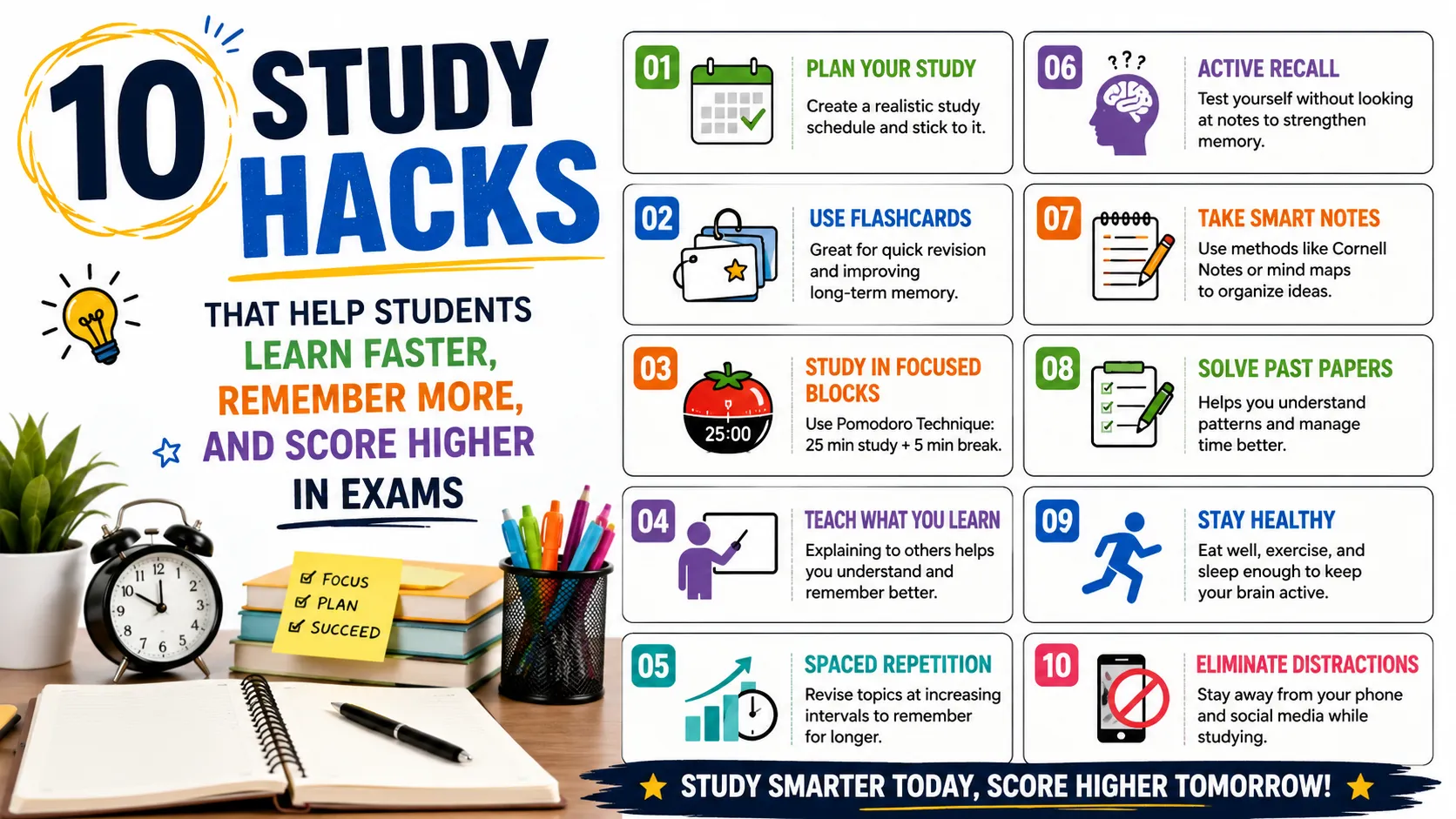
10 Study Hacks That Help Students Learn Faster, Remember More, and Score Higher in 2026
Learn 10 science-backed study hacks that help students study smarter, retain information longer, stay focused, and perform better in exams.

How Ed-Tech Uses Gamification to Boost Learning
Research confirms that gamification works. Students in gamified environments show 14% higher long-term knowledge retention, and gamified online courses achieve 30–40% better completion rates than non-gamified equivalents. Meanwhile, 89% of students say they would spend more time learning if tools felt more like games a number that explains why every major ed-tech platform from Duolingo to Khan Academy has gamification at its core.