
Physics Fundamentals: Core Concepts Every Beginner Must Know
Learn physics fundamentals, simple core concepts, real-life applications, branches, common misconceptions, and the best study strategies explained for beginners.
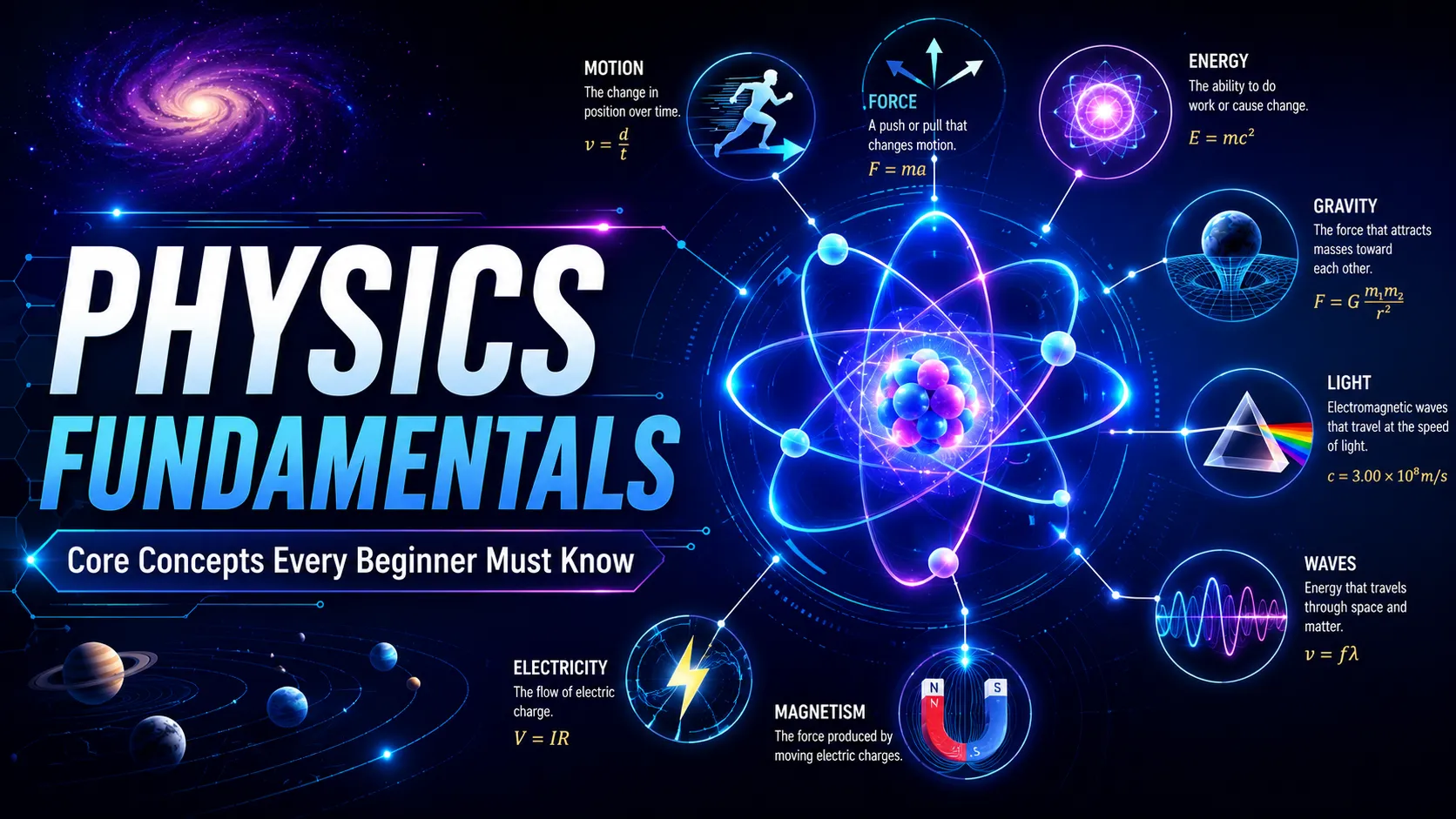
What Is Physics? A Beginner-Friendly Answer
It is the study of the laws and principles that explain how the universe behaves. It studies matter, energy, motion, force, and the rules that connect them. Every time you drop something, feel the warmth of sunlight, or charge your phone, the fundamental physics behind those moments is quietly at work.
Many beginners tend to think of physics as a field filled with complicated equations. That image is misleading. The equations are just shorthand for ideas, and the ideas almost always make sense before any math appears. Understanding what physics really means means understanding why things behave the way they do.
Physics and mathematics are closely linked, but math is the language, not the subject. You understand that a heavier trolley is harder to push before you ever see a formula. The formula just lets you calculate exactly how much harder.
Why Physics Matters in Everyday Life
One of the most common mistakes beginners make is thinking of physics as a classroom subject with no real-world connection. The opposite is true. The real-life applications of physics surround you.
Your smartphone exists because physicists discovered how electrons behave inside semiconductors. GPS works because Einstein's relativity predicted that time moves differently at high speeds and near massive objects. Every satellite signal carries a correction for this effect. Without it, navigation would drift by kilometres every day.
Medical imaging is applied physics. MRI machines use nuclear magnetic resonance. CT scanners use X-ray physics. Electric vehicles are built on electromagnetic principles developed in the 1800s. Even sport is physics in action, a basketball shot is a projectile motion problem, and a cyclist in a peloton is using fluid dynamics to reduce drag.
The importance of physics in daily life is not abstract. It is in the device you are reading this on, the building you are sitting in, and the light reaching your eyes right now.
Core Concepts of Physics Every Beginner Should Know
These are the basic physics concepts that appear in every branch and every application. Getting comfortable with them early makes everything else much easier to follow.
Force and Motion
A force can be described as any action that pushes or pulls an object. It can change how fast something moves, what direction it travels, or whether it moves at all. Motion is the change in an object's position over time, described by speed, velocity, and acceleration.
Newton's key insight was this: an object in motion keeps moving unless something acts on it. We rarely observe this cleanly on Earth because friction always interferes. In space, with no friction, a thrown object travels indefinitely. This is one of the most important ideas in classical physics and one of the most misunderstood.
Energy
Energy is the ability to do work, and it comes in many forms: kinetic energy in movement, potential energy in position, thermal energy in heat, and chemical energy in food or fuel. The fundamental rule, one of the most powerful in all of physics, is that energy is never created or destroyed. It only changes form.
When you eat and then exercise, chemical energy becomes kinetic energy. When a car brakes, kinetic energy becomes heat. The total always stays constant. This principle, conservation of energy, runs through every branch of the subject.
Gravity and Waves
Gravity is the natural force that draws objects with mass toward each other. Its strength increases when the objects are heavier and positioned closer together. It holds planets in orbit, keeps you on the ground, and shapes the structure of the entire universe.
Waves carry energy from place to place without moving matter along with them. Sound, light, radio signals, and Wi-Fi are waves of different types. Understanding wave behaviour explains most of how we communicate, how we see, and how modern technology transmits information.
Main Branches of Physics Explained
Physics covers an enormous range of scales and phenomena. Each branch of physics focuses on a different type of question.
Branch | What It Studies | Everyday Example |
|---|---|---|
Mechanics | Motion, force, and energy | How bridges hold weight; how balls fly |
Thermodynamics | Heat, temperature, and energy transfer | How engines and refrigerators work |
Electromagnetism | Electric and magnetic forces | Motors, generators, radio, light |
Optics | Behaviour of light | Lenses, cameras, fibre optic cables |
Quantum Physics | Matter and energy at atomic scales | Semiconductors, lasers, and MRI |
Relativity | Space, time, and gravity at extreme conditions | GPS corrections, black holes |
Nuclear Physics | Atomic nuclei and their behaviour | Nuclear energy, radiation therapy |
Classical Physics vs. Modern Physics
Dimension | Classical Physics | Modern Physics |
|---|---|---|
Period | Before 1900 | 1900s onward |
Scale | Objects visible to the naked eye | Atomic, subatomic, and cosmic scales |
Key Names | Newton, Galileo, Maxwell | Einstein, Bohr, Heisenberg |
Examples | Mechanics, thermodynamics, optics | Quantum mechanics, relativity |
Still used? | Yes, for most engineering problems | Yes, for advanced technology and research |
Modern physics did not replace classical physics; it extended it. For the vast majority of engineering and daily calculations, classical methods work perfectly. Modern physics fills in where classical physics breaks down: at very tiny scales, very high speeds, or in very strong gravitational fields.
Common Physics Misconceptions Corrected
Misconception | What Is Actually True |
|---|---|
Heavier objects fall faster | All objects fall at the same rate. Air resistance creates the difference we see, not gravity itself. |
You need force to keep something moving | You need force to change motion. Without friction, a moving object continues forever. |
Gravity only exists on Earth | Gravity is universal. Every object with mass has gravitational pull. The Moon and Mars have it too. |
Electricity gets used up in a circuit | Electric charge is conserved. What the circuit uses is energy, not charge. Current flows continuously. |
How to Actually Understand Physics, Not Just Memorise It
This is the section most beginner guides miss entirely. Knowing what physics says is very different from understanding it. Here is how to build real conceptual understanding in physics.
Concept First, Formula Second
Every equation describes a relationship between real things. F = ma tells you that force, mass, and acceleration are connected; double the mass and the same force produces half the acceleration. Understand that idea first. The formula is then just a compact way of writing something you already grasp.
A useful habit: before touching any equation, ask what would happen if I changed one variable. If mass doubles but force stays the same, what happens to acceleration? Answering that question builds genuine understanding. The formula becomes a tool you already know how to use.
Use Analogies, Then Go Beyond Them
Analogies are how the brain builds new understanding from things it already knows. Electric current flowing through a wire is like water flowing through a pipe. Voltage is pressure. Resistance is a narrow section of pipe that slows the flow.
Use analogies until they stop working, then ask why they stop working. That boundary is often where the most interesting physics begins.
Visualise Before You Calculate
Before solving any problem, draw what is happening. Sketch the forces. Draw the path of motion. Label what you know and what you are looking for. Physics problems become dramatically clearer when you can see the situation. Most students skip this step and then wonder why they get stuck.
Best Ways to Study Physics Efficiently
Solve problems every day, even briefly. Reading about physics and actually doing physics are completely different activities. Ten minutes of problem-solving builds more understanding than an hour of passive reading.
Use active recall. After reading a section, close the book and write down everything you remember without looking. The struggle to retrieve information is exactly what builds lasting memory.
Teach what you learn. Explaining a concept out loud, even to yourself, immediately shows you where your understanding has gaps. If you cannot explain it simply, you do not yet fully understand it.
Use simulations. Tools like PhET Interactive Simulations allow you to change gravity, adjust wave frequencies, and modify circuits in real time. Seeing concepts move and change is far more effective than any static diagram.
Space out your practice. Studying the same material across multiple sessions, separated by time, produces significantly stronger retention than one long cramming session.
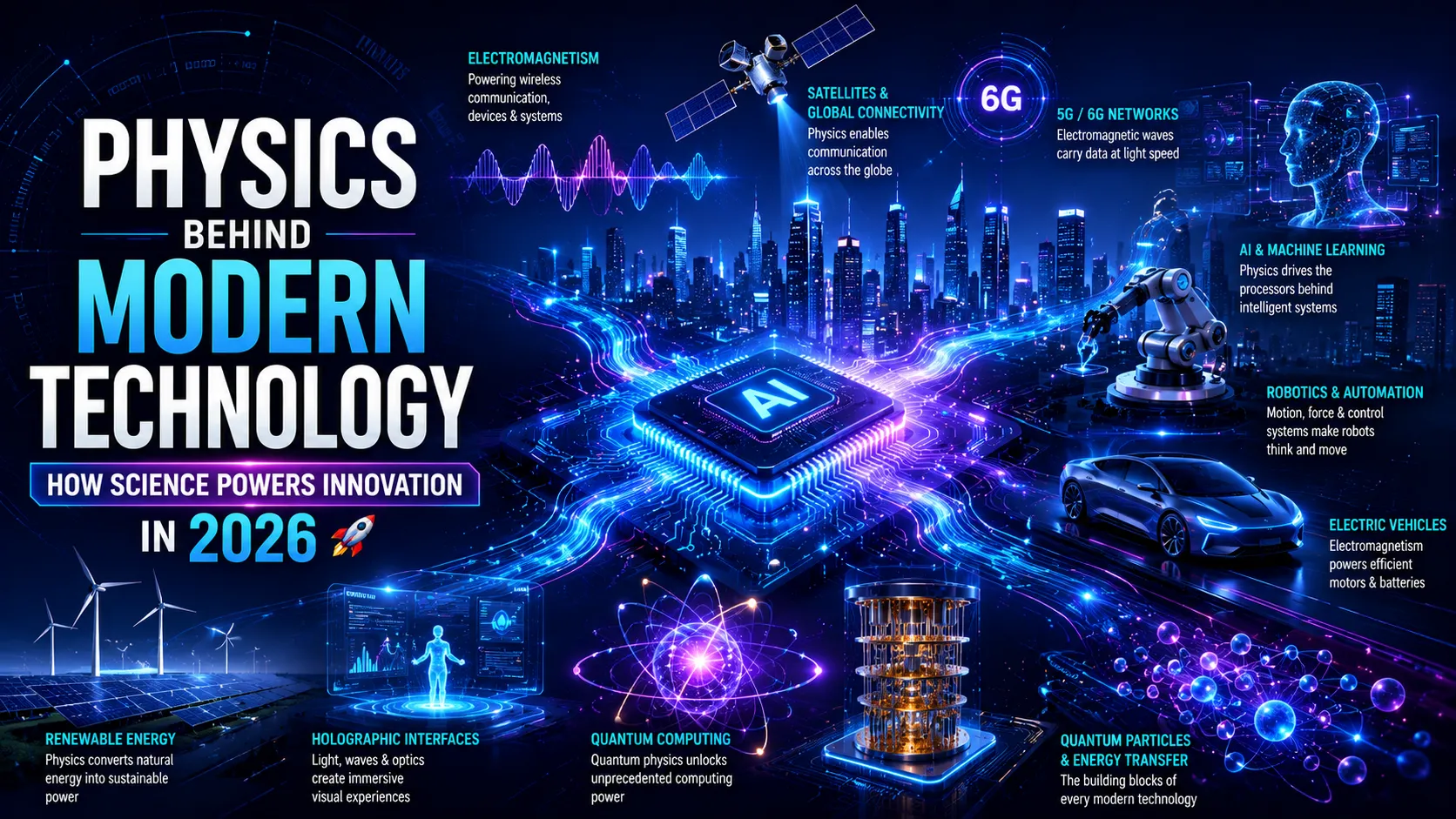
Physics Behind Modern Technology in 2026
The distance between fundamental physics research and the technology people use every day has never been shorter.
Quantum computing uses superposition and entanglement principles from quantum mechanics to solve problems that classical computers cannot. Working quantum processors exist today.
AI hardware runs on chips designed at the nanometer scale, where quantum effects are not just theoretical; they are engineering constraints that designers must account for in every transistor.
Electric vehicles depend on electromagnetic motor design, battery electrochemistry, and materials science rooted in both classical and modern physics.
GPS and satellite navigation require relativistic time corrections. Without them, positioning systems would drift by several kilometres per day, making them useless for navigation.
Medical imaging technologies, such as MRI, PET scans, and X-rays, are direct applications of physics that diagnose illness and save lives daily across the world.
The Future of Physics Research
Physics is not running out of questions. Recent decades have opened more doors than they have closed.
Fusion energy has seen genuine progress. Achieving more energy output than input ignition was demonstrated in a controlled setting in 2022. Commercial fusion power remains a challenge, but it is closer than it has ever appeared.
Quantum technology is moving from laboratories into commercial products. Quantum sensors, quantum-encrypted communications, and quantum networks are in active development.
AI is accelerating physics research. Machine learning now helps physicists analyse particle accelerator data, model complex systems, and discover patterns that manual analysis would miss entirely.
Dark matter and dark energy remain two of the largest open questions in science. We know they exist from their gravitational effects on galaxies. What they actually are remains completely unknown, and solving that would rank among the greatest scientific achievements in history.
Conclusion
Physics fundamentals are not just academic material. They are a framework for understanding how everything around you actually works. The core concepts of force, energy, motion, gravity, and waves appear in your daily life constantly, whether or not you notice them.
Start with the ideas. Build your intuition through analogies and visualisation. Use the equations as tools for things you already understand, not as rules to memorise blindly. Ask why more often than how.
The universe is genuinely remarkable, and learning to see it through the lens of physics makes it more interesting, not less.
Frequently Asked Questions
Q: Do I need strong math skills to learn physics?
Not to understand the concepts, no. Conceptual understanding comes before calculation. The ideas in physics can be grasped intuitively through mathematics, which is important when you want to make precise predictions, but that step comes later.
Q: Where should a beginner start?
Mechanics, the study of motion and force, is the standard starting point for good reason. It builds intuitions that apply across every other branch. Start there, understand it well, and the rest becomes much more approachable.
Q: Why does physics feel so difficult?
Usually, because it is taught formula-first rather than concept-first, building a genuine understanding of what is happening before introducing equations makes the subject far less intimidating and considerably more interesting.
Share this article
Related Articles
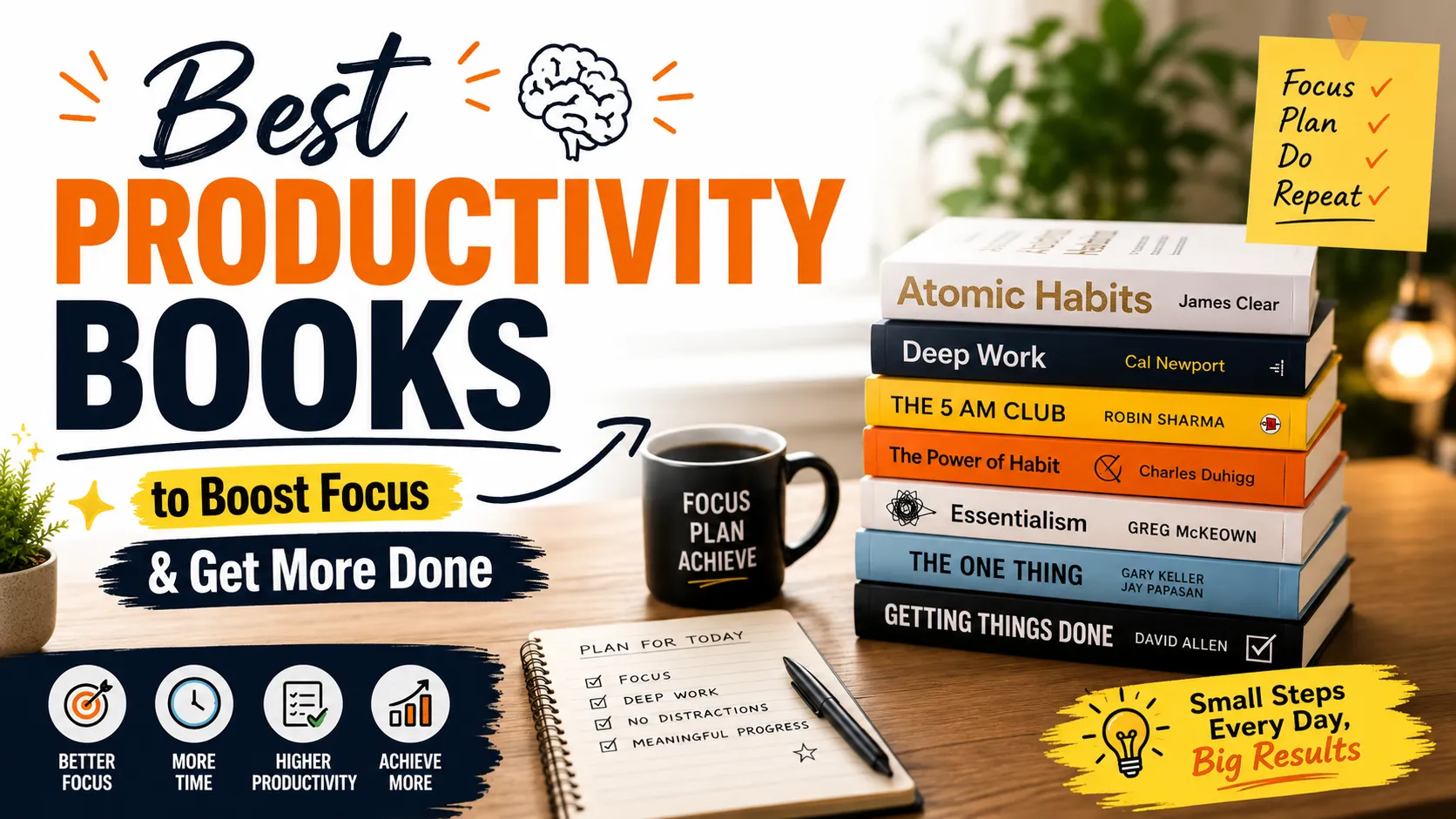
Best Productivity Books to Boost Focus & Get More Done
Struggling to stay focused, beat procrastination, or manage your time? Discover the 10 best productivity books in 2026 that offer proven strategies to build better habits, improve concentration, and help you get more done with less stress.
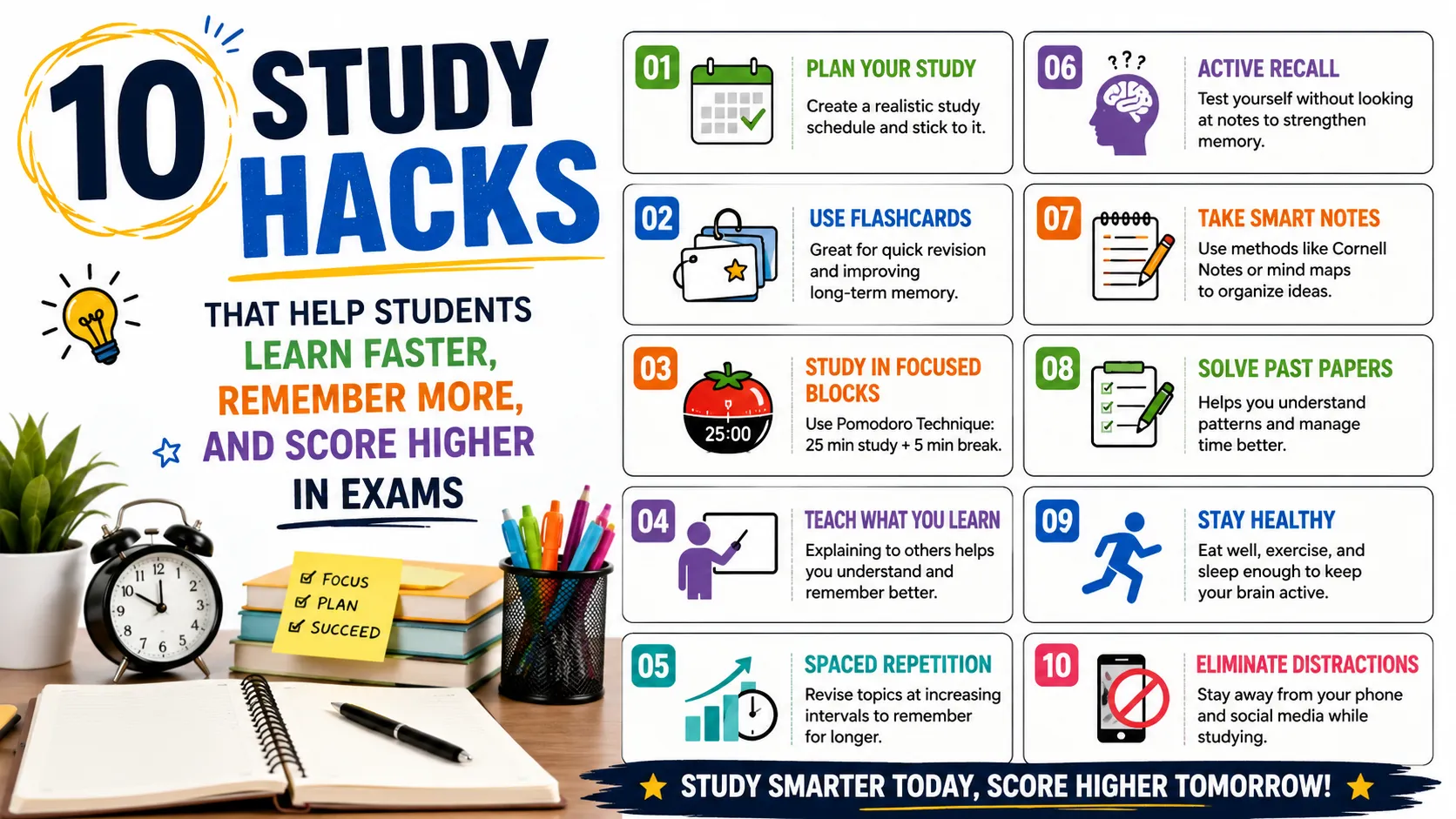
10 Study Hacks That Help Students Learn Faster, Remember More, and Score Higher in 2026
Learn 10 science-backed study hacks that help students study smarter, retain information longer, stay focused, and perform better in exams.

How Ed-Tech Uses Gamification to Boost Learning
Research confirms that gamification works. Students in gamified environments show 14% higher long-term knowledge retention, and gamified online courses achieve 30–40% better completion rates than non-gamified equivalents. Meanwhile, 89% of students say they would spend more time learning if tools felt more like games a number that explains why every major ed-tech platform from Duolingo to Khan Academy has gamification at its core.