
Neo Banks Explained: The Complete Guide to Digital Banking, Money Management, and the Future of Fintech
Discover how neo banks are transforming digital banking in 2026. Learn how they work, their benefits, and how they make money management faster, smarter, and completely app-based.

Picture this. You walk into a bank to open a simple savings account. You wait 40 minutes in line. You fill out three forms. Someone asks you to come back with more documents. You leave frustrated, empty-handed, and late for work.
Now picture a different experience. You download an app. You enter your details in under five minutes. Your account is live. You get a virtual card instantly. You can see every transaction in real time, set savings goals, track your spending by category, and send money to anyone in seconds.
That second experience is what a neo bank offers. And millions of people around the world are switching over every year.
Traditional banks have not kept up with modern life. Hidden fees, outdated apps, long processing times, and rigid processes have pushed customers away. Neo banks stepped into that gap and built banking from the ground up around what customers actually need: speed, transparency, and control.
This guide covers everything you need to know about neo banks. You will learn what they are, how they work, what features they offer, and how to use one effectively to manage your money smarter.
What Is a Neo Bank? A Simple, Clear Definition
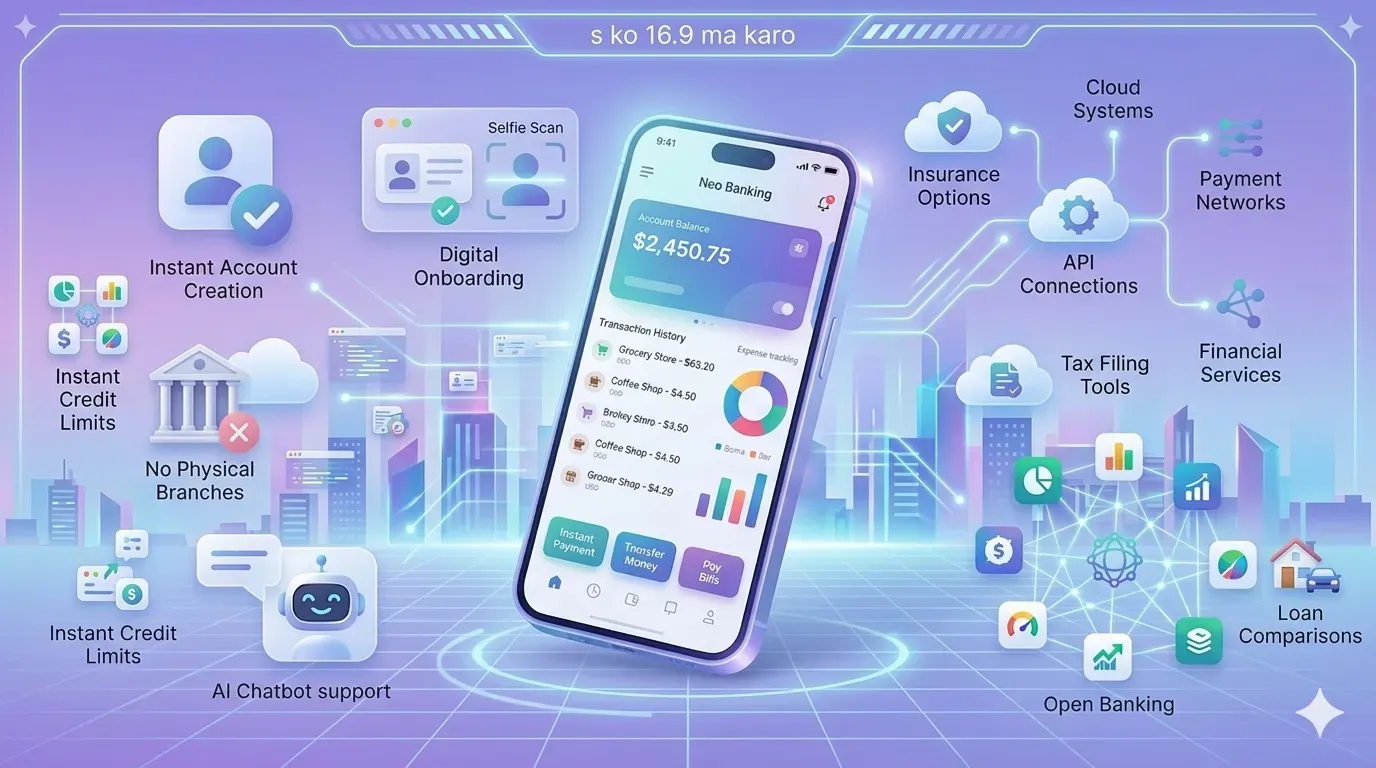
A neo bank is a fully digital bank that operates entirely online, usually through a smartphone app. It has no physical branches, no paper forms, and no long queues. Everything happens on your phone or computer.
Neo banks offer the core services you expect from a bank: current accounts, savings accounts, money transfers, debit cards, and sometimes loans or investment products. The difference is how they deliver those services. Everything is instant, transparent, and built around your digital experience.
"Think of a neo bank as your traditional bank, rebuilt for the smartphone era. Same purpose, completely different experience."
Neo Bank vs Traditional Bank: Key Differences
Traditional banks have branches everywhere. Neo banks operate 100% online.
Traditional banks often charge monthly fees, overdraft fees, and foreign transaction fees. Neo banks typically charge very little or nothing.
Traditional banks can take days to process transfers. Neo banks move money in seconds.
Traditional banks use outdated apps with basic features. Neo banks offer smart tools for budgeting, saving, and expense tracking.
Opening an account at a traditional bank can take days. A neo bank account takes minutes.
Why Are Neo Banks Growing So Fast?
The global neo bank market is expanding rapidly. There are several reasons behind this growth.
First, smartphones are everywhere. People manage their entire lives through apps. Banking is just another service that fits naturally into that lifestyle.
Second, younger generations distrust traditional banks. They want transparency, low costs, and great technology. Neo banks deliver all three.
Third, fintech innovation has made it easier than ever to build financial products. Neo banks use modern technology stacks that enable them to move quickly, add features quickly, and respond to customer needs in real time.
Fourth, the pandemic pushed millions of people toward digital services they had avoided before. Many of them discovered that digital banking was not just convenient but actually better.
How Neo Banks Work
App-Based Banking Explained
When you use a neo bank, you interact almost entirely through a mobile app. That app is your branch, your teller, your financial advisor, and your account dashboard, all in one place.
From the app, you can open an account, add money, view transactions, send payments, set up savings pots, track your budget, and contact customer support. Some neo banks also offer web dashboards, but the primary experience is mobile-first.
No Physical Branches
Neo banks do not pay rent on hundreds of high-street locations. They do not staff large teams of branch employees. That cost saving is passed directly to customers through lower fees and better rates.
Customer support is available via in-app chat, email, or occasionally by phone. Many neo banks use AI-powered chatbots for common questions and have human agents available for complex issues.
Digital Onboarding
Signing up for a neo bank is designed to be fast and friction-free. Here is how a typical onboarding process works.
You download the app from the App Store or Google Play.
You enter your name, email address, and phone number.
You verify your identity by uploading a photo of your ID and taking a selfie.
The app checks your details using automated verification tools.
Your account is approved, usually within minutes.
You receive a virtual card immediately and a physical card within a few days.
In real life, most users complete this process in under ten minutes. Compare that to visiting a branch, waiting in line, and returning with documents, and the appeal is obvious.
API-Based Systems and Open Banking
Neo banks are built on modern technology infrastructure. They use APIs (Application Programming Interfaces) to connect with payment networks, identity verification services, credit bureaus, and other financial platforms.
This API-based approach enables neo banks to add new features quickly, integrate with third-party tools, and offer a seamless experience across different services. It also enables open banking, which allows you to link your Neo bank account with other financial apps and get a complete picture of your finances in one place.
Neo Bank Features You Need to Know
Instant Account Opening
The first and most obvious feature is how quickly you can get started. Neo banks have removed almost every barrier to opening an account. You do not need to visit a branch, make an appointment, or wait for approval letters in the mail.
Real-Time Spending Alerts
Every time you make a transaction, your neo bank app sends you an instant notification. You see exactly what you spent, where, and how much, right at the moment it happens. This feature alone changes how most people relate to their money.
Many beginners make this mistake: they ignore spending alerts and treat them as noise. In reality, these alerts are your first line of defense against overspending and fraud. Pay attention to them.
Expense Tracking and Categorization
Neo bank apps automatically sort your spending into categories. Groceries, restaurants, transport, entertainment, subscriptions, and shopping. Each purchase lands in the right bucket without you doing anything.
At the end of the week or month, you can open your app and see exactly where your money went. Most people are genuinely surprised the first time they see this breakdown. It is one thing to know you spend money on food. It is another to see that you spent 40 percent of your discretionary budget at coffee shops.
Budgeting Tools
Most neo banks let you set monthly spending limits for different categories. You decide how much you want to spend on groceries, dining out, or entertainment. The app tracks your progress and warns you when you are getting close to your limit.
From a practical perspective, this turns budgeting from a chore into something almost automatic. The app does the tracking. You just need to respond to what it tells you.
Savings Pots and Goals
Neo banks often offer savings pots or vaults, which are mini savings accounts within your main account. You can create a pot for any goal: a holiday fund, an emergency fund, a new laptop, or a house deposit.
You can set rules to move money into these pots automatically. Round-up rules, for example, take the spare change from every transaction and put it in savings. If you spend 3.60 on a coffee, 40 pence goes into your holiday pot.
Financial Dashboards
Your neo bank app gives you a real-time view of your complete financial picture. Your balance, recent transactions, upcoming payments, savings progress, and monthly spending summary are all visible at a glance.
This level of visibility is something most traditional banks still cannot match, even with their digital apps.
Step-by-Step Guide: How Users Interact With a Neo Bank
Open the app and check your balance and recent transactions.
Review your spending categories to understand where your money is going.
Check your budget progress for the month.
Move money into savings pots if you have funds to spare.
Pay bills or transfer money directly from the app.
Review any alerts or notifications and act on them if needed.
Most users do this in under five minutes a day. Over time, it becomes a habit that fundamentally improves how you manage money.
The Real Benefits of Neo Banks
Lower Fees
Many neobanks charge no monthly fees, no minimum balance requirements, and no fees for standard transfers. Some offer free international spending, which is a significant advantage for travelers and anyone who shops from foreign websites.
In real life, a person switching from a traditional bank to a neo bank can save a meaningful amount each year just by eliminating fees they did not realize they were paying.
Faster Transactions
Neobanks process transfers much faster than traditional banks. Peer-to-peer payments often arrive in seconds. International transfers, which can take three to five business days at a traditional bank, can move much faster through fintech-powered networks.
Better User Experience
Neo bank apps are designed with the user in mind from the ground up. The interfaces are clean, intuitive, and fast. Finding information is easy. Making payments is simple. Everything works the way you expect it to.
Traditional bank apps, by contrast, are often built on top of legacy systems. They can be slow, confusing, and filled with features that are hard to find or understand.
Smart Money Insights
Because neo banks track every transaction and categorize your spending automatically, they can show you patterns in your financial behavior that you might never notice otherwise.
Some neo banks use AI to provide personalized insights. They might tell you that you spent more on subscriptions this month than usual, or that your grocery bill increased compared to last month. These insights help you make better financial decisions without doing any manual analysis.
Easy Budgeting
Budgeting with a neo bank is more natural than using a spreadsheet or a separate budgeting app. Because all your transactions flow through the same account, the app has everything it needs to track your budget automatically. You set your limits, and the app does the rest.
How to Use a Neo Bank Effectively?
Managing Your Income
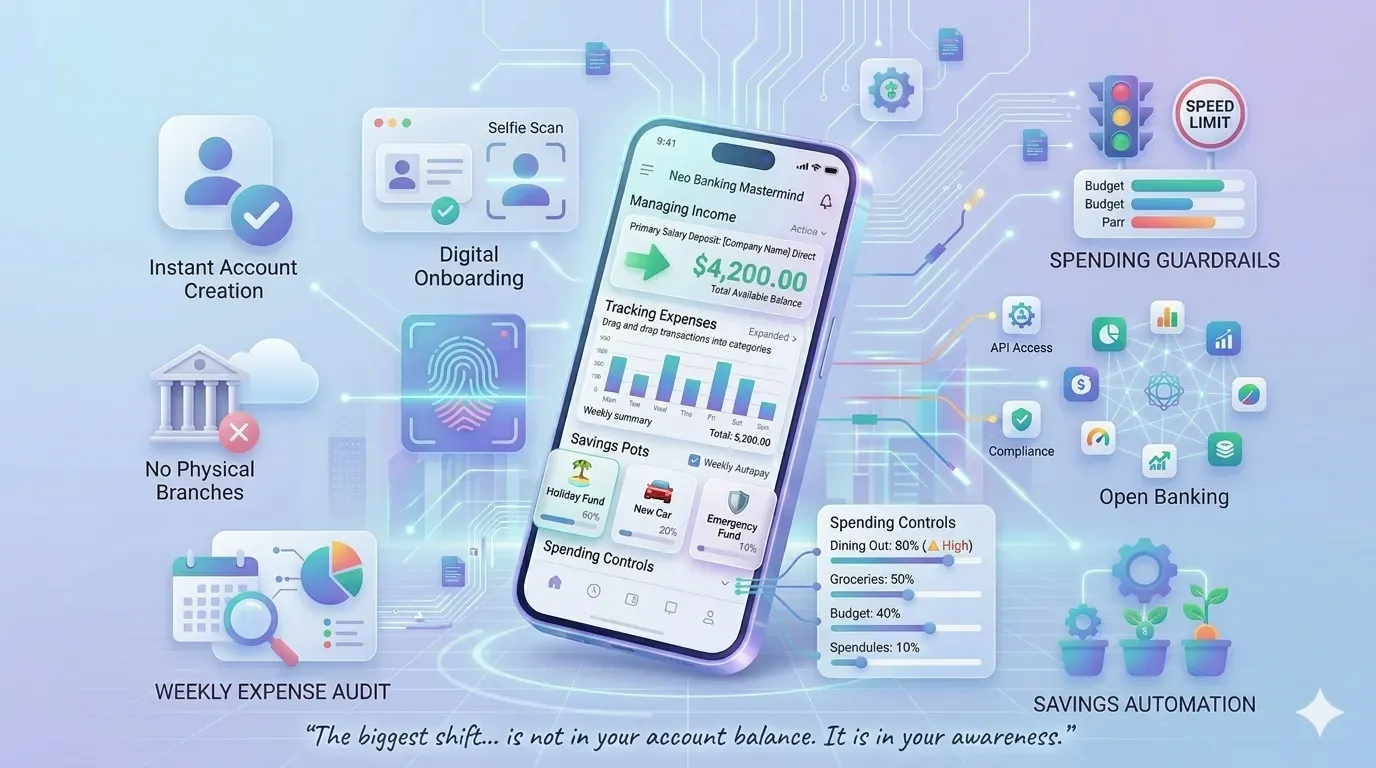
Start by setting your neo bank as your primary account. Have your salary or income deposited directly. This gives the app full visibility into your cash flow and makes all its tracking features more accurate.
Tracking Expenses
Check your spending categories at least once a week. Look at where your money actually went versus where you thought it went. Many users find that this simple habit alone leads them to cut back on spending they did not realize was adding up.
Setting Savings Goals
Create savings pots for your specific goals. Give each pot a clear name and a target amount. Set up automatic transfers to each pot on payday. Even small amounts add up over time, especially with round-up rules working quietly in the background.
Controlling Spending
Use your budget limits as guardrails. When the app tells you that you have reached 80 percent of your dining budget with two weeks left in the month, that is actionable information. You can choose to cook at home more often or decide consciously to go over budget. The point is that you are making an informed decision rather than spending blindly.
"The biggest shift neo banking creates is not in your account balance. It is in your awareness. When you can see exactly what you spend, you naturally begin to spend more intentionally."
Understanding Neo Bank Apps
How do the Apps Work?
A neo bank app connects to your account in real time. Every transaction you make updates your balance and your spending data instantly. The app uses this live data to power all its features: budgeting, savings, insights, and alerts.
The app is also your primary communication channel with the bank. Customer support, notifications, statements, and account settings all live inside the app.
The Core Formula of Neo Banking
Understanding your finances comes down to one simple formula:
Income − Expenses = Remaining Balance
Your neo bank app visualizes this formula in real time. You can always see your income, your total spending, and what is left over. From that remaining balance, you decide how much to save, how much to keep for upcoming expenses, and how much is truly available to spend.
A Beginner-Friendly Example
Imagine you earn 2,500 per month. Your fixed costs, rent, utilities, and subscriptions total 1,400. Your neo bank automatically identifies these as recurring payments. That leaves 1,100 for variable spending.
You set a budget of 300 for groceries, 150 for dining out, 100 for transport, and 200 for personal spending. You also create a savings pot with a 200 monthly transfer for your emergency fund and a 150 transfer toward a holiday.
At any point in the month, you can open the app and see exactly how much of each budget you have used and how much remains. There is no mental math. No guessing. No end-of-month surprise.
How to Combine Neo Banking With Budgeting, Expense Tracking, and Saving?
The Combined Strategy
Neo banking works best when you use all its features together. It is not enough to just have the account. The real value comes from actively using the budgeting, expense tracking, and savings tools in combination.
Daily Routine (5 Minutes)
Open the app and check your balance.
Review any new transactions and confirm they look correct.
Check if any new alerts or notifications need attention.
Weekly Routine (10 to 15 Minutes)
Review your spending by category for the week.
Check your budget progress for each category.
Move any surplus to a savings pot.
Look at your cash flow: what came in, what went out, what is left.
Adjust your behavior for the remaining days of the month if needed.
Monthly Routine (20 to 30 Minutes)
Review your full monthly spending report.
Compare this month to last month and look for trends.
Assess your savings progress against your goals.
Adjust your budget limits if any category consistently needs more or less.
Set your savings transfer amounts for the coming month.
This combined approach turns your neo bank from a simple payment account into a complete personal finance system. Many users report that following this routine for just three months changes their financial habits significantly.
Common Mistakes Neo Bank Users Make
Ignoring Spending Alerts
Real-time alerts are one of the most powerful features a neo bank offers. Many users turn them off or ignore them because they feel intrusive. This is a mistake. Alerts are your earliest warning system for overspending and unauthorized transactions. Treat them seriously.
Not Checking the App Regularly
Some users open their neo bank app only when they need to make a payment. They miss all the budgeting insights, savings prompts, and spending summaries. The app works best when you engage with it at least a few times a week.
Weak Budgeting Habits
Setting a budget is only the first step. You have to actually review it and respond to what it tells you. Many beginners set budgets, then forget about them entirely until the month is over. At that point, the data is interesting but no longer actionable.
Not Using Built-In Tools
Neobanks pack a lot of features into their apps. Many users never explore beyond the basic balance check and payment screen. Savings pots, round-up rules, spending insights, and financial dashboards are all there waiting to be used. Take the time to explore your app fully.
Security Negligence
Digital banking requires digital security habits. Use a strong, unique passcode for your app. Enable biometric login if available. Never share your login details with anyone. Be cautious about phishing messages that appear to come from your bank. In real life, most neo-bank fraud happens not because the bank was hacked, but because a user was tricked into sharing their own details.
Conclusion
Banking has changed more in the last ten years than in the previous hundred. Neo banks sit at the center of that change. They have taken a system designed for an earlier era and rebuilt it around what people actually need: digital access, transparent fees, smart tools, and total control.
If you are still using a traditional bank because it is familiar, that familiarity may be costing you. Hidden fees, slow transfers, outdated apps, and no real money management tools are the price you pay for staying put.
Neo banks offer a better deal. Lower costs, faster service, better technology, and features that actively help you understand and improve your financial life. The shift is not complicated. Download an app. Open an account. Spend five minutes a day engaging with your finances. Over weeks and months, that simple habit creates real change.
The future of fintech is moving fast. Neo banks are already adding investment products, insurance, credit tools, and AI-powered financial advice to their platforms. The gap between what a neo bank can offer and what a traditional bank can match will only grow wider.
The question is not whether digital banking is the future. It already is. The question is whether you are going to take advantage of it.
Frequently Asked Questions
Q: What is a neo bank?
A neo bank is a fully digital bank that operates through a mobile app or website, with no physical branches. It offers standard banking services like accounts, cards, and transfers, combined with modern features like expense tracking, budgeting tools, and real-time alerts.
Q: How does a neo bank work?
A neo bank uses app-based technology to deliver banking services. You open an account through the app, manage your money through the app, and interact with customer support through the app. The bank connects to payment networks and other financial services through APIs, which allows it to process transactions quickly and add features continuously.
Q: Are neo banks safe?
Reputable neobanks are regulated financial institutions subject to the same laws as traditional banks. They use bank-grade encryption to protect your data and your money. Most are covered by deposit protection schemes up to a certain amount, which varies by country. That said, you should always verify that any neobank you use is properly licensed and regulated in your country before depositing money.
Q: What are the best neo banks?
The best neo bank for you depends on where you live and what you need. Some of the most well-known neo banks globally include Revolut, Monzo, N26, Chime, Nu bank, and Starling Bank. Each has different features, fee structures, and availability. Research what is available in your region and compare the features that matter most to you.
Q: How do beginners start using neo banks?
Starting with a neo bank is straightforward. Download the app of a neo bank available in your country. Complete the digital onboarding process, which usually takes five to ten minutes. Add money to your account by bank transfer or debit card. Then explore the app and set up your budget categories and savings goals. Most neobank apps include guides and tutorials to help new users get started.
Share this article
Related Articles

10 Best AML Transaction Monitoring Software in 2026: Compare Top Platforms
Discover the best AML transaction monitoring software for 2026, with platform comparisons, pricing, features, and options for banks and accountants.

Top 10 Best Face Verification Software in 2026: The Complete Buyer's Guide
Discover the 10 best face verification software in 2026. Compare Jumio, iProov, FaceTec, Veriff, Incode, and more for secure identity verification.
Top 10 Best KYC Providers in the USA for 2026
Explore the 10 best fintech companies in the UK, including Revolut, Wise, Monzo, Starling Bank, and leading firms for banking, payments, and lending.