
Best SoC for Gaming Consoles in 2026: The Chips That Actually Drive Your Games
Explore the most powerful gaming console SoCs of 2026, from advanced AMD and NVIDIA chips to next-gen AI-powered processors delivering smoother gameplay and faster performance.
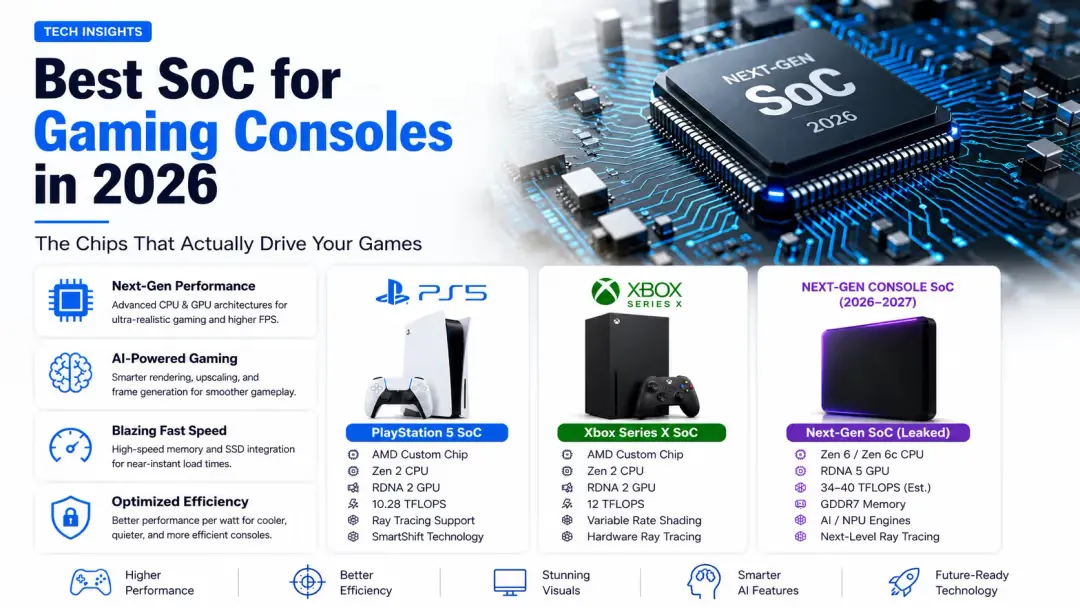
The silicon inside a gaming console determines everything: frame rates, load times, ray tracing quality, and whether a game runs at a buttery-smooth 60fps or a stuttering 30. If you want to understand why one console plays the same game better than another, the system-on-a-chip (SoC) is where the answer lives.
This guide breaks down the best SoCs for gaming consoles available right now in 2026. You'll learn exactly what each chip does, how the specs translate to real gaming performance, and which console's processor best fits your needs.
What Is a Gaming Console SoC and Why Does It Matter?
A system-on-a-chip (SoC) combines the CPU, GPU, memory controller, and other components onto a single piece of silicon. Traditional desktop PCs use separate chips for each of these roles. Consoles pack everything together, which saves space, lowers power draw, and lets manufacturers tightly optimize software for the hardware.
The SoC directly influences how fast games load, how smooth animations appear, and how detailed environments look. A more powerful SoC unlocks higher resolutions, faster frame rates, and better lighting effects like ray tracing. In other words, comparing console processors is the fastest way to understand the real-world gap between platforms.
Now that you know what a gaming console chip does, let's examine the top contenders.
PS5 SoC: Sony's "Viola" Chip Explained
Sony's PlayStation 5 Pro runs on a custom AMD chip internally codenamed Viola. The chip is manufactured on TSMC's N4P process node and uses the AMD RDNA 3 GPU architecture alongside Zen 2 CPU cores. Sony retained Zen 2 for CPU compatibility, allowing the vast back-catalog of PS5 games to run without modification. VideoCardz
GPU Performance: 16.7 TFLOPS of Rasterization Power
The PS5 Pro's GPU officially delivers 16.7 TFLOPs compared to the base PS5's 10 TFLOPs. That 67% GPU compute uplift is the biggest single-generation leap Sony has made on the PlayStation platform in over a decade. Tom's Hardware
The PS5 Pro reportedly uses 60 RDNA 3 compute units, along with RDNA 4-derived ray-tracing acceleration. This hybrid architecture gives the Viola chip a significant ray-tracing advantage over the base PS5 without requiring developers to completely rewrite their engines. According to PS5 system architect Mark Cerny, the customized RDNA 2. X architecture borrows many RDNA 3 features while maintaining enough of the original design to avoid forcing code rewrites. VideoCardzTom's Hardware
PSSR: Where the AI Comes In
One of Viola's most practical advantages is its AI upscaling capability called PSSR (PlayStation Spectral Super Resolution). The PS5 Pro boasts a 16.7 TFLOP GPU alongside new technologies, including PSSR and Wi-Fi 7. PSSR allows the console to render internally at a lower resolution and then reconstruct a sharp 4K image using machine learning similar to Nvidia's DLSS on PC. TechRadar
From a hands-on perspective, the results in enhanced titles are genuinely impressive. Games like Marvel's Spider-Man 2 run with visibly smoother motion and more stable 4K output than on the base PS5. The improvement is most noticeable on large 4K displays where image stability matters most.
Memory: 16GB GDDR6 Plus a Dedicated OS Pool
The PS5 Pro features 16GB of GDDR6 memory plus an additional 2GB of DDR5 dedicated to the system. Separating OS memory from game memory means developers can access more of the GDDR6 pool for rendering, which contributes to better texture quality and faster streaming. VideoCardz
The Viola SoC makes the PS5 Pro the most GPU-powerful home console on the market right now. Next, let's look at how Microsoft's AMD chip compares.
Xbox Series X Processor: AMD Zen 2 and RDNA 2 at 12 TFLOPS
The Xbox Series X uses a different custom AMD SoC, but it shares the same CPU architecture as the base PS5. The Xbox Series X runs an eight-core AMD Zen 2 processor at a slightly faster 3.8 GHz, compared to the PS5's 3.5 GHz variant. Eneba
The GPU Advantage in Raw Numbers
The Xbox Series X GPU has 52 compute units delivering 12 teraflops of performance, while the standard PS5's GPU has 36 compute units producing 10.28 teraflops. That gap made the Series X technically more powerful than the base PS5 on paper at launch. However, the PS5 Pro's Viola chip has now surpassed the Series X in GPU compute by a significant margin. Eneba
What Those Teraflops Mean in Practice
The Xbox Series X targets 4K gaming and advanced performance features suited for enthusiasts and professionals, paired with the fast Xbox Velocity Architecture SSD. The Velocity Architecture is worth highlighting, specifically, it allows the console to stream asset data from the SSD so quickly that developers can treat it almost like an extension of RAM. Fueler
The Xbox Series X supports native 4K gaming at up to 120fps with Dolby Vision and Dolby Atmos. The Series X also supports Quick Resume, which lets players jump between multiple suspended games almost instantly, a feature the SoC's memory architecture makes possible. Product Review Crew
For competitive and multiplayer-focused gamers, the Xbox Series X processor remains one of the most capable AMD console chips available. The story gets very different, though, when you look at Nintendo's approach.
Nintendo Switch 2 SoC: Nvidia T239 and the DLSS Advantage
Nintendo has always taken a different path with its console processors. Rather than chasing raw teraflops, the Switch 2 pairs modest hardware with Nvidia's AI-driven upscaling to punch well above its weight class.
The Custom Nvidia T239 Chip
The Switch 2's SoC is officially the Nvidia T239, a custom iteration of the Ampere architecture built specifically for Nintendo. The CPU portion features eight ARM Cortex A78C cores, while the GPU sports 1,536 CUDA cores similar in specification to Nvidia's mobile RTX 2050. TechPowerUpTom's Hardware
The custom Nvidia SoC also includes a dedicated decompression block for fast asset streaming from the Switch 2's SSD. This detail matters for open-world games, where constant texture streaming can bottleneck weaker hardware. Tom's Hardware
DLSS: Nvidia's Secret Weapon
The Nintendo Switch 2 supports real-time ray tracing via dedicated RT Cores, and AI-driven DLSS upscaling via Tensor Cores, enabling up to 4K gaming in TV mode and up to 120fps at 1080p in handheld mode. NVIDIA Blog
DLSS is genuinely transformative for a portable console. In testing Switch 2 titles side-by-side with their Switch 1 counterparts, the generational jump in image quality is immediately obvious. Games like The Legend of Zelda titles look genuinely sharp at 4K docked, even though the chip is running at a fraction of the raw GPU compute of the PS5 Pro or Xbox Series X.
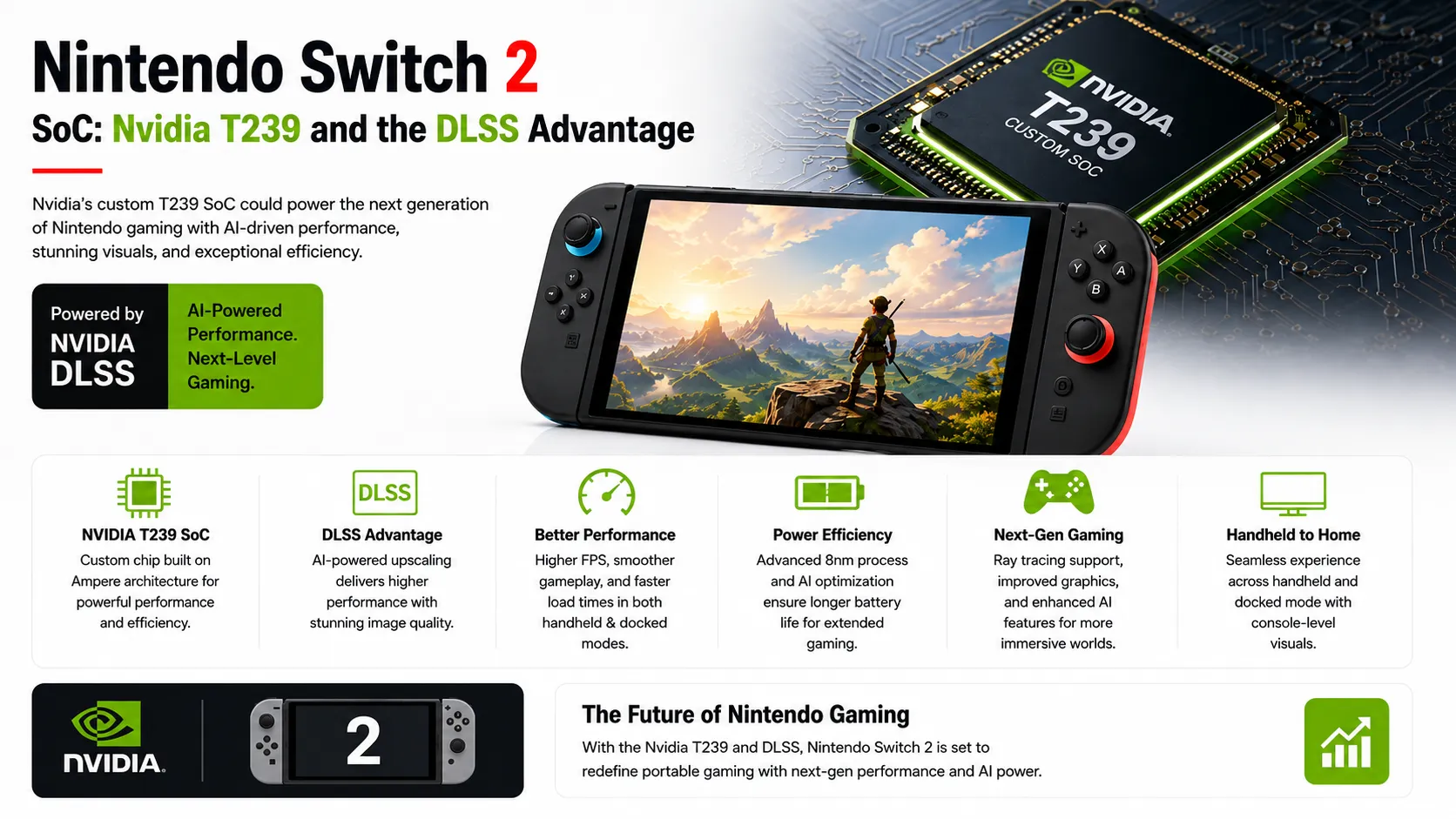
The Switch 2 features 12GB of RAM, 256GB of storage, and Nintendo confirmed a custom Nvidia chip that supports 4K docked output. VICE
The Switch 2's gaming console chip is the most efficient in the lineup, but if you want maximum fidelity, you still need a home console. Here's how all three SoCs stack up side-by-side.
Gaming Console Chip Comparison: PS5 Pro vs Xbox Series X vs Switch 2
Spec | PS5 Pro (Viola) | Xbox Series X | Switch 2 (T239) |
|---|---|---|---|
CPU | 8-core AMD Zen 2 | 8-core AMD Zen 2 | 8-core ARM Cortex A78C |
GPU Architecture | AMD RDNA 3 (+ RDNA 4 RT) | AMD RDNA 2 | Nvidia Ampere |
GPU Compute | 16.7 TFLOPS | 12 TFLOPS | ~1.4 TFLOPS (peak) |
RAM | 16GB GDDR6 + 2GB DDR5 | 16GB GDDR6 | 12GB LPDDR5 |
Upscaling Tech | PSSR (AI/ML) | FidelityFX Super Resolution | DLSS (Tensor Cores) |
Ray Tracing | RDNA 4-level RT hardware | RDNA 2 RT | Ampere RT Cores |
Targeting | 4K / 60–120fps | 4K / 60–120fps | 4K docked / 1080p portable |
Which Console Processor Wins for Your Use Case?
The answer depends entirely on how and where you play.
For maximum visual fidelity: The PS5 Pro's Viola SoC leads the pack. Its raw GPU compute, AI upscaling, and enhanced ray tracing hardware combine to deliver the best image quality of any home console currently on the market.
For raw performance and game library breadth, the Xbox Series X processor offers 12 TFLOPS paired with the Velocity Architecture and Game Pass. PlayStation leads the US market with approximately 45% market share, followed by Nintendo at 27% and Xbox at 23%, but market share doesn't mean raw hardware performance, and the Series X remains a powerhouse. Fueler
For portable play: The Nvidia T239 in the Switch 2 is in a class of its own. No other gaming console chip delivers handheld ray tracing and DLSS upscaling in a battery-powered device. For gamers who split time between home and travel, this SoC's efficiency advantage matters more than its teraflop deficit.
How AMD Became the Dominant Console Chip Maker
It's worth stepping back and appreciating how dominant AMD has become in gaming hardware. Both the PS5 Pro and Xbox Series X run custom AMD SoCs based on the Zen CPU architecture and RDNA GPU architecture, the same technology AMD sells in its Radeon graphics cards and Ryzen processors.
This dominance benefits developers. Writing optimized code for AMD's console chips is now closely aligned with optimizing for PC gaming, which speeds up cross-platform development. It also benefits gamers, because AMD's RDNA architectures support advanced features like hardware ray tracing and variable rate shading that make games look and play better without proportionally increasing power consumption.
A next-gen Xbox, codenamed Project Helix, has been confirmed to be powered by a custom AMD SoC. AMD's grip on console silicon shows no sign of loosening, which is excellent news for the long-term feature roadmap of gaming hardware. Tom's Hardware
Conclusion
The best SoC for gaming consoles in 2026 depends on the kind of gamer you are. The PS5 Pro's Viola chip leads in GPU horsepower and AI upscaling quality, making it the top pick for players who want the absolute best visual experience on a 4K TV. The Xbox Series X processor counters with comparable performance, unmatched backward compatibility, and the Game Pass ecosystem. The Nintendo Switch 2's Nvidia T239 wins on efficiency and portability, bringing ray tracing and DLSS to a device that fits in a bag.
Rather than chasing teraflop numbers, focus on the platform's game library and how well the SoC's unique technologies, PSSR, DLSS, or Velocity Architecture serve your actual play style. That's the approach that leads to the most satisfying purchase.
Frequently Asked Questions
Q: What does SoC stand for in gaming consoles?
SoC stands for System-on-a-Chip. It combines the CPU, GPU, memory controller, and other processing hardware onto a single piece of silicon. Every modern gaming console, PS5, Xbox Series X, Switch 2, uses a custom SoC designed specifically for gaming workloads.
Q: Which console has the most powerful SoC in 2026?
The PS5 Pro holds the top spot in raw GPU compute with 16.7 TFLOPS from its custom AMD Viola SoC. The Xbox Series X follows with 12 TFLOPS. The Nintendo Switch 2's Nvidia T239 prioritises efficiency over raw power, making it the clear leader for portable gaming.
Q: Is the PS5 SoC based on AMD RDNA 2 or RDNA 3?
The base PS5 uses a custom AMD chip primarily based on RDNA 2. The PS5 Pro upgrades to the "Viola" SoC, which uses RDNA 3 for rasterisation with additional ray tracing improvements drawn from RDNA 4. Sony's system architect Mark Cerny described it as a heavily customised hybrid architecture.
Q: How does the Xbox Series X processor compare to the PS5 SoC?
At launch, the Xbox Series X had a higher raw GPU compute figure (12 TFLOPS vs. 10.28 TFLOPS on the base PS5). The PS5 Pro has since surpassed the Series X. Both the PS5 and Xbox Series X share the AMD Zen 2 CPU architecture, which means CPU-side performance is essentially equivalent.
Q: Why does the Nintendo Switch 2 have lower teraflops than PS5 and Xbox?
The Switch 2 is a hybrid portable console, so it must balance performance with battery life and thermal limits. NVIDIA compensates for the lower raw compute by including DLSS, which uses AI (Tensor Cores) to reconstruct high-resolution images from lower-resolution renders. The result is 4K-capable output despite the chip's modest specs.
Q: What is PSSR on the PS5 Pro?
PSSR (PlayStation Spectral Super Resolution) is Sony's proprietary AI upscaling technology built into the PS5 Pro's Viola SoC. It works similarly to Nvidia's DLSS; the GPU renders frames at a lower internal resolution, and the AI reconstructs a sharp 4K output. The result is higher frame rates with image quality close to native 4K.
Q: Will future consoles still use AMD SoCs?
Almost certainly yes, at least for PlayStation and Xbox. Microsoft has already confirmed that the next-generation Xbox (Project Helix) will use a custom AMD SoC. AMD's vertical integration across Zen CPU and RDNA GPU architectures, combined with a proven track record in consoles, makes them the most logical silicon partner for the next generation.
Share this article
Related Articles

Gamification in 2026: The Complete Guide to Engagement, Motivation & Growth
Discover how gamification in 2026 boosts engagement, motivation, and business growth through rewards, AI-driven experiences, leaderboards, and interactive digital strategies.
Best CPU for Gaming 2026: Top Picks for Every Budget
Find the best gaming CPUs for 2026 with top AMD and Intel picks for every budget. Compare performance, FPS, value, and future-proof gaming power.
What Is Ping in Gaming? The Ultimate Guide to Latency, Lag & Low-Ping Performance
Low ping can mean the difference between victory and defeat. Learn what ping really is, how latency affects online gaming, and the best ways to reduce lag for smoother, faster gameplay in 2026.