
Comfortable Gaming Chairs in 2026: Best Picks for Every Gamer
Experience all-day comfort with the best gaming chairs of 2026. Discover ergonomic, budget, and premium picks built for long gaming sessions, better posture, and ultimate support.
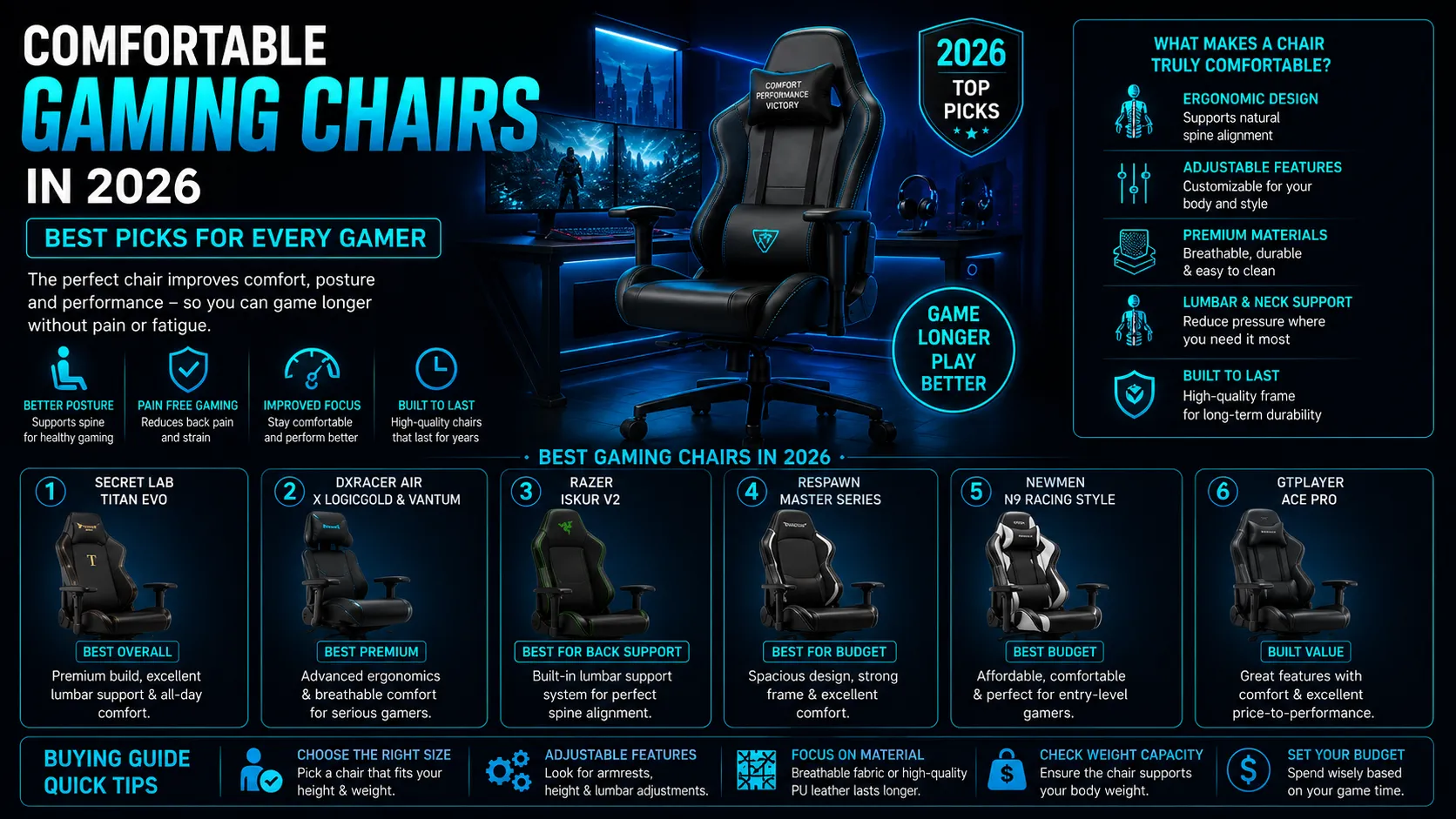
Your back shouldn't be the reason you quit a session early. Whether you game for two hours or ten, the chair you sit in directly affects your performance, your posture, and how you feel the next morning. This guide breaks down what actually makes a gaming chair comfortable and which models deliver in 2026.
Why Comfort Matters More Than Aesthetics in a Gaming Chair
Most people shop for gaming chairs with their eyes. They see bold colors, flashy stitching, and a racing-style design, and they assume that means quality. It usually doesn't.
The chairs that look the most aggressive often sacrifice ergonomics for style. After testing multiple models across different price points, the biggest lesson is this: the most comfortable chairs are often the least flashy.
According to occupational health research, sitting for extended periods without proper lumbar and neck support increases the risk of chronic lower back pain. For gamers who average 3–4 hours per session (a figure frequently cited in gaming behavior studies), that adds up fast.
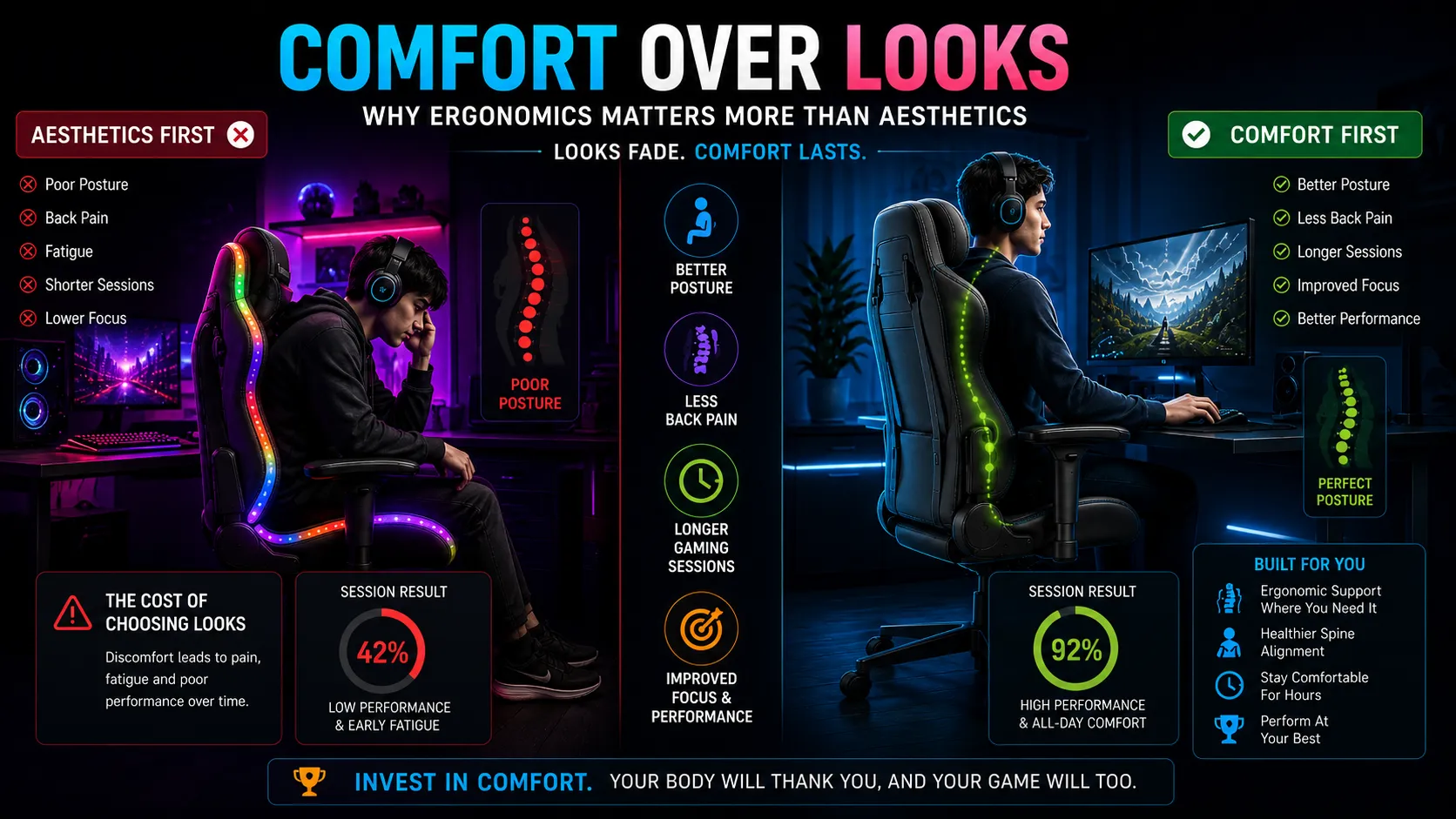
The real markers of a comfortable gaming chair include:
Adjustable lumbar support that actually reaches your lower spine
A seat cushion that doesn't flatten after 60 minutes
Armrests that adjust in height, width, and angle
A recline function with a reliable locking mechanism
A headrest pillow that you can position, not just one that's sewn in place
A good chair isn't a luxury. It's a long-term investment in your health and focus. With that in mind, let's cover what to look for before you spend a dollar.
What to Look for in an Ergonomic Gaming Chair
Shopping for an ergonomic gaming chair without a checklist is how people end up with buyer's remorse. Here's what separates the great chairs from the average ones.
Lumbar Support
This is non-negotiable. A chair without proper lumbar support forces your lower spine into a C-curve, leading to fatigue and pain during long sessions. Look for either a built-in adjustable lumbar pad or a firm detachable pillow you can reposition.
Some high-end chairs, particularly those borrowing from office chair design, build lumbar support directly into the backrest. These tend to hold their shape better over time than standalone foam pillows.
Seat Depth and Cushion Density
Seat depth matters more than most buyers realize. If the seat is too long, it cuts into the backs of your knees and restricts blood flow. If it's too short, you lose thigh support. Ideally, there should be a 2–3 finger gap between the seat edge and the back of your knees.
High-density foam cushions outperform low-density alternatives by a wide margin. Low-density foam feels soft at first but compresses within weeks. High-density foam retains its shape; look for foam density ratings of 50 kg/m³ or higher when manufacturers list that spec.
Armrest Adjustability
Fixed armrests are one of the biggest ergonomic failures in budget chairs. Your arms need to rest at roughly a 90-degree angle to avoid shoulder tension. Look for 4D armrests (height, depth, width, and pivot angle) on mid-to-high range models. Even 3D armrests are a major upgrade over fixed ones.
Recline and Tilt Mechanism
A chair with a recline range of 90–165 degrees gives you flexibility for gaming, watching, and resting. More importantly, the tilt tension should be adjustable so you're not fighting the chair or falling back unintentionally.
Now that you know what to look for, here are the best comfortable gaming chairs available in 2026.
Best Gaming Chairs for Long Hours in 2026
These picks cover different use cases, body types, and budgets. Each one has been evaluated on cushion quality, lumbar support, adjustability, and durability.
Secretlab Titan Evo 2022 Series (Updated 2026 Edition)
The Secretlab Titan Evo remains one of the best gaming chairs for long hours on the market. It features an integrated 4-way lumbar system built into the backrest, no pillow required, and a magnetic memory foam head pillow that holds its position.
The cold-cure foam seat is noticeably firmer than budget alternatives, which is a good thing. Firm cushions hold your weight evenly and reduce pressure points. Most users report zero significant cushion compression even after two years of daily use.
The chair supports users up to 290 lbs and comes in three size variants (Small, Regular, XL), which is rarer than it should be in this industry.
Best for: Serious gamers and streamers who sit 4–8 hours daily.
Herman Miller x Logitech G Embody
This collaboration between Herman Miller and Logitech G brought office-grade ergonomics to the gaming world. The Embody's backrest mimics the natural curvature of your spine using a pixelated support matrix of dozens of small pads that flex with your movement rather than holding you rigidly in place.
It doesn't look like a traditional gaming chair. There's no racing stripe or neck pillow. But for pure ergonomic comfort during long sessions, it outperforms nearly every gaming-branded alternative.
The price is steep, around $1,495, but for professionals, streamers, or anyone with chronic back issues, the investment often pays for itself in reduced discomfort and medical costs.
Best for: Professional gamers, streamers, and users with back pain or posture issues.
Razer Iskur V2
Razer improved significantly on the original Iskur with the V2. It includes a multi-layer cushion system with memory foam on top of high-density base foam, a smart design that combines initial softness with long-term support.
The lumbar support system is adjustable via a dial on the side, allowing you to increase or decrease firmness without leaving your seat. That small feature makes a big difference during long sessions when your needs change as you fatigue.
The 4D armrests and wide recline range (90–165 degrees) round out a strong ergonomic package at a mid-range price point.
Best for: Gamers who want a feature-rich chair at a reasonable price.
AndaSeat Kaiser 3 (Large)
The AndaSeat Kaiser 3 punches well above its price. It uses a magnetic neck pillow and a lumbar cushion that you can actually adjust to the right height, something many chairs in this price range get wrong by placing the lumbar pillow too low.
The seat cushion uses cold-cure foam with a density that holds up noticeably better than comparable budget chairs. AndaSeat backs it with a 2-year warranty on foam density, which signals real confidence in the product.
It also accommodates users up to 440 lbs in the XL version, making it one of the most size-inclusive options on the market.
Best for: Gamers on a mid-range budget who need a durable, size-inclusive option.
Best Budget Gaming Chair: Dowinx LS-666801F
For gamers on a tight budget, the Dowinx LS-666801F offers surprising comfort at under $200. It features a massage lumbar pillow (USB-powered vibration), a winged backrest, and a rocking function that most chairs at this price point omit.
The foam isn't as dense as premium alternatives, and the armrests only adjust in height. However, for casual sessions of 1–3 hours, it's a comfortable and practical option that won't drain your wallet.
Best for: Students, casual gamers, and anyone needing a budget gaming chair under $200.
Mesh vs. Foam: Which Gaming Chair Material Is More Comfortable?
Material choice affects both comfort and durability more than most buyers expect. The two dominant materials are PU leather (with foam padding) and mesh.
Foam and PU Leather
Foam-padded chairs with PU leather exteriors are the most common gaming chair design. They feel plush initially and tend to hold their shape well if the foam density is high enough. The downside is heat retention leather and dense foam trap body heat, which becomes uncomfortable during long summer sessions.
Mesh Backrests
Mesh chairs allow constant airflow against your back, which dramatically reduces heat buildup. Office chair brands like Herman Miller and Steelcase have used mesh backrests for decades, and gaming chair brands are increasingly adopting the design.
The tradeoff is that mesh provides less initial cushioning. Some users find mesh firmer or less enveloping than foam. However, for gamers in warm climates or those who run hot, the breathability is worth it.
Bottom line: If you game in a climate-controlled room and prefer a plush feel, foam is fine. If you run or play games in the summer, a mesh backrest chair is a significantly more comfortable choice.
How to Set Up Your Gaming Chair for Maximum Comfort
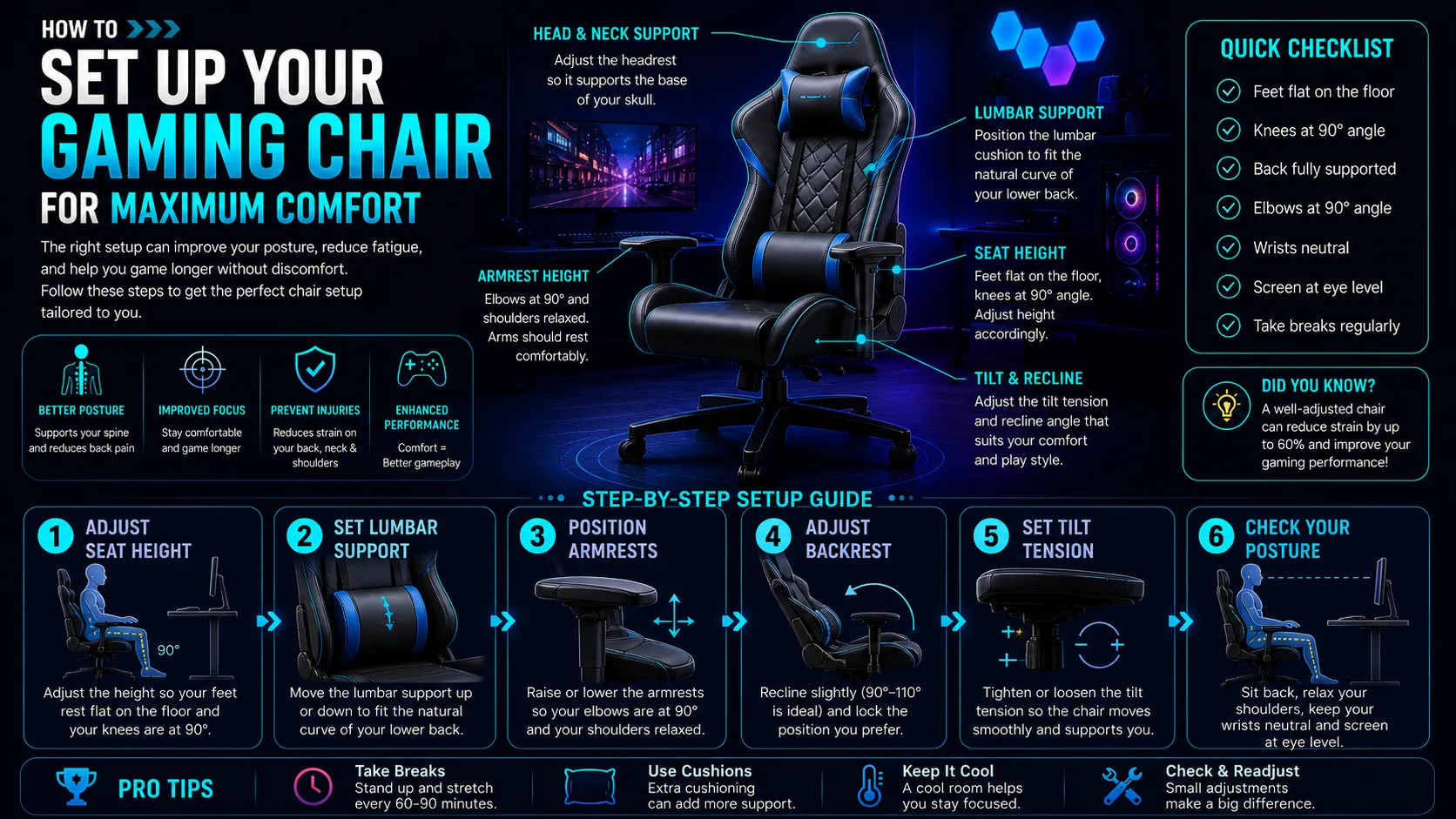
Even the best ergonomic gaming chair won't help if you set it up incorrectly. Here's a quick setup protocol that takes less than five minutes.
Set Seat Height First
Adjust the height so your feet rest flat on the floor with your knees at approximately 90 degrees. Your thighs should be roughly parallel to the ground. This is your foundation; everything else builds on it.
Adjust Lumbar Support
Push the lumbar support, whether it's a pillow, dial-adjustable pad, or built-in curve, to the point where it gently fills the natural inward curve of your lower back. You should feel light contact, not pressure.
Set Armrest Height
Raise or lower the armrests until your shoulders are relaxed and your elbows rest at approximately 90 degrees. Your shoulders should not hunch upward or drop down to reach the armrests.
Adjust Headrest Position
Position the headrest to support the back of your head when you sit upright. If it's pushing your head forward, it's too high. If you can't feel it at all, it's too low.
Recline Slightly
A very slight recline, around 100–110 degrees, actually reduces spinal compression more than sitting bolt upright. Lock the recline at that angle for regular gaming sessions.
Conclusion
Finding the best comfortable gaming chair comes down to three things: proper lumbar support, a durable seat cushion, and enough adjustability to fit your body, not a generic template. Aesthetics matter, but they should come second.
If budget isn't a concern, the Herman Miller Embody and Secretlab Titan Evo are the top performers in 2026. For mid-range buyers, the Razer Iskur V2 and AndaSeat Kaiser 3 deliver excellent value. On a tight budget, the Dowinx LS-666801F covers the essentials without breaking the bank.
Frequently Asked Questions
Q: How long should a gaming chair last?
A quality gaming chair with high-density foam and durable stitching should last 3–5 years with regular use. Premium chairs like the Secretlab Titan and Herman Miller Embody often last 7–10 years.
Q: Are gaming chairs actually better than office chairs for long sessions?
Not always. Premium office chairs (Herman Miller, Steelcase) often outperform gaming chairs ergonomically. However, mid-range gaming chairs frequently outperform budget office chairs in cushion quality and adjustability. It depends on what you're comparing.
Q: What's the best gaming chair for back pain?
The Herman Miller x Logitech G Embody is widely regarded as the best option for users with chronic back pain due to its spine-mapping backrest design. The Secretlab Titan Evo's integrated lumbar system is also highly rated for lower back support.
Q: Can a gaming chair help improve posture?
A well-adjusted ergonomic gaming chair can encourage better posture by supporting the natural curve of your spine. However, a chair alone won't fix posture; you also need to be conscious of your sitting habits and take regular movement breaks.
Q: What is a good budget gaming chair?
The Dowinx LS-666801F and the AndaSeat Phantom 3 offer the best value under $250. For under $150, options are limited but exist, focusing on foam density and adjustable lumbar support as your minimum criteria.
Q: Is mesh or leather better for gaming chairs?
For warm climates or long sessions, mesh is more comfortable due to airflow. For cooler environments or those who prefer a plush feel, foam with PU leather is a solid choice. Neither is universally superior.
Q: How do I know if a gaming chair fits my body size?
Check the manufacturer's weight and height specifications before buying. Most standard chairs fit users between 5'4" and 6'2" and up to 250–300 lbs. Look for "XL" or "Plus" variants if you fall outside those ranges.
Share this article
Related Articles

Gamification in 2026: The Complete Guide to Engagement, Motivation & Growth
Discover how gamification in 2026 boosts engagement, motivation, and business growth through rewards, AI-driven experiences, leaderboards, and interactive digital strategies.

Best CPU for Gaming 2026: Top Picks for Every Budget
Find the best gaming CPUs for 2026 with top AMD and Intel picks for every budget. Compare performance, FPS, value, and future-proof gaming power.
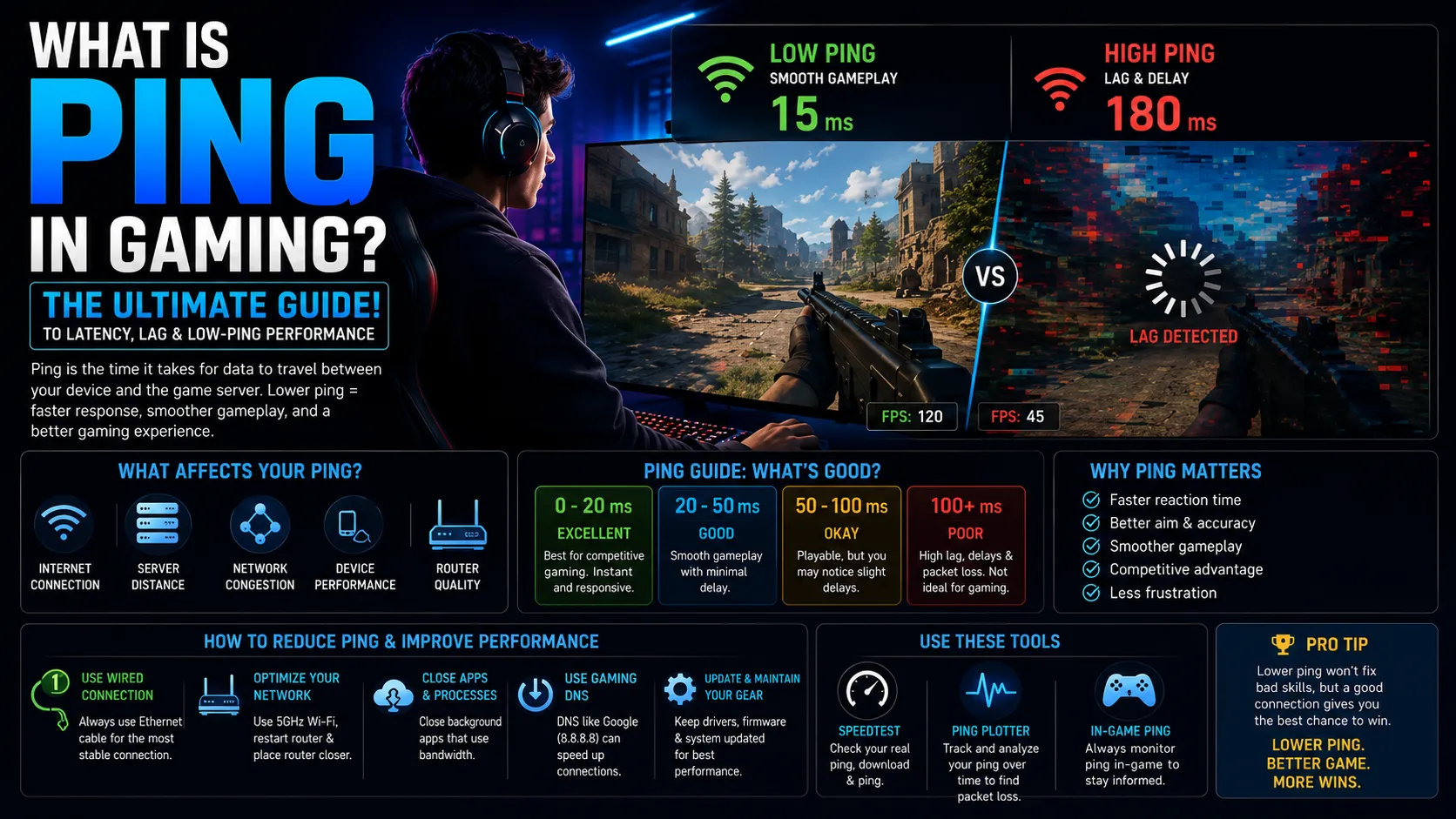
What Is Ping in Gaming? The Ultimate Guide to Latency, Lag & Low-Ping Performance
Low ping can mean the difference between victory and defeat. Learn what ping really is, how latency affects online gaming, and the best ways to reduce lag for smoother, faster gameplay in 2026.