
What is Green Technology? A Beginner's Guide to Clean Innovation and a Sustainable Future
Learn how green technology is creating a sustainable future through renewable energy, clean innovation, and eco-friendly solutions that reduce environmental impact.
Something is changing in the way the world powers itself.
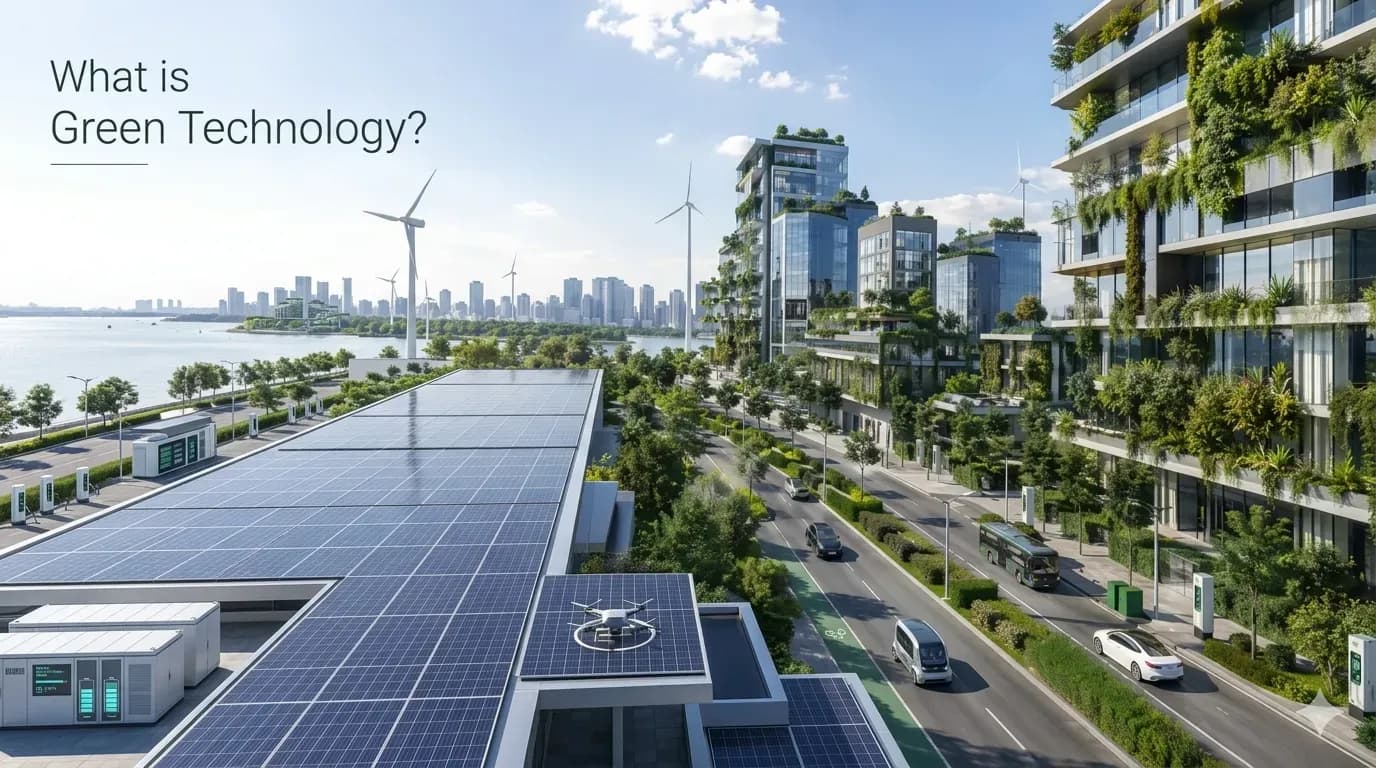
Rooftops are filled with solar panels. City buses are going electric. Farmers are using sensors instead of guesswork. Buildings are being designed to produce more energy than they consume. This shift is quiet, practical and accelerating is what green technology looks like in the real world.
This guide is written for anyone who wants to understand it clearly: what it is, why it matters, and where it is headed.
What Is Green Technology?
Green technology is the use of science and engineering to create products and systems that meet human needs while causing as little harm to the environment as possible.
The word "green" here does not mean a color. It means clean, responsible, and built to last. Where older industrial approaches often extracted resources and left damage behind, green technology tries to work within the natural limits of the planet.
A simple way to think about it: traditional technology asks, "How do we get what we need?" Green technology asks, "How do we get what we need without making things worse for everyone else?"
In practice, this includes everything from a solar panel on a family home to an AI system managing electricity demand across an entire city.
Why Does Green Technology Matter Right Now?
The timing is not accidental. Several problems have converged at once, and green technology is emerging as a practical response to all of them.
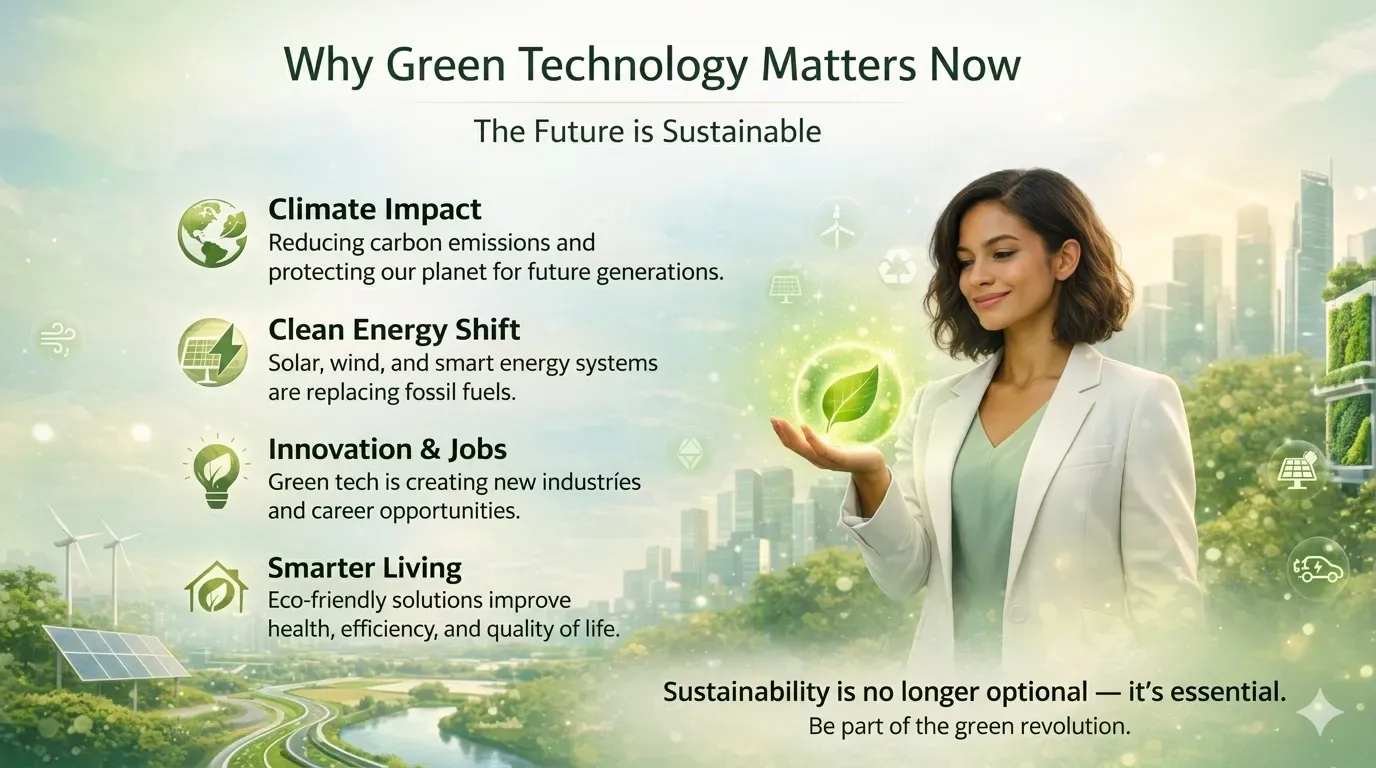
Rising energy costs: Are putting pressure on households and businesses everywhere. Systems that generate their own power or use energy more efficiently offer real financial relief, not just environmental benefit.
Climate change: Is no longer a distant forecast. Heatwaves, floods, and shifting seasons are affecting agriculture, infrastructure, and public health in visible ways. The root cause of excess carbon released by burning fossil fuels is something green technology directly addresses.
Resource depletion: Is a quiet but serious problem. Oil, natural gas, and rare minerals are finite. The sooner we build systems that run on renewable inputs, such as sunlight, wind, water the less vulnerable we become to supply disruptions and price shocks.
Health: Is perhaps the most personal reason. Air pollution from vehicles and power plants causes millions of premature deaths every year. Cleaner energy means cleaner air, and cleaner air means longer, healthier lives.
These are not hypothetical concerns. They are already shaping policy, investment, and daily decisions in every country.
The Main Types of Green Technology
Green technology is not one thing. It spans several fields, each addressing a different part of the environmental challenge.
Renewable Energy
This is the foundation. Renewable energy comes from sources that naturally replenish themselves, such as the sun, wind, and water, unlike coal or oil, which took millions of years to form and are gone once burned.
Solar panels convert sunlight into electricity. Wind turbines capture the energy in moving air. Hydropower draws on the flow of rivers and the force of water. Together, these three sources now provide a growing share of electricity in dozens of countries.
Cleaner Transportation
Vehicles are one of the biggest sources of urban air pollution. Electric vehicles remove tailpipe emissions entirely. Hydrogen fuel cell vehicles offer another zero-emission option for longer distances. Better public transport, cycling infrastructure, and ride-sharing systems reduce the number of vehicles on roads altogether.
Smarter Buildings
Buildings consume enormous amounts of energy for heating, cooling, lighting, and appliances. Green building design uses better insulation, passive solar principles, and smart energy management to cut that consumption dramatically. Some modern buildings are now "net-zero," meaning they produce as much energy as they use over the course of a year.
Sustainable Agriculture
Growing food accounts for a significant share of global water use, land clearing, and chemical runoff. Precision agriculture uses sensors and data to apply water and fertilizer only where needed, in the right amounts. Vertical farming grows crops indoors using far less water and no pesticides. These approaches feed people while reducing strain on land and water systems.
Waste Reduction and Circular Design
Traditional economies follow a straight line: make, use, throw away. Circular design closes that loop. Products are designed to be repaired, repurposed, or recycled. Composting systems turn food waste into soil. Waste-to-energy facilities convert non-recyclable materials into electricity. The goal is a world where nothing useful is simply discarded.
Real Examples You Can See Today
Green technology is not waiting for the future. It is already working, at scale, in ordinary places.
In Germany, rooftop solar has become so common that on sunny afternoons, the country sometimes generates more electricity than it can use. Excess power is exported to neighbouring countries or stored for later.
In Shenzhen, China, the entire public bus fleet of over 16,000 vehicles has been converted to electric. The city's air quality improved measurably within a few years of the transition.
In the Netherlands, greenhouse agriculture has been refined to such a degree that Dutch farmers produce enormous quantities of vegetables using a fraction of the water and land that traditional farming would require.
In Masdar City at Abu Dhabi, an entire urban district was designed around sustainability with buildings oriented to minimise heat gain, shaded walkways, and renewable energy throughout.
These are not experimental projects. They are working systems, delivering results and being replicated elsewhere.
Benefits Worth Understanding
The case for green technology is stronger than most people realise, because the benefits extend well beyond environmental protection.
For the environment, the gains include reduced carbon emissions, cleaner air and water, less land degradation, and healthier ecosystems. These matter not just for nature but for the agricultural systems and water supplies that human life depends on.
For economies, the transition to clean energy is creating an enormous number of jobs in manufacturing, installation, maintenance, research, and infrastructure. The International Labor Organization estimates tens of millions of new jobs will be created globally as the energy system shifts. At the same time, energy efficiency reduces costs for businesses and households in ways that compound over time.
For health, the connection is direct. Fewer emissions mean fewer cases of asthma, lung disease, and cardiovascular problems caused by air pollution. Cleaner water means fewer waterborne illnesses. Less pesticide runoff benefits both rural communities and urban water supplies.
Honest Challenges
A guide that only presents the benefits would not be very useful. Green technology faces genuine challenges that are worth understanding.
The upfront cost of many clean technologies remains higher than conventional alternatives, even though the gap has narrowed significantly. A household that cannot afford the initial cost of solar panels will not benefit from the long-term savings, no matter how compelling the numbers look.
Infrastructure is a persistent obstacle. Electric vehicles need charging networks. Renewable energy needs updated power grids that can handle variable supply. In many parts of the world, that infrastructure is not yet in place, which limits how quickly adoption can happen.
Raw materials are another concern. Solar panels, wind turbines, and batteries all require minerals such as lithium, cobalt, and nickel that must be mined. If that mining is done irresponsibly, it creates new environmental problems even while solving old ones. This is why sustainable supply chains and responsible sourcing matter as much as the technology itself.
None of these challenges is insurmountable. But they are real, and pretending otherwise does not help anyone.
Where Green Technology Is Heading: 2026 and Beyond
The pace of change in this space is faster than most people appreciate. Several trends are worth watching.
Artificial intelligence and energy management are coming together in ways that make renewable energy far more practical. AI can predict when solar output will drop due to clouds, balance supply across a grid in real time, and shift demand from peak to off-peak hours automatically. This makes the whole system more efficient and more reliable.
Green hydrogen is emerging as a key solution for industries that are difficult to electrify, such as steel production, shipping, and aviation, among them. Hydrogen produced using renewable electricity emits nothing when burned. Costs are falling, and investment is accelerating.
Battery storage is improving rapidly. Better batteries mean solar and wind energy can be stored and used at night or during calm weather, solving one of the main criticisms of renewable energy. Longer-lasting, cheaper, and faster-charging batteries are coming.
Smart cities are being built and retrofitted around efficiency. Sensors manage traffic flow to reduce idling. Street lighting dims when streets are empty. Water systems detect leaks automatically. These changes reduce waste without requiring anyone to change their behaviors.
Ocean energy, tidal, wave, and offshore wind represent a largely untapped resource. The ocean is consistent in ways that solar and land-based wind are not. Developers are investing in technologies to harness it at scale.
Where Innovation Goes Public
A Green Tech Festival is an event that brings together everyone involved in building a cleaner world: engineers, investors, policymakers, students, and curious members of the public in one place.
The most established of these events takes place in Berlin each year. It has become a significant platform for sustainable innovation and attracting participants from dozens of countries.
At these events, startups demonstrate technologies that have not yet reached the market. Established companies announce commitments and partnerships. Experts discuss what is working, what is not, and what is needed next. Awards recognize the most impactful innovations of the year.
Beyond the business conversations, events like this serve a broader purpose. They make visible the scale and seriousness of the transition underway. They show that green technology is not a niche interest or a political talking point; it is an active, global, well-funded movement with real momentum.
For anyone entering this field as an engineer, entrepreneur, investor, or policymaker, these events are worth paying attention to.
Clearing Up Common Misunderstandings
A few ideas circulate about green technology that are worth correcting.
"It only works in rich countries." This is not accurate. Some of the fastest-growing solar markets are in India, Bangladesh, and sub-Saharan Africa, where off-grid solar is providing electricity to communities that never had access to it before. Green technology is often most valuable precisely where conventional energy infrastructure is weakest.
"The technology is not ready yet." For most applications, it is. Solar and wind are now the cheapest sources of new electricity generation in most of the world. Electric vehicles are practical for everyday use. LED lighting, smart appliances, and energy-efficient buildings are all proven and widely available.
"Individual choices do not matter." They do this not because any one person's actions will solve the problem alone, but because markets respond to demand, and demand is shaped by individual choices. The rapid fall in solar panel costs happened partly because millions of households chose to install them, creating scale that drove prices down.
Conclusion
Green technology is not a theory about how the world should work. It is a practical, expanding, increasingly affordable set of tools for making the world work better.
The problems it addresses, climate change, pollution, resource depletion, and energy costs, are serious. But the responses are real, proven, and spreading. The question is no longer whether clean technology works. The question is how quickly it can be adopted, and at what scale.
That is a question worth caring about. And understanding it is the first step toward being part of the answer.
Frequently Asked Questions
Q: What is green technology in simple terms?
It is technology designed to meet human needs for energy, food, transport, and shelter while reducing harm to the environment. The goal is to do more with less, using clean and renewable resources wherever possible.
Q: What are some everyday examples of green technology?
Solar panels on homes, electric vehicles, LED light bulbs, smart thermostats, energy-efficient washing machines, composting systems, and recycled packaging are all forms of green technology that many people already use.
Q: Why is green technology becoming more important?
Because the environmental costs of conventional technology are becoming impossible to ignore in the form of climate change, pollution, and resource depletion, and because clean alternatives have become affordable and practical enough to replace them.
Q: Is green technology affordable for ordinary people?
Increasingly, yes. The cost of solar panels has dropped by more than 90 percent since 2010. LED bulbs, efficient appliances, and basic insulation improvements are affordable for most households. Many governments also offer grants, subsidies, or low-interest financing to reduce upfront costs further.
Q: What does the future of green technology look like?
The broad direction is clear: more renewable energy, smarter energy management, cleaner transport, more efficient buildings, and more circular approaches to manufacturing and waste. The pace and shape of that future will be influenced by policy decisions, investment choices, and public demand, which means it is still, in part, something we get to shape.
Share this article
Related Articles
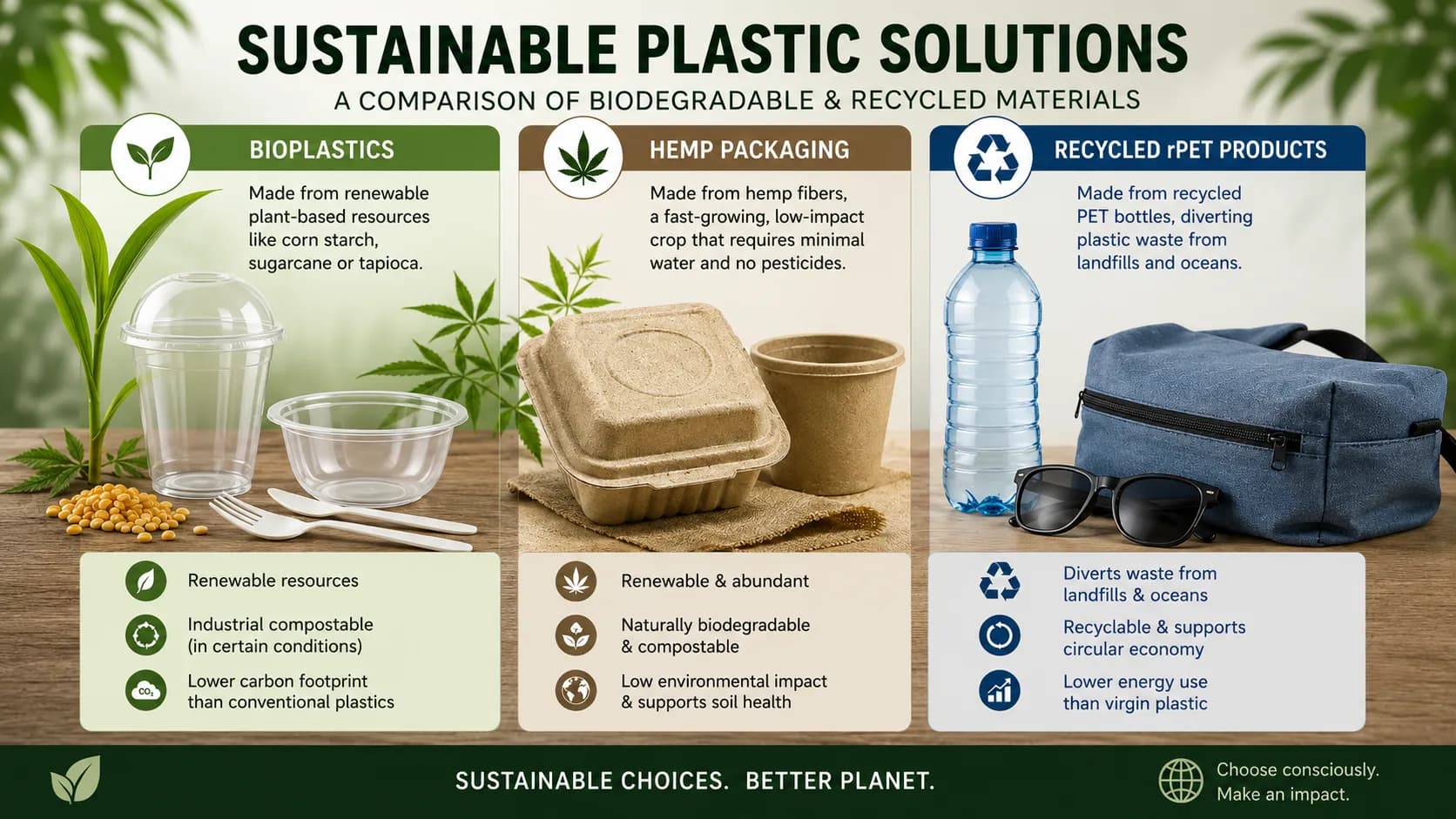
Eco-Friendly Plastic Alternatives and Sustainable Plastic Solutions That Actually Work
Explore eco-friendly plastic alternatives and sustainable solutions that reduce waste, improve sustainability, and help businesses move beyond traditional plastics.
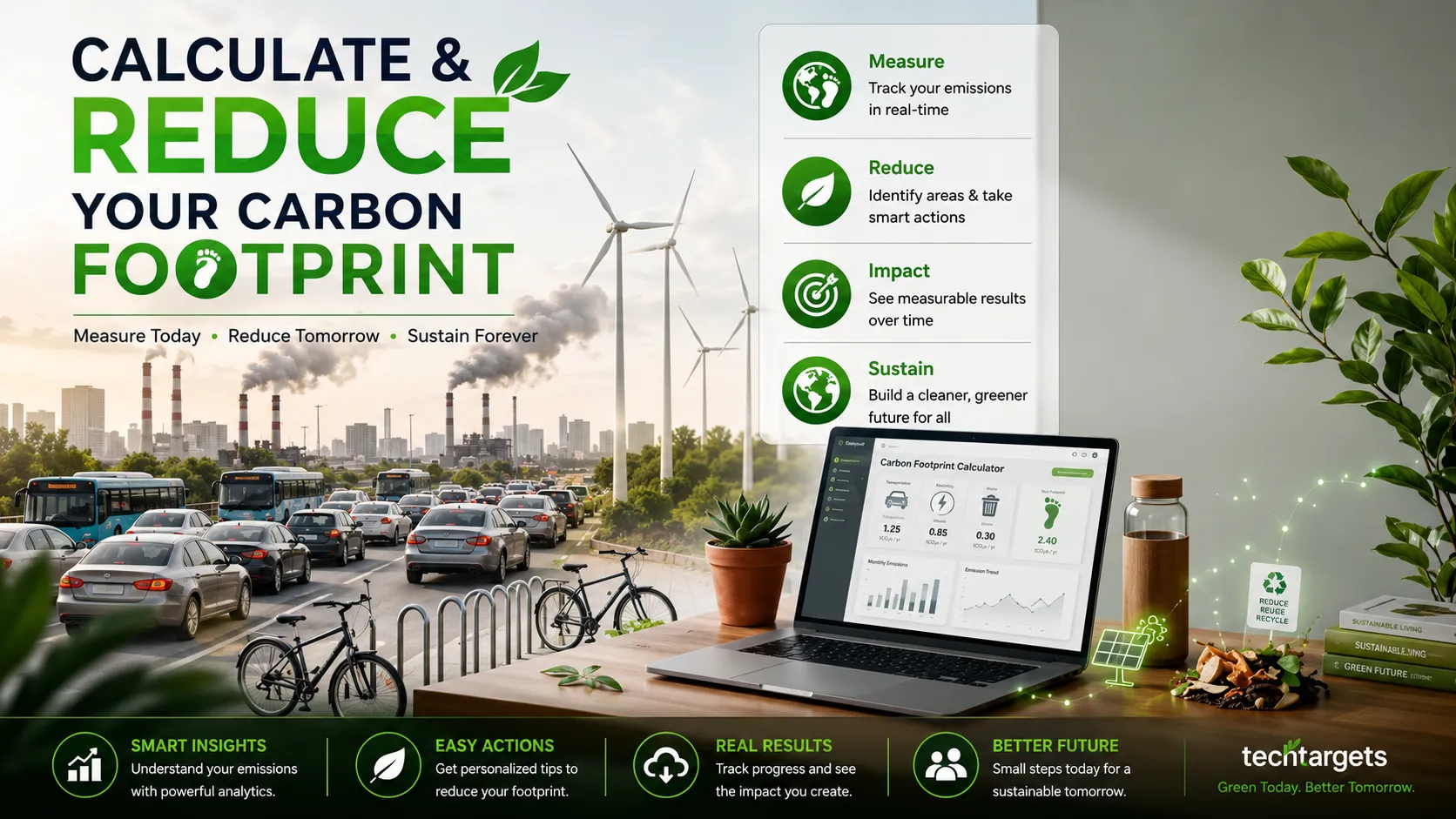
How to Calculate Your Carbon Footprint and Reduce It in 2026
Learn how to calculate your carbon footprint, identify the biggest sources of emissions, and take practical steps that actually reduce your environmental impact in daily life.
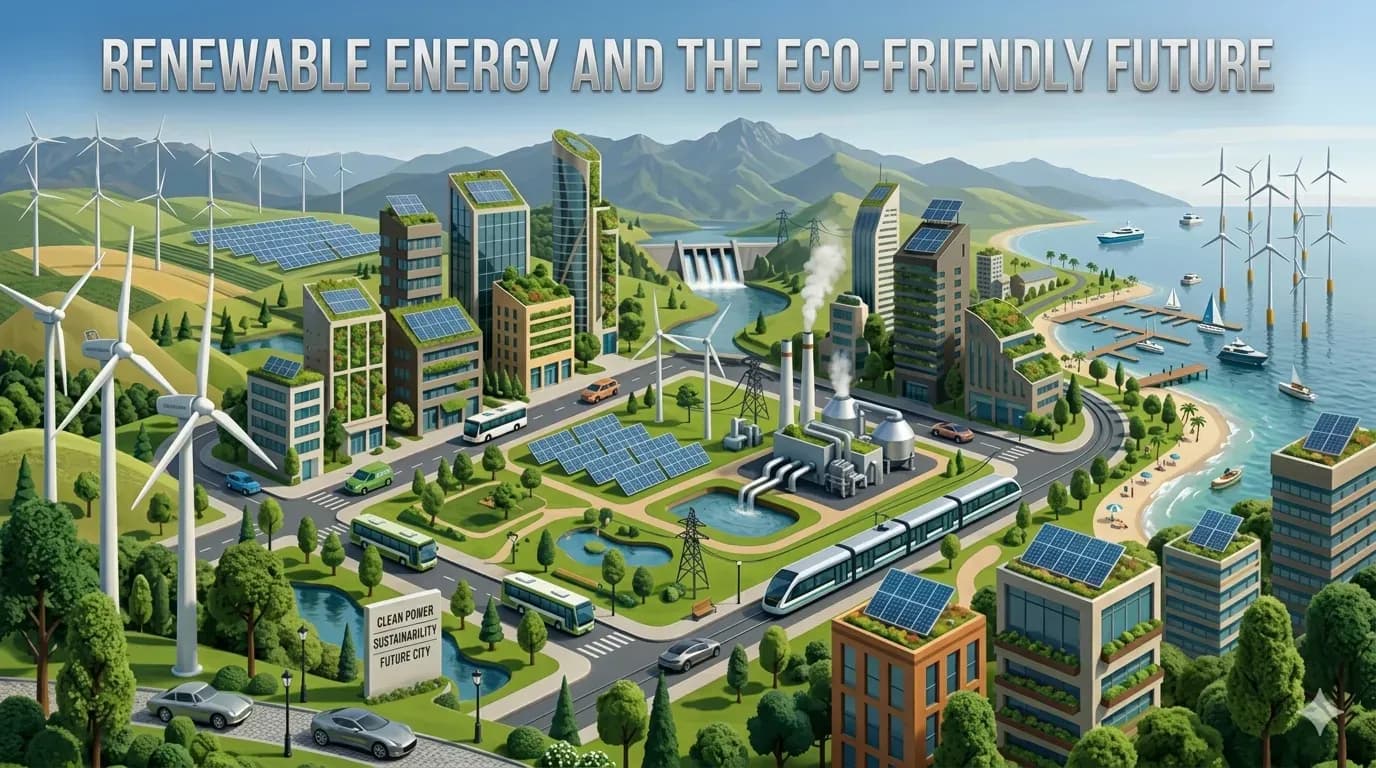
Renewable Energy and the Eco-Friendly Future
Discover how renewable energy is powering an eco-friendly future through solar, wind, and clean technologies that reduce emissions and create a more sustainable world.