
Eco-Friendly Plastic Alternatives and Sustainable Plastic Solutions That Actually Work
Explore eco-friendly plastic alternatives and sustainable solutions that reduce waste, improve sustainability, and help businesses move beyond traditional plastics.
Plastic is everywhere in your coffee cup, your grocery bag, the lining of your food cans, and even the synthetic fibers of your favorite hoodie. The problem isn't just that it's overused. The real problem is that most of it never truly disappears. If you're searching for real, practical plastic alternatives and sustainable plastic solutions that reduce your environmental footprint without sacrificing everyday convenience, this comprehensive guide breaks it all down from the science behind plastic pollution to the materials replacing it right now.
Why Plastic Pollution Has Become a Global Emergency
Every year, the world produces over 400 million metric tons of plastic, according to the United Nations Environment Programme. Of that staggering volume, less than 10% ever gets recycled. The remaining 90% ends up in landfills, incinerators, rivers, and oceans, where it slowly breaks apart into microplastics that infiltrate our food chain, drinking water, soil, and even the human bloodstream.
Researchers have now detected microplastics in human lungs, placentas, and breast milk. This isn't a distant environmental threat anymore. It's a present-day public health crisis.
Single-use plastics sit at the center of this crisis. Straws, packaging film, plastic bags, disposable cutlery, and water bottles, each used for a matter of minutes, persist in the environment for 200 to 500 years. A plastic straw you used at lunch today will likely outlive your grandchildren.
The economic cost is also massive. According to the Ellen MacArthur Foundation, plastic packaging alone costs the global economy $80–$120 billion annually in lost material value after a single use. The fishing industry, tourism sector, and coastal communities bear billions more in damage from ocean plastic every year.
Understanding the depth of this problem is the essential first step. But knowing what replaces plastic effectively and how to make that shift in your own life and business is where real change begins.
The Most Effective Eco-Friendly Plastic Alternatives Available Today
Not every alternative material works in every situation. The best eco-friendly plastic alternatives depend on the product, use case, and disposal infrastructure available in your region. Here's a thorough breakdown of the leading options across different categories.
Bioplastics and Plant-Based Materials
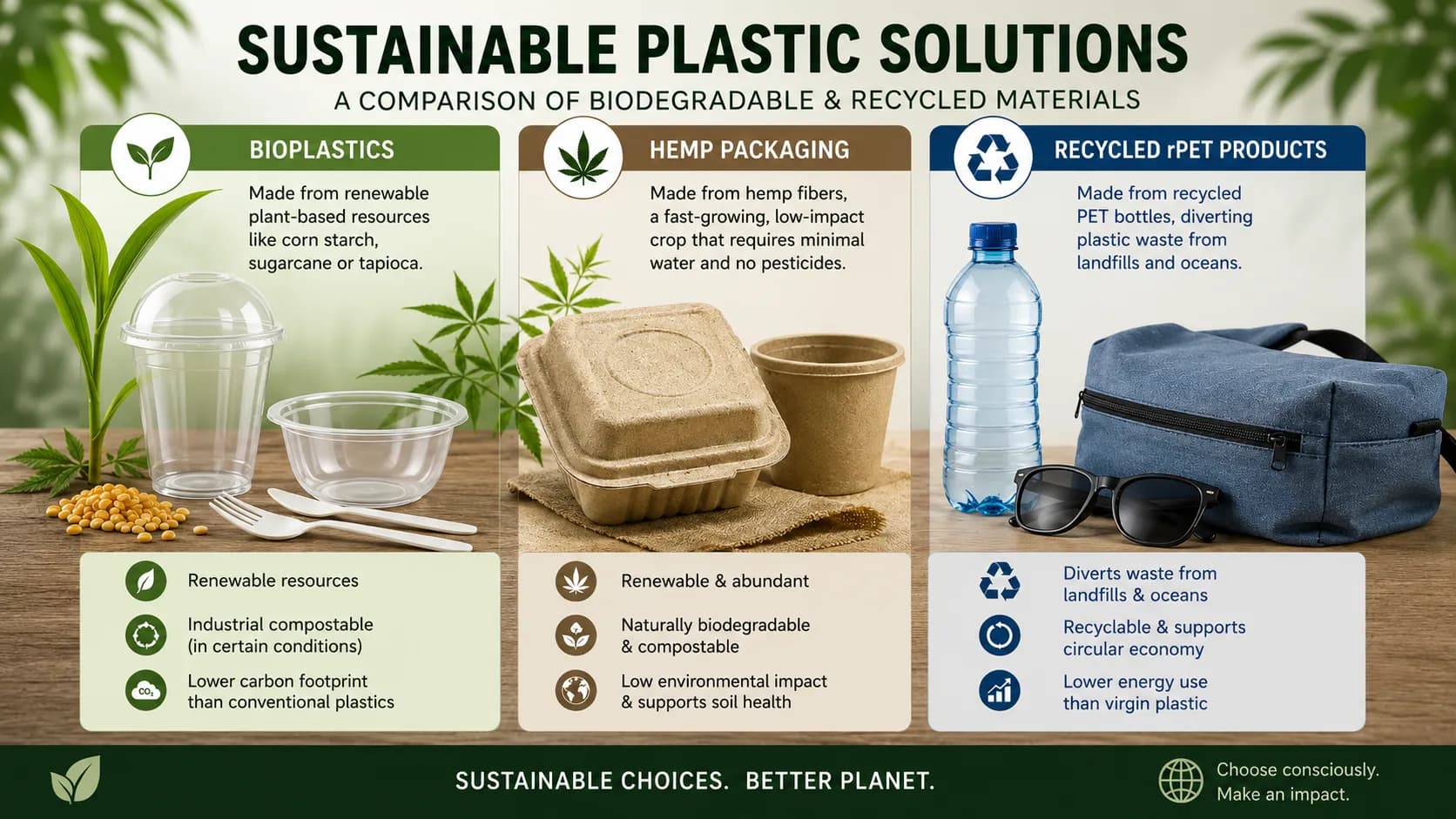
Bioplastics are manufactured from renewable biological sources, such as corn starch, sugarcane, cassava root, potato starch, or algae, rather than petroleum. The most widely used bioplastic is Polylactic Acid (PLA), which you'll find in compostable coffee cups, food containers, cutlery, and 3D printing filaments.
PLA performs comparably to conventional plastic in many applications. It's clear, rigid, and food-safe. However, the critical caveat is that most brands don't advertise clearly enough: PLA only breaks down properly in industrial composting facilities that maintain temperatures above 140°F (60°C) for sustained periods. In a home compost bin, landfill, or ocean, it behaves almost identically to regular plastic.
This doesn't make bioplastics useless. It makes consumer education essential. If your city has industrial composting pickup, use PLA products and compost them correctly. If it doesn't, choose a different alternative for that application.
On the cutting edge, algae-based packaging is showing remarkable promise. Companies like Notpla, based in London, have developed seaweed-derived coatings and edible packaging that dissolve in water within four to six weeks with zero toxic residue. Their technology has already replaced plastic sachets at major marathon events and UK sporting venues. This is one of the most exciting biodegradable plastic alternatives in active commercial use right now.
Bamboo: The Fast-Growing Replacement
Bamboo is one of nature's most renewable resources. It grows up to three feet per day in its native environment, requires no pesticides, minimal water, and naturally regenerates from its root system without replanting. It also sequesters carbon at a higher rate than most tree species.
These properties make bamboo an outstanding raw material for replacing plastic across dozens of product categories. Today, you'll find bamboo replacing plastic successfully in toothbrushes, kitchen utensils, cutting boards, straws, food containers, phone cases, clothing fibers, and even construction materials.
Its natural antimicrobial properties make it particularly practical for kitchen and personal hygiene products in areas where plastic alternatives need to meet high cleanliness standards.
The main trade-off is cost. Bamboo products typically run 20–40% more expensive than conventional plastic equivalents. However, increased consumer demand has pushed prices down considerably over the past five years, and that trend continues. Additionally, a quality bamboo product often outlasts its cheaper plastic counterpart, making the long-term cost comparison far more favorable.
One important nuance: bamboo fabric (like bamboo viscose used in clothing) sometimes involves chemical processing that offsets its environmental benefit. Look for brands with transparent supply chains and certifications like OEKO-TEX or FSC.
Glass and Stainless Steel: The Timeless Classics
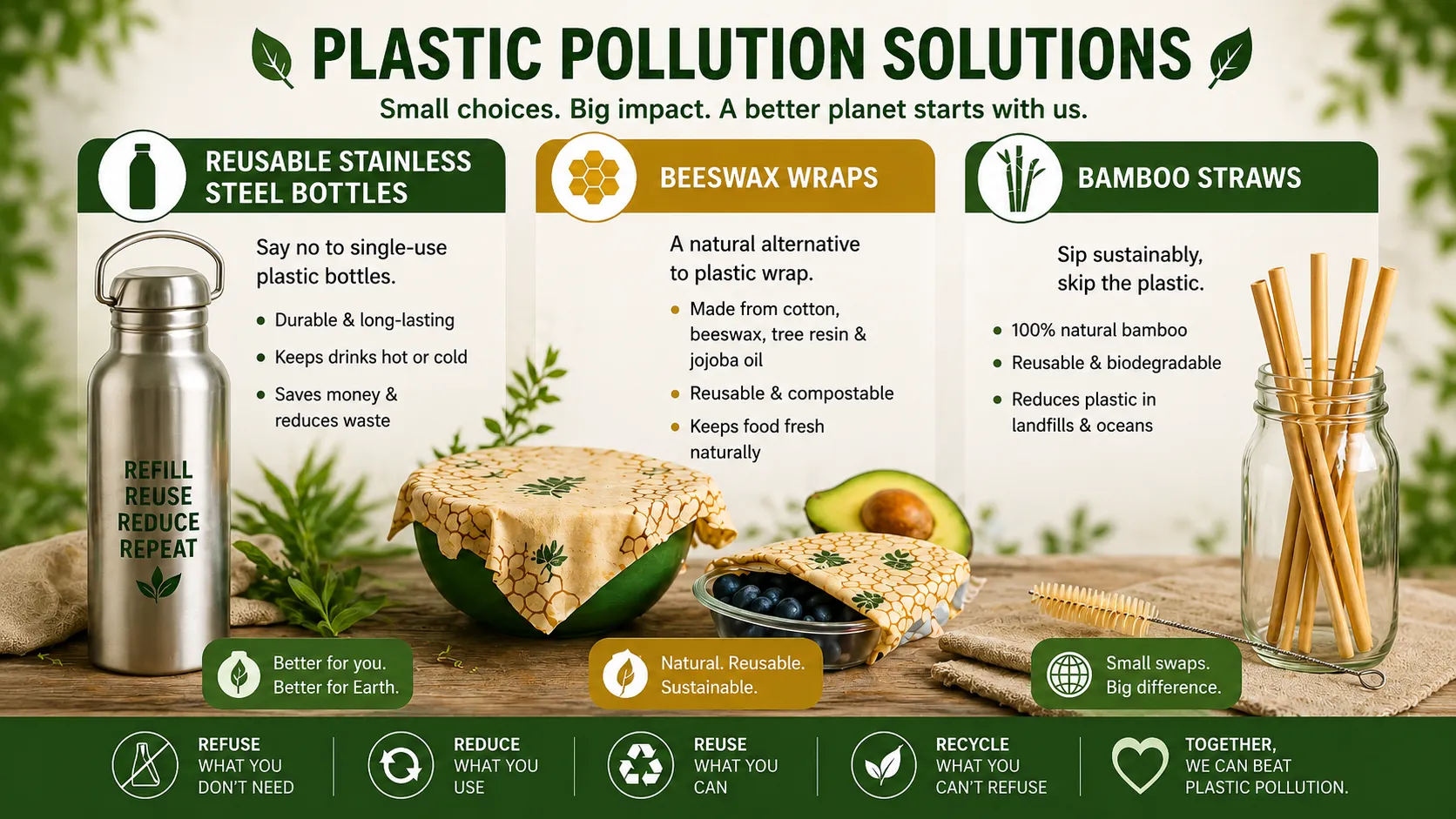
Glass and stainless steel aren't glamorous innovations, but they remain two of the most powerful sustainable plastic solutions available to individuals today. The reason is simple: both materials are infinitely recyclable without any loss of quality or purity, something plastic fundamentally cannot claim.
Every time plastic is recycled, its polymer chains degrade slightly. Most plastics can only be recycled two or three times before its becomes unusable. Glass and stainless steel can cycle through the system endlessly, maintaining full material integrity each time.
For food storage, beverages, personal care products, and kitchen organization, switching to glass or stainless steel delivers immediate, measurable impact. A high-quality stainless steel water bottle, used daily, replaces an estimated 156 single-use plastic bottles per year. Over a five-year lifespan, that's nearly 800 bottles kept out of circulation.
Glass does carry drawbacks, weight and fragility being the main ones. For home use and routine commutes, these are minor inconveniences. For travel or outdoor activities, stainless steel is the stronger choice.
Recycled and Upcycled Materials
Using what already exists is just as powerful and sometimes more scalable than inventing new materials. Recycled plastic, particularly rPET (recycled polyethylene terephthalate), keeps valuable material in active circulation rather than sending it to landfill or incineration.
The circular economy model treats plastic not as waste but as a resource. Brands like Patagonia, Adidas, and Girlfriend Collective have built entire product lines using ocean-recovered and post-consumer recycled plastic. A single Patagonia fleece jacket incorporates approximately 60 recycled plastic bottles. That's 60 bottles diverted from landfill and transformed into a functional, durable product.
Upcycling goes one creative step further, transforming plastic waste into entirely new product categories. Companies now produce outdoor furniture, building tiles, children's playground equipment, and decorative art from recovered plastic. Some startups even convert ocean plastic into luxury eyewear frames. The material doesn't disappear, but its value is dramatically extended.
Hemp, Cork, and Natural Fiber Composites
Hemp is one of the most underutilized sustainable materials on earth. It grows quickly, improves soil health, requires no herbicides, and produces strong, versatile fibers. Hemp composites are now being used in automotive panels, packaging, and consumer products as direct plastic replacements.
Cork, harvested from the bark of cork oak trees without cutting them down, is another outstanding natural alternative. It's lightweight, waterproof, naturally antimicrobial, and fully biodegradable. Cork works particularly well as an alternative to plastic in flooring, insulation, bottle stoppers, and fashion accessories.
Natural fiber composite materials that combine plant fibers like flax, jute, or kenaf with biodegradable resins are entering the automotive, aerospace, and consumer goods sectors. These materials match or exceed the performance of fiberglass in many structural applications while being significantly lighter and fully compostable at the end of life.
How Businesses Are Driving Sustainable Plastic Solutions at Scale
Individual consumer choices matter, but systemic business-level change creates the most significant and fastest impact. Forward-thinking companies are redesigning supply chains, product lines, and business models around plastic waste management and sustainable packaging, not purely from altruism, but because sustainability has become a core market demand.
Packaging Redesign and Innovation
Major consumer goods companies are fundamentally rethinking packaging. Unilever has committed to making 100% of its plastic packaging reusable, recyclable, or compostable. Nestlé invested over $2 billion into sustainable packaging R&D. These aren't symbolic gestures; they represent a structural industry transition driven by regulatory pressure, investor scrutiny, and consumer expectation.
Mushroom-based packaging mycelium composites developed by companies like Ecovative Design are among the most innovative developments in this space. By growing packaging material from agricultural byproducts and mushroom root networks in custom molds, Ecovative produces rigid, protective packaging that fully composts in home conditions within 30 days. IKEA and Dell have both piloted this material as a replacement for expanded polystyrene foam.
Paper-based alternatives coated with water-resistant natural treatments instead of plastic laminates are also making strong commercial inroads for food and beverage packaging.
Refill and Reuse Systems
Zero-waste stores and corporate refill programs are expanding rapidly across Europe, North America, and parts of Asia. The core model is simple: customers bring their own containers, refill them with household products, detergent, shampoo, conditioner, and cleaning spray, and pay only for the product content, not the packaging.
Loop Industries pioneered an industrial version of this concept, partnering with major retailers such as Carrefour and Kroger to offer premium-branded products in durable, returnable containers that the company sterilizes and refills. This model reduces packaging waste by up to 70% compared to conventional single-use retail.
For businesses considering this shift, the return on investment improves significantly at scale. Initial infrastructure costs are offset by reduced packaging spend, improved brand perception, and growing regulatory compliance benefits.
Extended Producer Responsibility and Policy Frameworks
Legislation is accelerating the corporate transition to sustainable materials faster than any voluntary initiative could. The European Union's Single-Use Plastics Directive bans ten of the most frequently found plastic items on European beaches, including plates, cutlery, straws, balloon sticks, and cotton bud stems. Manufacturers must now fund the cleanup of products they still produce.
Extended Producer Responsibility (EPR) laws place financial accountability for product end-of-life directly on manufacturers. Under EPR frameworks, companies that produce hard-to-recycle packaging pay into funds that finance recycling infrastructure, cleanup operations, and consumer education programs. This fundamentally changes the economics of packaging design; suddenly, recyclability has a direct dollar value.
Canada banned single-use plastics nationwide in 2022. India banned 19 categories of single-use plastic in the same year. Rwanda remains a global benchmark, banning plastic bags entirely back in 2008, with strict enforcement that has genuinely transformed the country's waste landscape.
Practical Plastic Waste Management Strategies for Everyday Life
Systemic change matters most, but personal action builds the awareness, habits, and market demand that enable systemic change. These strategies work in real life, not just in theory.
Start with the five highest-impact swaps: Replace single-use plastic bags with sturdy reusable totes, swap plastic wrap for beeswax wraps or silicone lids, ditch plastic straws for stainless steel or bamboo versions, switch to a bamboo toothbrush, and invest in a quality reusable water bottle. These five changes alone eliminate hundreds of plastic items from your household waste stream every year.
Learn your local recycling rules, specifically: Recycling contamination is one of the most underappreciated problems in plastic waste management. In many US cities, contamination rates exceed 25%, causing entire loads to be rejected and sent to landfill. Spend 10 minutes on your local waste authority's website to learn exactly what they accept. That knowledge makes your recycling actually effective rather than performative.
Audit your plastic use for one week: Keep a simple daily count of every single-use plastic item you touch, packaging, bags, utensils, bottles, and wrappers. Most people who complete this exercise are genuinely shocked by their total. Awareness is the non-negotiable starting point for lasting behavioral change.
Choose businesses that invest in sustainable packaging: Every purchase is a vote. When you consistently choose brands using eco-friendly materials and sustainable packaging, you send a direct, quantifiable market signal. Enough of those signals aggregated across millions of consumers reshape what companies produce.
Participate in local cleanup and advocacy: Joining a local beach, park, or river cleanup contributes directly to plastic waste management in your community. Contacting local representatives about plastic legislation amplifies your individual impact to a systemic level. Both actions matter.
Conclusion
Plastic pollution is one of the defining environmental challenges of our generation, but it is not an unsolvable one. Eco-friendly plastic alternatives already exist across virtually every product category. Sustainable plastic solutions are scaling from niche experiments into mainstream commercial reality. Governments are legislating. Businesses are redesigning. And millions of individuals are making smarter, more deliberate choices every day.
The transition away from single-use plastic requires coordinated action at every level. Individuals are making consistent swaps. Businesses are rebuilding supply chains around circular principles. Policymakers are setting ambitious standards and holding producers accountable. None of these levers works in isolation, but together they create compounding, unstoppable progress.
Your next step doesn't need to be dramatic. Pick one swap this week: a reusable bag, a bamboo toothbrush, or a glass food container instead of plastic wrap. Do another swap next week. Then another. Small, consistent decisions compound into meaningful, lasting change.
The world doesn't need a small group of people living in perfect sustainability. It needs hundreds of millions of people making imperfect but genuine progress consistently, and starting now.
Frequently Asked Questions
Q: What is the single best eco-friendly alternative to plastic packaging?
There's no universal answer; it depends on the application. For food storage, glass or certified compostable PLA works well. For beverages, stainless steel is the most durable and infinitely recyclable option. For protective shipping packaging, mycelium composites are an outstanding choice.
Q: Are bioplastics genuinely better for the environment?
Often yes, but context matters significantly. Bioplastics made from renewable sources reduce fossil fuel dependence and can lower carbon emissions in production. However, most bioplastics require industrial composting to break down; in landfills, they can behave nearly identically to conventional plastic. Always check disposal requirements before purchasing.
Q: Is bamboo actually a sustainable material?
Generally, yes. Bamboo grows rapidly, requires minimal resources, and sequesters carbon effectively. However, bamboo fabric (viscose) sometimes involves chemical processing that reduces its environmental benefit. Look for products with OEKO-TEX or FSC certification and transparent supply chains.
Q: How long does conventional plastic take to decompose?
Most conventional plastics take between 200 and 500 years to fully decompose. Even then, they fragment into microplastics rather than disappearing; these particles persist indefinitely in ecosystems and have now been detected in human blood, lungs, and breast milk.
Q: Can individual consumer choices really make a meaningful difference?
Yes, particularly when combined with collective action. Individual swaps reduce personal footprint and generate market demand for sustainable products. Supporting businesses with strong sustainability commitments and advocating for policy change multiplies individual impact to a systemic level. Neither individual nor collective action alone is sufficient; both are necessary.
Q: What is the circular economy, and how does it solve plastic pollution?
A circular economy keeps materials in productive use as long as possible through reuse, repair, remanufacturing, and recycling. Applied to plastic, it means designing products for recovery and reuse from the outset rather than accepting single-use disposal as the default. Brands like Patagonia and Loop Industries are actively building circular models at commercial scale.
Q: Which countries lead the world in addressing plastic pollution?
The European Union leads through comprehensive legislation like the Single-Use Plastics Directive and EPR frameworks. Rwanda pioneered a nationwide plastic bag ban in 2008 with effective enforcement. Canada and India both implemented broad single-use plastic bans in 2022. These examples demonstrate that decisive policy action produces rapid, measurable environmental results
Share this article
Related Articles
How to Calculate Your Carbon Footprint and Reduce It in 2026
Learn how to calculate your carbon footprint, identify the biggest sources of emissions, and take practical steps that actually reduce your environmental impact in daily life.
Renewable Energy and the Eco-Friendly Future
Discover how renewable energy is powering an eco-friendly future through solar, wind, and clean technologies that reduce emissions and create a more sustainable world.
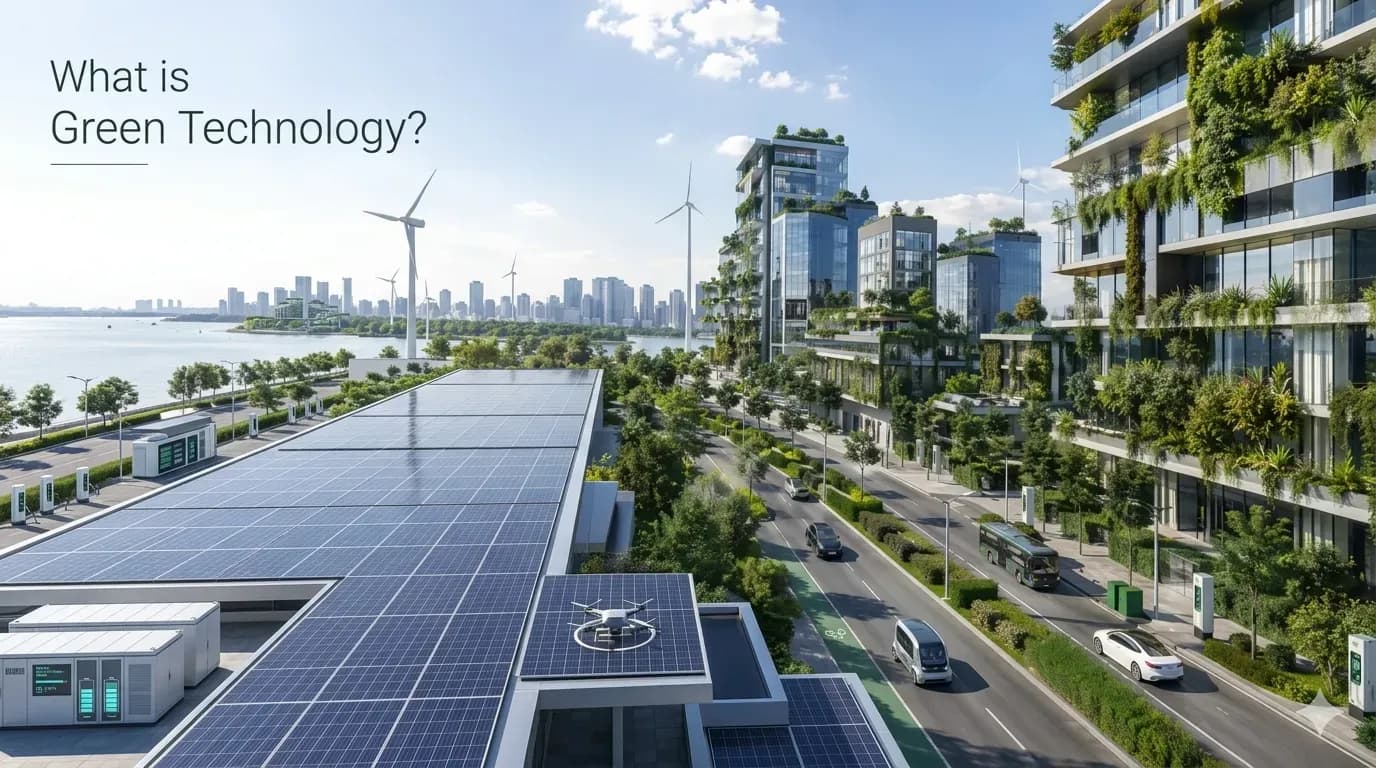
What is Green Technology? A Beginner's Guide to Clean Innovation and a Sustainable Future
Learn how green technology is creating a sustainable future through renewable energy, clean innovation, and eco-friendly solutions that reduce environmental impact.