How Long Does an Internship Interview Take?
Wondering how long an internship interview takes? Most internship interviews last 15–45 minutes, while technical and panel interviews may take longer. Learn what to expect, how long different interview formats take, when to expect a response, and how to prepare with confidence.
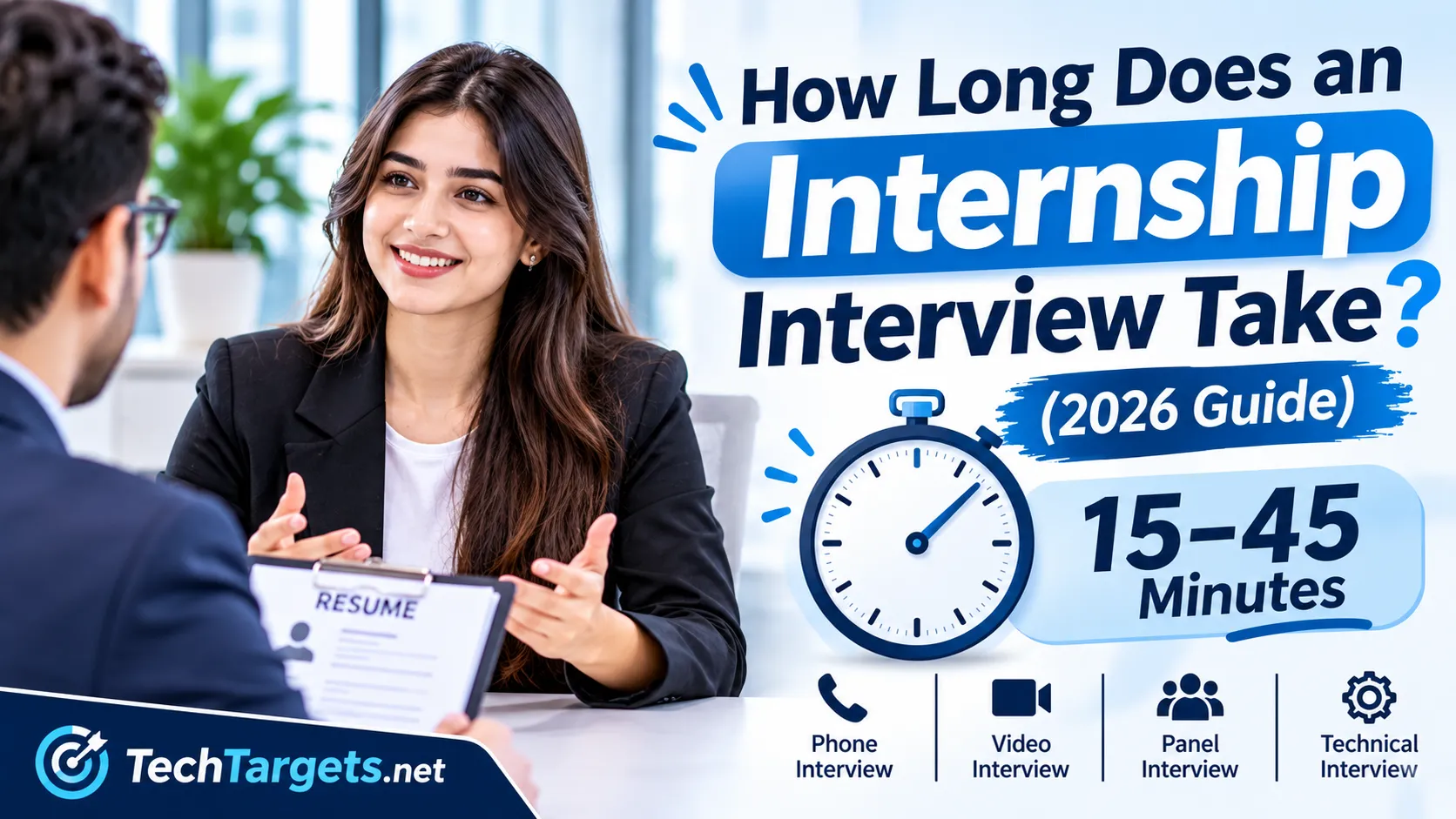
How long does an internship interview take? Most last between 15 and 45 minutes. A first-round screening sits at the short end, while technical interviews, panels, and final rounds can run an hour or longer. No universal standard exists, so your invitation email is the best guide to timing. This guide covers duration by format, what fills those minutes, how long employers take to reply, and when to follow up.
How we researched this: We compared the Magnet.me internship guide, Forage’s guides to interview length and internship length, MIT’s career office, and the follow-up pages of Pima Community College and Hobart and William Smith Colleges. Co-op length comes from Extern and summer-length discussion from NACE. Where no reliable figure exists, we say so instead of guessing.
How Long Does an Internship Interview Take?
Typically 15 to 45 minutes, depending on the round and format. Published guides differ slightly, which reflects how much practice varies between employers.
According to Magnet.me, a first internship interview often lasts 15 to 35 minutes, although the same guide also mentions an average of around 45 minutes. Forage quotes a former Meta university recruiter who says most interviews run 30 to 45 minutes. Together, these sources support a working range of roughly 15 to 45 minutes.
For example, a student applying for a marketing internship might get a 20-minute video call with a recruiter, then a 40-minute conversation with the hiring manager a week later. Both are normal, because each round has a different job to do.
Interview length is a weak signal about the result. Forage cautions that a 10-minute recruiter call does not automatically mean rejection, but suggests that a very short final-round or technical interview may be a worse sign. That is editorial guidance, not research, and we found no study linking length to outcomes.
Internship Interview Duration by Interview Type
Duration depends more on format and round than on the word “internship.” The table shows ranges reported in the sources we reviewed, with a note on how much weight each deserves.
Interview type | Typical range reported | Source |
|---|---|---|
Recruiter phone screen | 15 to 20 minutes, sometimes about 30 | Forage, quoting a former Meta recruiter |
First-round or screening interview | 15 to 35 minutes | Magnet.me guide |
General one-to-one interview | 30 to 45 minutes | Forage (recruiter quote) |
In-person interview | 30 to 60 minutes | Forage |
Technical interview | 60 minutes or longer | Forage |
Panel or multi-interviewer visit | Often an hour or more; one example is four 30-minute interviews over two hours | Forage |
Final round with a panel or case study | About 1 to 1.5 hours | Forage, quoting a former Meta recruiter |
Group interview or assessment centre | 45 minutes to half a day | Designbeep (lower authority) |
Forage’s figures describe job interviews in general rather than internships specifically, and Designbeep is a blog rather than a university source. Treat every range as typical, not guaranteed.
Phone Interviews
A phone screen is a short call, often with a recruiter, that checks your basics, availability, and interest before a longer round. Forage’s quoted recruiter puts these calls at 15 to 20 minutes, while Forage itself describes about 30 minutes as usual. Part of the slot may be left for your questions, so ask the recruiter how long to expect.
Video Interviews
Video interviews follow the same pattern as phone screens but often add a few minutes for technology checks. Magnet.me describes Enterprise Rent-A-Car starting with a video interview, followed by an on-site interview and assessment tests. In other words, video is often the first step, not the whole process.
In-Person Interviews
In-person interviews can run 30 to 60 minutes according to Forage, because the manager is judging how well you might perform, not just whether you qualify. The visit takes longer once you add travel, check-in, and waiting time. Some programmes stretch across two days: Magnet.me reports that PwC invites candidates to a breakfast presentation the day before the interview and adds a short case study challenge.
Technical Interviews
Forage notes that technical interviews can reach 60 minutes or longer, because candidates may need to draw or code something and then explain their choices. For software, data, or engineering internships, plan for at least an hour. Ask whether you will need a laptop, a shared editor, or a whiteboard.
Panel Interviews
A panel interview means two or more interviewers question you in one session, or you meet a team in several shorter back-to-back interviews. Forage gives an example of four 30-minute interviews spread over two hours, and notes that some visits include an office tour. Because you meet more people, plan for longer than a one-to-one conversation and confirm the schedule with the employer.
How Long Does an Internship Interview Take for Students and Freshers?
Students and freshers (applicants with little or no work experience) usually face the same 15 to 45 minute range as other candidates. What changes is the content: interviewers lean on coursework, projects, and motivation instead of work history.
Magnet.me notes that large graduate recruiters often run internship applications through the same process as their graduate programmes, so a fresher applying to a big company may meet several rounds. For more informal internships, a simple chat with a manager may be enough. Smaller organisations often work this way.
In campus recruiting, where an employer meets many students in one day, slots are often scheduled back-to-back. This is a general observation, not a sourced figure, so check your invitation for the exact slot.
For example, a fresher applying for a finance internship might have one 30-minute conversation about their degree and a spreadsheet project, followed by a short online test. Preparation matters more than length: a 20-minute interview rewards a clear, practised introduction.
What Happens During an Internship Interview?
Most interviews move from introductions to background questions, then to skills or assessments, and finish with your questions. MIT’s career office describes the same flow: greetings, a two-way discussion of your background, time for your questions, and next steps.
Introduction and Background
Expect a few minutes of greetings and a request to introduce yourself. Magnet.me suggests a pitch of about sixty seconds that links your achievements and your motivation. Practise it aloud so it stays under a minute.
Questions About Education and Skills
Interviewers then connect your studies to the role. A computer science applicant may be asked about projects and languages, while a business student may explain a group assignment. Choose examples with a clear result that you can describe in a minute or two.
Internship Interview Questions
Internship interview questions tend to fall into a few families. Motivation questions ask why you want this internship and this company. Experience questions ask about a project you are proud of, a deadline you managed, or a mistake you corrected. Learning questions ask how you would pick up an unfamiliar tool in your first week. Teamwork questions ask how you handle disagreement in a group, and forward-looking questions ask what you hope to learn by the end.
For behavioural questions, MIT points students to a guide on the STAR method. STAR structures an answer as situation, task, action, and result, which keeps stories short and specific.
Practical or Technical Assessments
Some employers add a task. Magnet.me reports that PwC uses a short case study to test problem-solving on the spot. Technical roles may involve coding or sketching a solution, as described above.
Candidate Questions and Closing
Interviews usually end with your questions. Magnet.me advises asking when you should expect to hear back, instead of asking whether you got the job. That one question gives you a timeline to plan around.
What Factors Affect Internship Interview Duration?
Round number, format, role type, employer size, and candidate volume all shift timing. Early rounds act as short filters, while later rounds go deeper.
Technical roles take longer because of exercises. Large employers tend to use structured, multi-stage processes, while small ones may need a single conversation. Magnet.me adds that the number of candidates being interviewed can change how much time the interviewer spends on each question.
Individual style matters too, as some interviewers move briskly and others chat. A manager with back-to-back meetings is also more likely to keep to the slot. [AUTHOR EXPERIENCE NOTE: add a real insight here]
How Long Does It Take for Internships to Get Back to You After an Interview?
There is no universal answer. Replies can arrive within days or take several weeks, and the employer’s own estimate is your best guide.
MIT’s career office says response times vary by company and industry, from days to weeks or even months. That line describes application review, but the same variation is a sensible expectation after interviews. Career centres do not publish a standard reply time, yet their follow-up advice shows what they consider a reasonable wait. Pima Community College suggests a polite email about one week after the interview when no timeline was given, and Hobart and William Smith Colleges suggest a check-in five business days after the interview, or one business day after the date the employer promised.
Hiring style also matters. With rolling hiring, an employer reviews and interviews applicants as they arrive and may fill places early. With deadline-based hiring, decisions often wait until the application window closes and all interviews finish. This is a general description, not a sourced timeline.
What Do Candidates Say on Reddit About Internship Interview Length?
Candidate experiences vary widely, so treat any single post as one data point.
We did not analyse Reddit threads for this guide, so we do not report specific posts or trends. Candidate forums generally show wide variation, which fits the ranges above. When you read a thread about how long to hear back after an internship interview, remember it describes one person, one company, and one hiring season. MIT suggests Glassdoor interview reviews, where candidates sometimes share timelines, and its alumni network as ways to learn about a specific company’s process.
Should You Follow Up After an Internship Interview?
Yes. Send a short thank-you email within 24 hours and, if the promised date passes in silence, one polite check-in.
Pima Community College and Hobart and William Smith Colleges both advise sending a thank-you email within 24 hours. Pima adds that you should mention something specific you discussed, so the note feels personal. If the employer gave a date, wait until after it passes before checking in.
Keep every message brief and polite. Hobart and William Smith Colleges suggest one check-in about five business days after the interview and, if there is still no reply, a second after another five business days. Pima suggests about one week for a first check-in. After that, keep applying elsewhere. Here is a sample check-in:
Subject: Checking in on the [role] internship interview
Dear [Name],
Thank you again for speaking with me on [date] about the [role] internship. I enjoyed learning about [specific topic] and remain very interested. Could you share an update on your decision timeline?
Kind regards, [Your name]
[AUTHOR EXPERIENCE NOTE: add a real insight here]
How Long Is an Internship?
Most summer internships last 10 to 12 weeks, while academic-year internships run roughly 12 to 16 weeks.
Forage reports summer internships of about 10 to 12 weeks and academic-year internships closer to 12 to 16 weeks, with winter internships that may last closer to a month. NACE community discussions show no consensus on a standard summer length, though recruiters generally agreed that 10 to 12 weeks works better than shorter schedules. Co-ops are longer: Extern describes them as four to six months per rotation. If the length is unclear, Forage suggests asking the recruiter or raising it in the interview.
How to Prepare for an Internship Interview
Confirm the format and length when scheduling, research the employer, and rehearse a short introduction plus two or three stories.
Magnet.me recommends researching what the company does, what your role involves, and its culture, and bringing a copy of your resume. Prepare two or three STAR stories from coursework, projects, or part-time work. Write down two questions for the interviewer, including one about next steps.
For video interviews, test your camera, microphone, and connection the day before. For in-person interviews, plan your route and arrive early. If a technical task is likely, practise it under a timer, so a 60-minute session feels familiar.
Conclusion
Expect 15 to 45 minutes for most internship interviews, with technical, panel, and final rounds taking longer. Ask about length and next steps when you schedule, and send a thank-you within 24 hours. If the promised date passes, one polite check-in is reasonable. The best preparation is a clear introduction and a few specific stories.
Frequently Asked Questions
Is an internship interview shorter than a regular job interview?
Not necessarily. Magnet.me notes that large recruiters often use the same process for interns and graduates, and we found no reliable study comparing the two. Length depends on the employer’s process.
Does a short interview mean I did not get the job?
Not reliably. Forage cautions that a 10-minute recruiter call does not automatically mean rejection, though it suggests a very short final-round interview may be a worse sign. That is editorial guidance, and we found no study linking length to results.
Can an internship interview include a test or case study?
Yes. Employers such as PwC, as reported by Magnet.me, use case studies, and technical roles may include coding or design tasks.
What should I ask about timing at the end of the interview?
Ask when you should expect to hear back. Write down the answer and use it to decide when to follow up.
Is it okay to follow up more than once?
One thank-you and one polite check-in is the safest pattern. Hobart and William Smith Colleges allow a second reminder after another five business days, but each message should stay short.
Should I keep applying while I wait?
Yes. Pima Community College and Hobart and William Smith Colleges both advise continuing to apply until you have accepted a written offer, because a hiring process can stall for reasons outside your control.
How many interview rounds does an internship have?
It varies by employer. Magnet.me gives examples ranging from Accenture, which runs an HR interview followed by a business interview, to Enterprise Rent-A-Car, which uses a video interview, an on-site interview, and assessment tests. Smaller organisations may hold only one conversation, so ask the recruiter how many stages to expect.
Who will interview me for an internship?
Usually a recruiter or HR specialist in the early rounds, then a hiring manager or future teammates later. MIT’s career office lists the hiring manager, an HR specialist, and prospective colleagues as people candidates may meet across rounds. Ask for interviewer names beforehand so you can address your thank-you emails correctly.
How early should I arrive or join the call?
Magnet.me lists being prompt as a basic rule. We found no standard lead time, so arriving a few minutes early for an in-person interview and logging in a few minutes before a video call to check your setup, is a sensible habit rather than a required standard.
What should I wear to an internship interview?
Match the industry. Magnet.me suggests classic, conservative outfits for finance, law, and public-sector roles, and says creative or tech employers may allow trendier clothes. When unsure, choose the smarter option.
Can I ask for feedback if I am not selected?
Yes, politely. Magnet.me recommends contacting the interviewer after a rejection to ask for constructive feedback, which can help your next application and leave a good impression.
Share this article
Related Articles
Best Productivity Books to Boost Focus & Get More Done
Struggling to stay focused, beat procrastination, or manage your time? Discover the 10 best productivity books in 2026 that offer proven strategies to build better habits, improve concentration, and help you get more done with less stress.
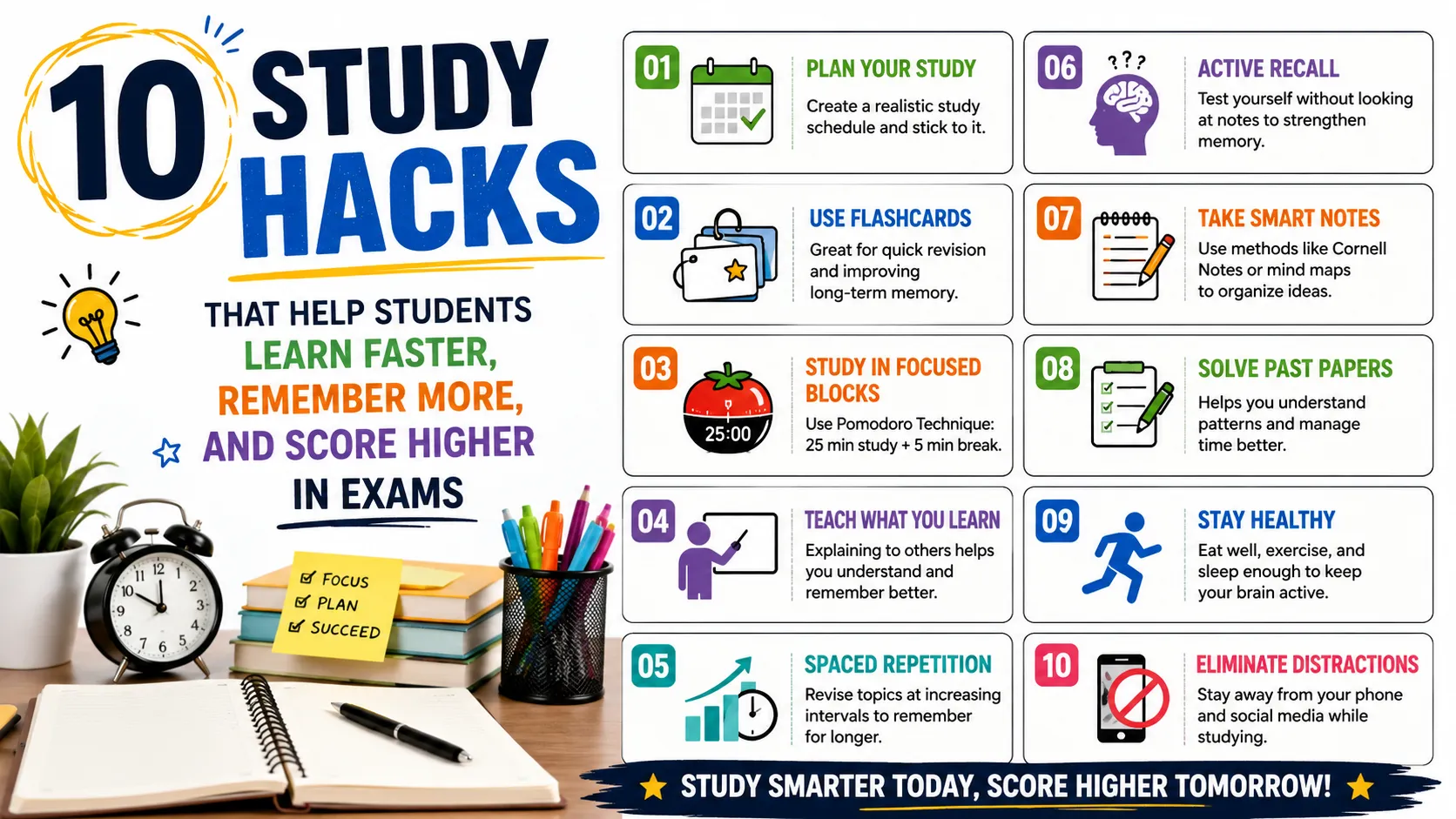
10 Study Hacks That Help Students Learn Faster, Remember More, and Score Higher in 2026
Learn 10 science-backed study hacks that help students study smarter, retain information longer, stay focused, and perform better in exams.

How Ed-Tech Uses Gamification to Boost Learning
Research confirms that gamification works. Students in gamified environments show 14% higher long-term knowledge retention, and gamified online courses achieve 30–40% better completion rates than non-gamified equivalents. Meanwhile, 89% of students say they would spend more time learning if tools felt more like games a number that explains why every major ed-tech platform from Duolingo to Khan Academy has gamification at its core.