Top 20 Fintech Companies in the USA Leading Financial Innovation
Explore the top 20 fintech companies in the USA for 2026, their categories, market impact, products, and what makes them industry leaders.
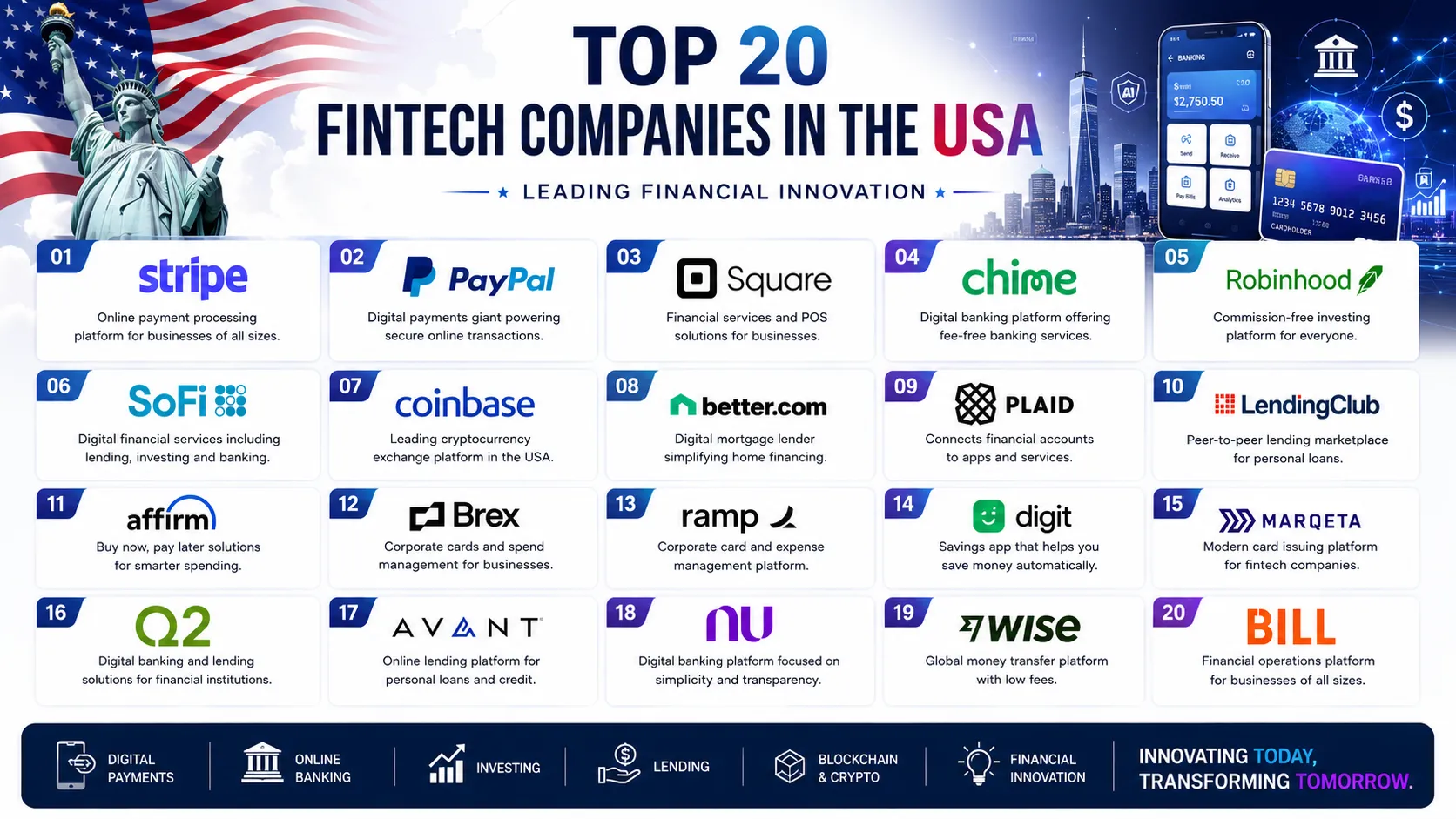
The United States is home to the deepest and most competitive fintech market in the world, and the top 20 fintech companies in the USA market right now are the ones setting the pace for everyone else, from how people bank on their phones to how businesses move money across borders. If you have searched for the top fintech companies USA or tried to compare the largest fintech companies in the US against global names, you have probably noticed that most lists repeat the same five or six brands and stop there. This guide goes further. It groups companies by what they actually do, explains the criteria that separate a real market leader from a well-funded startup, and gives you a practical framework for judging any fintech company on your own, whether you are a consumer, an investor, or a founder scoping the competitive landscape.
What Makes a Fintech Company a Market Leader in 2026?
Ranking fintech companies by funding alone is a mistake, because a large funding round tells you about investor appetite, not about whether the product actually works at scale. If you are new to the space, it helps to start with a plain-language look at what fintech companies actually are and how they work before comparing individual brands. After reviewing product filings, app store data, and public financial disclosures across dozens of companies, four signals consistently separate genuine leaders from companies riding a hype cycle:
Regulatory standing: A company holding an actual bank charter, money transmitter licenses in most states, or a broker-dealer registration has cleared a much higher bar than one operating purely through a partner bank. Identity checks are part of this bar too, which is why most regulated fintechs lean on established KYC identity verification providers to onboard customers compliantly.
Distribution, not just downloads: App installs are cheap to buy through ads. What matters is retained, funded accounts, meaning users who actually deposit money and keep using the product month after month.
Infrastructure dependency: Some of the most powerful fintech companies in the US are invisible to consumers because they sit behind other fintechs, for example, Plaid connecting bank accounts or Marqeta issuing cards. Leadership in infrastructure is measured by how many other companies depend on you.
Profitability path: In a higher interest rate environment, cheap growth is no longer rewarded. Companies that show a credible route to profit, or are already profitable, are the ones still standing after the market corrects.
How This List Was Built
This list was compiled by cross-referencing company disclosures, funding databases, app ranking data, and coverage from financial trade publications such as Forbes' annual Fintech 50, then filtering for companies that are headquartered or primarily operate in the United States. Companies are grouped by the category they compete in rather than ranked strictly by valuation, because a $2 billion payments processor and a $2 billion consumer banking app are not solving the same problem and should not be judged on the same scale. Where a company spans multiple categories, it is listed under the one that drives most of its revenue.
The Top 20 Fintech Companies in the USA
Here is the full list at a glance, followed by a closer look at each category. Every company below is headquartered in the United States and has a verifiable, operating product, not just a pitch deck.
# | Company | Category | Known For |
|---|---|---|---|
1 | PayPal | Digital Payments | Founding online payments network; PayPal, Venmo checkout at 30M+ merchants |
2 | Block (Square + Cash App) | Payments / Consumer Finance | Point-of-sale hardware for small businesses plus Cash App peer-to-peer transfers |
3 | Stripe | Payments Infrastructure | API-first payment processing that powers checkout for millions of internet businesses |
4 | Chime | Neobanking | Fee-free mobile banking with early paycheck access, no minimum balance |
5 | SoFi | Digital Banking / Lending | Student loan refinancing that expanded into a full-service online bank |
6 | Robinhood | Investing / Trading | Commission-free stock and crypto trading that reshaped retail investing |
7 | Coinbase | Cryptocurrency | Largest U.S.-based, publicly traded cryptocurrency exchange |
8 | Plaid | Financial Data Infrastructure | Connects bank accounts to apps; the plumbing behind thousands of fintech products |
9 | Affirm | Buy Now, Pay Later | Point-of-sale installment loans embedded at checkout with retailers |
10 | Marqeta | Card Issuing Infrastructure | Cloud card-issuing platform behind Cash App, DoorDash, and Instacart cards |
11 | Brex | Corporate Cards / Spend Management | Corporate credit cards and expense software built for startups and scale-ups |
12 | Ramp | Spend Management | Corporate cards paired with automated expense controls and bill pay |
13 | Mercury | Business Banking | Startup-focused banking with treasury and API banking tools |
14 | Wealthfront | Wealthtech / Robo-Advisory | Automated investing and tax-loss harvesting for long-term investors |
15 | Betterment | Wealthtech / Robo-Advisory | One of the original robo-advisors; goal-based automated portfolios |
16 | Varo Bank | Neobanking | First U.S. neobank to receive a national bank charter |
17 | Intuit | Financial Software | TurboTax, QuickBooks, Credit Karma, and Mailchimp under one roof |
18 | Fiserv | Core Banking Infrastructure | Core processing and the Clover point-of-sale system for banks and merchants |
19 | FIS (Fidelity National Information Services) | Core Banking Infrastructure | Enterprise banking, capital markets, and merchant technology at global scale |
20 | Circle | Stablecoin Infrastructure | Issuer of USDC, one of the most widely used regulated stablecoins |
Fintech Categories Explained: The Topical Map
Search intent around fintech usually falls into a handful of clusters. Understanding these clusters helps you compare companies against the right peer group instead of against the whole market.
Payments and Payment Processing
This is the largest and most mature category. PayPal, Block, and Stripe move money between buyers and sellers, either online or at the point of sale. The mistake most comparisons make is treating these three as direct competitors when their business models differ sharply: PayPal and Block own the consumer relationship, while Stripe mostly sells infrastructure to other businesses and rarely touches the end customer.
Neobanking and Digital-First Banking
Chime, SoFi, and Varo Bank replace or supplement a traditional bank account with a mobile-first experience. The practical difference to check before choosing one: does the company hold its own bank charter, like Varo, or does it rely on a partner bank, as Chime does with The Bancorp Bank and Stride Bank? A partner-bank model is not necessarily worse, but it changes who you are actually trusting with your deposits.
Investing and Wealthtech
Robinhood, Wealthfront, and Betterment automate or simplify investing. Robinhood focuses on active trading and now crypto, while Wealthfront and Betterment focus on hands-off, goal-based portfolios. If you are comparing these for personal use, the deciding factor is usually not the app itself but the fee structure: flat advisory fees versus payment-for-order-flow revenue models produce very different incentives.
Lending and Buy Now, Pay Later
SoFi and Affirm represent two different lending philosophies. SoFi underwrites larger, longer-term loans like student refinancing and mortgages. Affirm focuses on short-term, point-of-sale installment credit. A mistake shoppers make with BNPL is assuming it is free money with no credit impact; the Consumer Financial Protection Bureau has flagged BNPL credit reporting as an area under active regulatory review, and an increasing number of providers now furnish loan activity to credit bureaus, which changes how BNPL use can affect a credit score.
B2B Spend Management and Business Banking
Brex, Ramp, and Mercury built products for startups that traditional business banks were slow to serve, particularly fast account opening and real-time spend controls. Ramp built its growth around automated expense categorization and savings insights, while Brex leaned into credit limits based on cash balance rather than personal credit history.
Financial Infrastructure and APIs
Plaid, Marqeta, Fiserv, and FIS rarely appear in consumer headlines, but they are arguably the most systemically important companies on this list. If Plaid has an outage, dozens of budgeting apps and neobanks stop working. This is the category to watch if you care about resilience risk in the fintech ecosystem, not just growth. It is also the layer where fraud gets caught before money moves, which is why transaction monitoring software built for AML and fraud prevention sits quietly behind so many of the brands on this list.
Crypto and Stablecoin Infrastructure
Coinbase and Circle anchor the regulated end of U.S. crypto. Coinbase is the consumer and institutional exchange; Circle issues USDC, a dollar-backed stablecoin used heavily in trading and cross-border settlement. Regulatory clarity in this category has moved faster than most other fintech segments, which is worth watching if you are evaluating long-term risk. Identity checks are stricter here too, and many exchanges now rely on face verification software during account opening to meet KYC requirements.
Financial Software and Tax
Intuit sits slightly apart from the rest of the list because its products, including TurboTax, QuickBooks, and Credit Karma, are less about moving money and more about managing and understanding it. It is included here because Credit Karma alone functions as a lending marketplace that influences how millions of Americans shop for credit.
Common Mistakes People Make When Comparing Fintech Companies
Having reviewed dozens of comparison requests, the same few errors show up again and again:
Confusing app store ratings with financial safety: A 4.8-star rating reflects user experience, not deposit insurance or regulatory standing.
Assuming FDIC insurance is automatic: Fintech apps are not banks. Deposits are usually insured only through pass-through coverage at a partner bank, and only if the fintech meets specific record-keeping conditions, according to the FDIC's own consumer guidance. Always confirm the named partner bank in the app's disclosures rather than assuming coverage.
Treating valuation as market share: Private valuations are negotiated between a company and its investors and can lag or lead actual usage by years.
Ignoring the business model behind 'free': Free trading, free banking, and free budgeting tools are usually monetized through interchange fees, payment-for-order-flow, or interest on customer deposits. Knowing the revenue model tells you what the company is actually optimizing for.
Comparing infrastructure companies to consumer apps: Stripe and Chime are both 'fintech,' but comparing their growth metrics side by side is comparing a wholesale supplier to a retail store.
A Practical Framework for Choosing a Fintech Company
Whether you are picking a banking app, evaluating a vendor, or researching the sector for investment, run through this checklist before making a decision:
Identify the category: Payments, banking, investing, lending, B2B spend, infrastructure, or crypto. This sets the right peer group for comparison.
Check the regulatory backing: Look up whether the company holds its own charter or license, or operates through a partner bank, and confirm current FDIC or SIPC coverage on the company's own disclosure page.
Read the fee and revenue model: Search the company's help center for 'how we make money.' If you cannot find a clear answer in two minutes, treat that as a red flag.
Check funding stage and profitability signals: A public company's 10-K filing or a well-funded private company's press coverage will usually disclose revenue growth and burn rate.
Test the actual product: Open a small account or a sandbox/demo environment before committing meaningful money or integrating an API into production.
Review support and dispute resolution: Fintech apps without phone support can turn a frozen account into a weeks-long problem. Before signing up, read how disputed transactions actually get resolved so you know what to expect if a charge ever needs to be challenged.
USA vs. Europe vs. the World: How the Fintech Map Compares
The United States leads the world in fintech by total funding raised and by the sheer number of unicorn-stage companies, largely because of its deep capital markets and a single large, English-speaking consumer market. But it is not the only fintech power center, and the leading players look different by region:
Europe: Wise, Revolut, Adyen, and Klarna lead the top fintech companies in Europe conversation, alongside challenger banks covered in this roundup of the best fintech companies in the UK. European fintechs have generally moved faster on open banking regulation, which pushed data-sharing standards years ahead of similar U.S. efforts.
Asia-Pacific: Ant Group and WeChat Pay dominate mobile payments in China at a scale unmatched anywhere else, built around super-app ecosystems rather than single-purpose apps.
Global infrastructure players: Companies like Stripe and Visa operate across all these regions simultaneously, which is why 'largest fintech companies in the world' lists often blend U.S. and international names depending on whether you are ranking by valuation, revenue, or user count.
If your search intent is really about the top fintech companies in the world or top fintech companies in Europe rather than the U.S. specifically, the categories above still apply. The difference is mostly regulatory: open banking mandates and instant-payment rails matured earlier in the UK and EU than in the U.S.
What About the Top 50 or Top 100 Fintech Companies?
Once you move past the top 20, the list stops being about household names and starts being about specialization. A realistic top 50 fintech companies in the USA list would add names like Klarna's U.S. competitors in BNPL, regional neobanks, insurtech players such as Lemonade, payroll-fintech hybrids like Gusto, and vertical banking platforms built for specific industries like real estate or freelancers. A top 100 fintech companies list stretches further still into RegTech, InsurTech, and embedded finance vendors that most consumers never interact with directly but that quietly power banking features inside non-financial apps.
The practical takeaway: the deeper you go past the top 20, the more the companies are B2B and infrastructure-focused rather than consumer brands. If you are researching for investment or competitive analysis, do not stop at recognizable names, because a lot of the real innovation in payments fraud detection, compliance automation, and embedded lending happens outside the top 20.
Conclusion
The top 20 fintech companies in the USA are not just a list of well-known apps. They represent seven distinct problems being solved in parallel: moving money, holding deposits, growing wealth, extending credit, managing business spend, powering other companies' products, and settling value on-chain. Use the categories and checklist above the next time you compare fintech companies, whether you are choosing a product for yourself, researching competitors, or scoping the wider market beyond the top 20 into the top 50 or top 100.
Frequently Asked Questions
Q: What is the largest fintech company in the USA by valuation?
Valuations shift with funding rounds and public market pricing, but Stripe, PayPal, and Block have consistently ranked among the highest-valued U.S. fintech companies in recent years, with Stripe holding one of the highest private valuations in the sector.
Q: Is Stripe considered a fintech company?
Yes. Stripe is a payments infrastructure company, meaning it builds the technology other businesses use to accept and move money, rather than serving consumers directly.
Q: What is the difference between a neobank and a traditional bank?
A neobank, like Chime or Varo, operates primarily through a mobile app with lower overhead and often no physical branches. Some neobanks hold their own bank charter, while others partner with a chartered bank to hold deposits and provide FDIC insurance.
Q: Are fintech apps safe to use?
Most major U.S. fintech apps are safe when they clearly disclose FDIC or SIPC coverage through a partner institution. Always verify this in the app's own terms rather than assuming it, since not every fintech product carries deposit insurance.
Q: How is this different from the top 50 or top 100 fintech lists?
This list focuses on the 20 companies with the broadest impact on how Americans bank, pay, invest, and borrow today. Broader lists include specialized B2B and infrastructure vendors that most consumers never see directly.
Share this article
Related Articles
10 Best AML Transaction Monitoring Software in 2026: Compare Top Platforms
Discover the best AML transaction monitoring software for 2026, with platform comparisons, pricing, features, and options for banks and accountants.

Top 10 Best Face Verification Software in 2026: The Complete Buyer's Guide
Discover the 10 best face verification software in 2026. Compare Jumio, iProov, FaceTec, Veriff, Incode, and more for secure identity verification.
Top 10 Best KYC Providers in the USA for 2026
Explore the 10 best fintech companies in the UK, including Revolut, Wise, Monzo, Starling Bank, and leading firms for banking, payments, and lending.