
10 Best AML Transaction Monitoring Software in 2026: Compare Top Platforms
Discover the best AML transaction monitoring software for 2026, with platform comparisons, pricing, features, and options for banks and accountants.
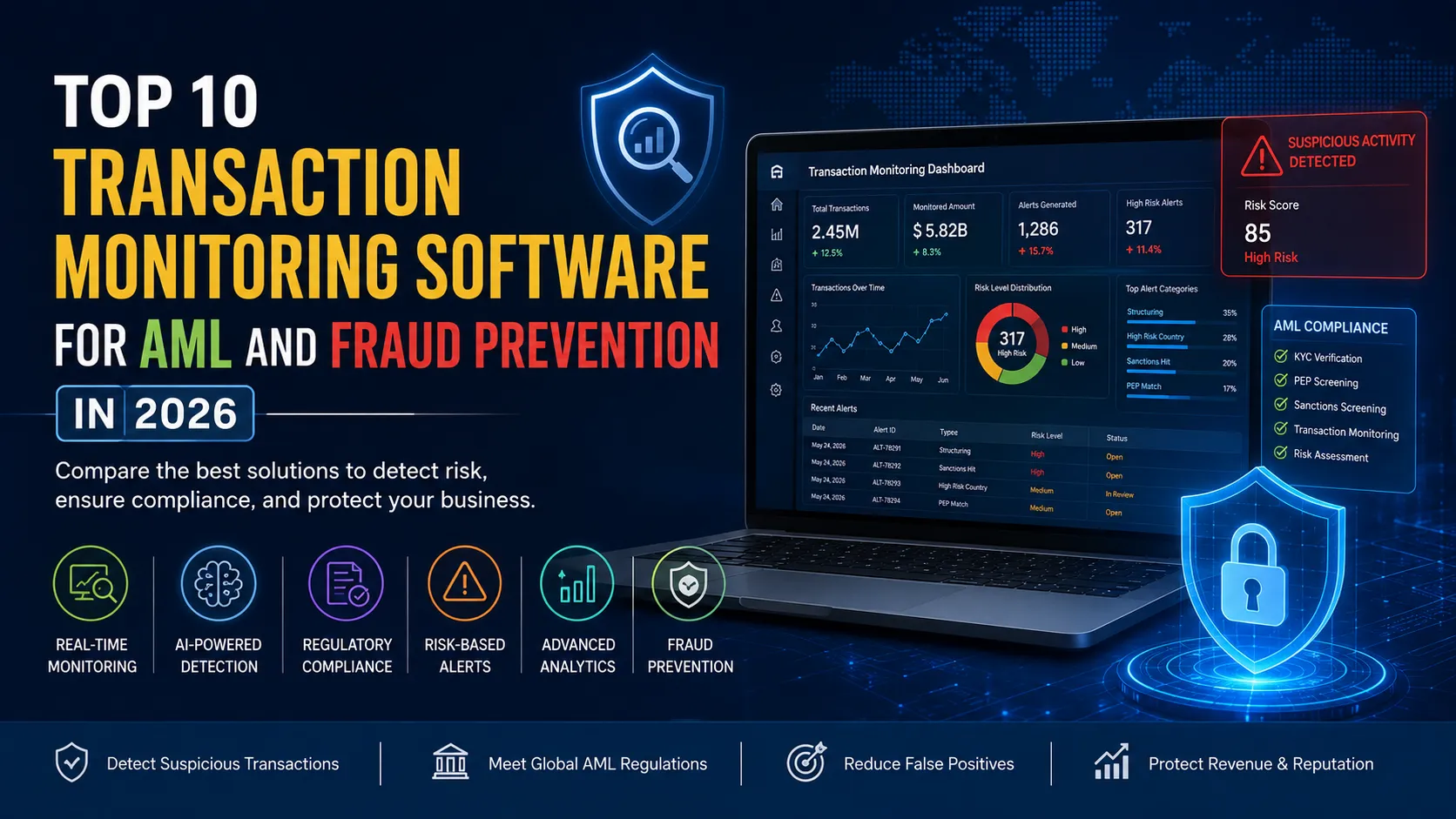
Why Choosing the Right AML Software Matters
Regulators do not forgive a system that missed a pattern it should have caught. In 2026, FinCEN's proposed AML program rule shifts emphasis toward effectiveness over volume, meaning examiners increasingly ask why an alert fired, not just how many fired. A platform that buries analysts in false positives creates the exact blind spot regulators are trying to close, since fatigued teams start closing real alerts faster to keep pace.
This guide profiles the ten platforms banks, credit unions, and fintechs actually deploy this year, and separately addresses a frequently confused query: AML software for accountants, which needs a different tool than bank-scale transaction monitoring.
What Is Transaction Monitoring Software and How It Works
Transaction monitoring software scans customer transactions against rules and behavioral models to flag activity consistent with money laundering, terrorist financing, or fraud, running continuously against every transaction an account generates. It picks up where onboarding checks such as KYC identity verification leave off, since a clean onboarding check says nothing about how an account behaves months later. Three components typically work together.
Rules engine: flags known patterns such as structuring or rapid movement of funds under reporting thresholds.
Behavioral analytics: builds a baseline for each customer and flags deviations a static rule would miss.
Case management: routes flagged activity to analysts and produces the audit trail examiners request.
A platform strong on detection but weak on case management still fails in practice, since examiners judge programs on documented investigation quality as much as detection accuracy.
How We Evaluated These Platforms
Rather than repeating vendor marketing claims, this guide weighs each platform against five practical criteria.
False positive reduction: whether the vendor publishes alert-to-case conversion data.
Explainability: whether analysts can trace exactly why a model generated an alert.
Integration effort: compatibility with core banking systems and data pipelines.
Independent recognition: placement in evaluations like the Forrester Wave or Chartis RiskTech Quadrant.
Pricing transparency: usage-based pricing versus fully custom enterprise quotes.
The 10 Best AML Transaction Monitoring Software in 2026
These are the ten transaction monitoring platforms worth shortlisting this year, ranked by overall strength rather than a single metric.
1. NICE Actimize
NICE Actimize is a veteran platform built for tier one global banks processing billions of transactions across jurisdictions. Its X Sight architecture uses entity-centric risk modeling to shift focus from single transactions to holistic behavior. Cost and complexity put it out of reach for smaller institutions.
2. Oracle FCCM
Oracle Financial Crime and Compliance Management uses graph analytics to uncover hidden relationships between accounts, a strength for detecting money laundering rings within traditional banking ecosystems. It connects seamlessly to Oracle Core Banking, though other core systems face a heavier lift.
3. SAS Anti-Money Laundering
SAS AML sits on the SAS Viya analytics environment, giving compliance and data science teams direct control over detection models rather than a locked vendor engine. This transparency helps cut false positives methodically, though it assumes a team capable of tuning models.
4. SymphonyAI Sensa
SymphonyAI Sensa, formerly NetReveal, ranked among the top platforms in a recent Forrester Wave evaluation. It layers explainable AI on top of existing rule sets rather than replacing them outright, shortening the path to production for banks wary of a rebuild.
5. Featurespace
Featurespace built its ARIC engine around adaptive behavioral analytics that score risk in real time as a transaction happens. It handles fraud and AML signals together, suiting payment processors and card issuers facing both threats through one channel.
6. Hawk AI
Hawk AI markets itself on explainability, using AI native detection with a no-code rule builder compliance teams can adjust without engineering support. Independent reviews cite it for cutting false positives while keeping deployment timelines short.
7. Napier AI
Napier, based in the UK, offers a sandbox called Napier Continuum that lets teams test detection models against historical data before pushing changes live. Its central risk hub unifies transaction monitoring with client screening.
8. ComplyAdvantage
ComplyAdvantage built its name on proprietary sanctions, PEP, and adverse media data, then extended into transaction monitoring on top of that foundation. This suits institutions where screening data quality outweighs modeling depth.
9. Nasdaq Verafin
Verafin runs a cross-institution consortium network, letting participating banks and credit unions see fraud typologies observed at other member institutions, not just their own data. Adoption is strong among North American community banks.
10. ThetaRay
ThetaRay uses unsupervised machine learning to surface anomalies without relying on predefined rules, built for correspondent banking and cross-border payment corridors where laundering patterns constantly shift.
Comparison Table: Recognition, Pricing, and Standout Feature
Software | Independent Recognition | Pricing Model | Standout Feature |
|---|---|---|---|
NICE Actimize | Forrester and Chartis leader | Enterprise custom quote | Entity-centric risk modeling |
Oracle FCCM | Major analyst evaluations | Enterprise custom quote | Graph analytics for hidden links |
SAS AML | Established analytics leader | Enterprise custom quote | Full model transparency on Viya |
SymphonyAI Sensa | Top two in 2025 Forrester Wave | Enterprise custom quote | AI layered on existing rules |
Featurespace | Fraud and AML analyst placements | Enterprise custom quote | Real-time adaptive scoring |
Hawk AI | Cited for explainability | From about 50,000 euros yearly | No code rule builder |
Napier AI | Growing AML AI recognition | Enterprise custom quote | Continuum testing sandbox |
ComplyAdvantage | Proprietary screening data | Usage-based subscription | Sanctions and adverse media depth |
Nasdaq Verafin | Strong community bank adoption | Enterprise custom quote | Cross-institution consortium data |
ThetaRay | Correspondent banking AI leader | Enterprise custom quote | Unsupervised anomaly detection |
Is This the Right Category for Accountants and Small Firms?
Searches for AML software for accountants and AML tools list often lead buyers to the enterprise platforms above, and that is usually the wrong shortlist. Bank-grade transaction monitoring software is priced and built for institutions processing millions of transactions daily. An accounting or law firm typically needs client-level AML screening and due diligence instead, not continuous transaction surveillance across a banking core.
Firms in this category should look at tools built for regulated professional services, such as SmartSearch, Sumsub, or ComplyAdvantage's entry tier, which focus on onboarding checks, sanctions and PEP screening, and periodic rescreening of an existing client book. Where a relationship involves in-person verification, pairing that screening tool with dedicated face verification software covers the identity side more thoroughly than a bundled feature usually does. Buying enterprise monitoring software for a ten-person practice means paying for infrastructure the firm will never use.
How to Choose the Right Software for Your Institution
The right answer depends on institution size and risk profile, not which vendor has the largest market presence.
Tier one global banks: prioritize scale and multi-jurisdiction support. NICE Actimize or Oracle FCCM fit here.
Mid-size banks and fintechs: prioritize fast deployment and explainability. Hawk AI or Napier fit well.
Community banks and credit unions: prioritize shared intelligence and lower cost. Nasdaq Verafin suits this segment.
Banks with heavy cross-border exposure: review FATF's guidance on correspondent banking risk alongside a platform like ThetaRay.
Before signing a contract, ask for the vendor's alert-to-case conversion rate and a reference from a similarly sized institution. Cross-check the AML program design against the FFIEC BSA/AML Examination Manual to confirm the platform supports what examiners expect.
Common Mistakes Institutions Make
Buying for detection breadth alone. A platform that flags everything overwhelms analysts and quietly reduces coverage.
Ignoring case management. Detection without a clean investigation workflow leaves no defensible audit trail, and it also slows down how fast a team can resolve a disputed transaction once a customer flags it.
Treating accountant tools and bank platforms as interchangeable. The two categories solve different problems and are priced accordingly.
Underestimating integration cost. License fees are often smaller than connecting a platform to core banking data, an issue FinCEN's proposed AML program rule expects institutions to have solved.
Skipping model validation. An unvalidated model is a finding waiting to happen at the next exam.
Conclusion
There is no single best AML software for every institution in 2026. The right choice depends on transaction volume, integration needs, and internal capacity to tune models. NICE Actimize and Oracle FCCM suit the largest global banks, SAS and SymphonyAI Sensa suit teams wanting analytical control, and Hawk AI or Napier suit mid-size institutions wanting speed. Accountants should look outside this list toward tools built for client-level screening. Match the platform to the transaction volume you actually have.
Frequently Asked Questions
Q: What is the best AML software for banks in 2026?
NICE Actimize and Oracle FCCM lead for large banks, while Hawk AI and Napier suit institutions wanting faster deployment.
Q: What is the best AML software for accountants?
SmartSearch, Sumsub, and ComplyAdvantage's entry tier fit accounting firms better than bank-scale platforms.
Q: What is the difference between AML software and transaction monitoring software?
AML software covers screening and due diligence broadly. Transaction monitoring is one part, watching ongoing activity for suspicious patterns.
Q: How much does transaction monitoring software cost for banks?
Most vendors quote custom pricing based on transaction volume and entity count, though a few publish starting figures.
Q: What features should top AML software include?
Behavioral analytics, explainable alert scoring, integrated case management, and audit-ready documentation are core requirements.
Q: Can small fintechs use enterprise AML platforms?
Some, like Hawk AI and Napier, suit fast deployment at smaller scale, while NICE Actimize usually serves larger institutions.
Q: Why do AML systems generate so many false positives?
Static rule-based systems flag any matching transaction regardless of context. AI-driven platforms reduce this by learning normal activity.
Share this article
Related Articles

Top 10 Best Face Verification Software in 2026: The Complete Buyer's Guide
Discover the 10 best face verification software in 2026. Compare Jumio, iProov, FaceTec, Veriff, Incode, and more for secure identity verification.
Top 10 Best KYC Providers in the USA for 2026
Explore the 10 best fintech companies in the UK, including Revolut, Wise, Monzo, Starling Bank, and leading firms for banking, payments, and lending.

10 Best Fintech Companies in the UK You Must Know
Explore the 10 best fintech companies in the UK, including Revolut, Wise, Monzo, Starling Bank, and leading firms for banking, payments, and lending.