
10 Best Fintech Companies in the UK You Must Know
Explore the 10 best fintech companies in the UK, including Revolut, Wise, Monzo, Starling Bank, and leading firms for banking, payments, and lending.
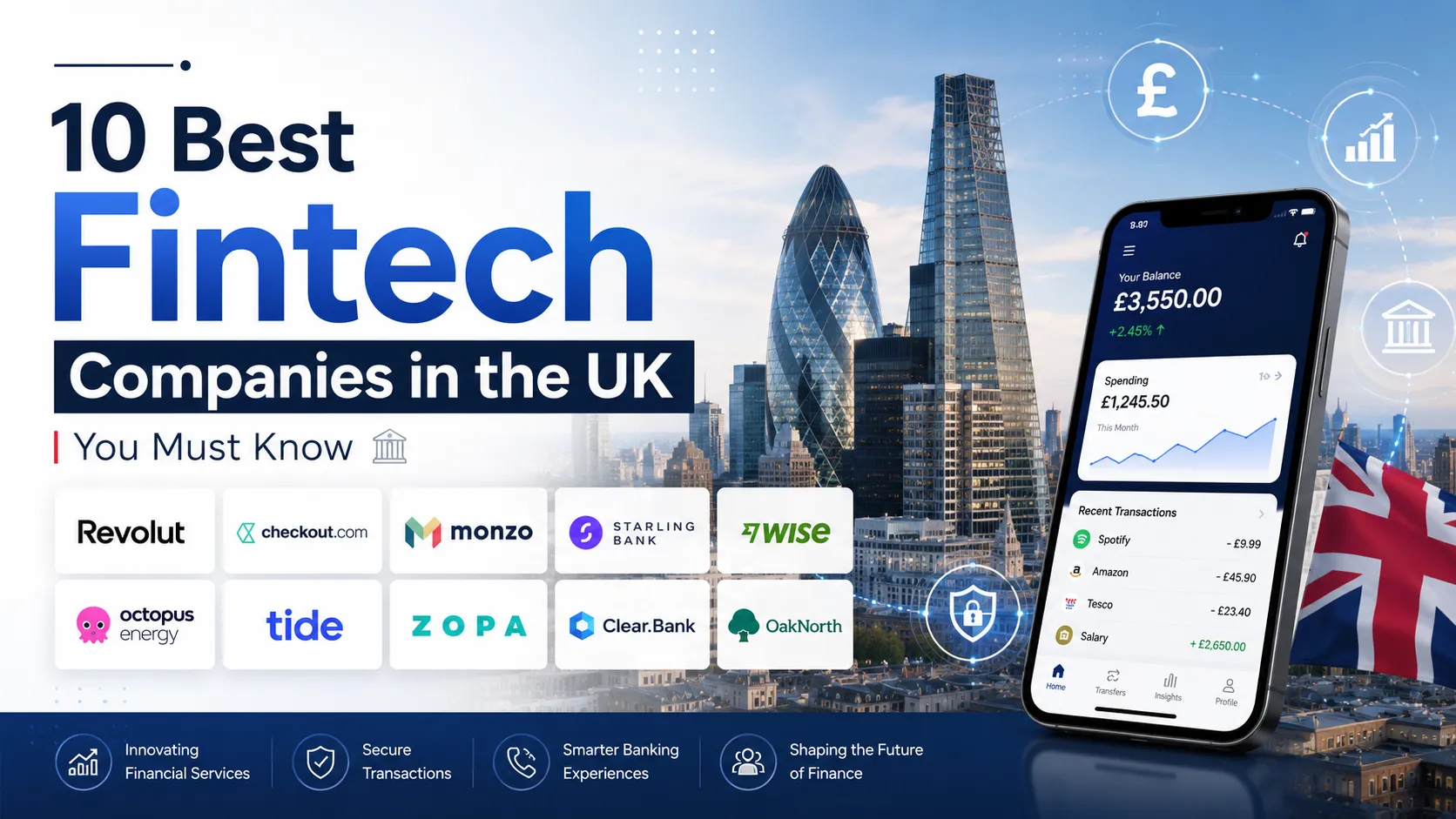
The United Kingdom runs one of the busiest fintech markets on the planet, trailing only the United States in total investment and company count. Anyone typing the top 10 fintech companies in the UK into Google usually wants a fast answer for research or a shortlist before opening an account. This guide ranks the ten fintech companies that shape banking, payments, and lending across the UK today, explains what each does well, and closes with a practical framework for choosing between them.
What Makes a Company a True Fintech Leader in the UK
Many lists rank fintech companies purely by funding raised, which flatters startups that burn cash without building a durable product. A more useful lens looks at four signals together: FCA regulatory status, the size of the customer base, a credible path to profit, and proof the business works outside the UK as well as inside it. A fintech unicorn and a fintech company with real revenue are not the same thing, since valuation reflects future belief while revenue reflects what a company actually is right now. This guide leans on the second measure wherever the two disagree.
How This List Was Put Together
Four criteria decided who made the cut: a UK headquarters or primary operating base, FCA authorisation either directly or through a licensed partner, clear evidence of scale, and a place within one of several fintech categories rather than only digital banking, since the biggest fintech companies UK search rarely means neobanks alone. No company here paid for inclusion, and every figure reflects public reporting rather than marketing claims.
If some of the terminology below is new, our guide to what fintech companies actually are and how they work covers the fundamentals before you dive into the list.
The 10 Best Fintech Companies in the UK You Must Know
Revolut
Revolut started as a prepaid travel card and grew into a full app covering accounts, multi-currency holdings, trading, and business banking. It serves tens of millions of customers and ranks as the most valuable fintech company from the UK. Many users only open it for foreign spending abroad, paying for a bigger toolkit than they use.
Wise
Wise built its reputation on one promise: send money abroad at the real mid-market exchange rate instead of the marked-up rate banks quote. That grew into a multi-currency account, a global debit card, and a business platform for paying international suppliers. Wise became one of the first major UK fintech companies to list directly on the London Stock Exchange, and it almost always beats a bank transfer once you account for the hidden markup, not just the flat fee.
Monzo
Monzo built its following around the Coral card and instant spending notifications, then expanded into savings pots, joint accounts, and short-term borrowing. It holds a full UK banking licence and reported its first full year of profit years after launch, a milestone many neobanks still have not reached. It excels at spending visibility but trails Revolut on investing and multi-currency tools.
Starling Bank
Starling holds a full UK banking licence and built its name on award-winning service and strong small business banking. Its integration with accounting software such as Xero and QuickBooks suits sole traders and limited companies. Starling also licenses its technology to other institutions through a banking as a service arm, quietly placing it in the infrastructure category as well, a detail most comparison articles skip.
Checkout.com
Checkout.com is not a consumer app, and most people searching for UK fintech companies never interact with it directly, which is exactly why it belongs on this list. It processes online payments for large enterprises, competing with Stripe and Adyen, and at its funding peak became one of the most valuable privately held fintech companies from the UK. High-volume online businesses should evaluate it, since enterprise pricing rarely appears on public pages.
Zopa Bank
Zopa launched as the world's first peer-to-peer lending platform, connecting savers directly with borrowers, then made the unusual leap into becoming a fully licensed UK bank. It now offers savings accounts, credit cards, and personal loans through a conventional model, representing the maturity path many fintech companies take once they prove they can manage risk at scale.
OakNorth Bank
OakNorth focuses on a segment most consumer fintech companies ignore: lending to established, growing small and medium businesses that traditional banks often find too small to prioritise. It built its own credit intelligence software and licenses that technology to other banks internationally, and it tends to move faster on lending decisions because its underwriting runs on proprietary data models rather than manual review.
ClearBank
ClearBank became the first new clearing bank to launch in the UK in more than two hundred and fifty years, and it operates almost entirely behind the scenes. Rather than serving consumers directly, it provides the core banking infrastructure other fintech companies build on top of, which explains how smaller apps offer full banking features without being a bank themselves.
GoCardless
GoCardless solved a narrow but expensive problem: recurring card payments fail constantly, and that failure drives subscription cancellations. It built its business around bank debit collection instead, which fails far less often and costs less per transaction. Subscription businesses and membership platforms across the UK rely on it to reduce involuntary churn, since it complements a standard payment processor rather than replacing it.
Allica Bank
Allica Bank rarely appears on generic fintech lists despite ranking among the fastest-growing and most profitable challenger banks in the country. It targets established small and medium businesses, offering business accounts, savings, and commercial mortgages built for companies traditional banks often underserve, with a path to profitability faster than most neobank peers.
The 10 Best UK Fintech Companies at a Glance
Scan the full list in seconds before reading the detail above.
Company | Founded | Category | Best For |
|---|---|---|---|
Revolut | 2015 | Digital banking | All-in-one everyday and travel finance |
Wise | 2011 | Payments and transfers | Low-cost international money transfer |
Monzo | 2015 | Digital banking | Everyday spending and budgeting |
Starling Bank | 2014 | Digital banking | Small business banking |
Checkout.com | 2012 | Payments infrastructure | Enterprise online payment processing |
Zopa Bank | 2005 | Lending and banking | Personal loans, savings, credit cards |
OakNorth Bank | 2015 | Business lending | Growth finance for established SMEs |
ClearBank | 2015 | Banking infrastructure | Powering other fintech apps |
GoCardless | 2011 | Payments infrastructure | Recurring and subscription billing |
Allica Bank | 2019 | Business banking | Profitable, established SME banking |
UK Fintech Companies by Category
Grouping the sector by function, rather than by hype, makes it easier to find the right match, whether the search is fintech banks UK, fintech companies in London, or top fintech companies in the world.
Digital Banking and Neobanks
Revolut, Monzo, and Starling Bank compete for personal banking, each with a different strength: breadth, spending visibility, and business tools.
Zopa Bank and Allica Bank show how a fintech company can start narrow and grow into a full bank.
Payments and Money Transfer
Wise dominates consumer international transfers with transparent, real-rate pricing.
Checkout.com and GoCardless serve businesses, handling checkout processing and recurring billing.
Lending and Business Finance
OakNorth Bank leads SME growth lending, while Zopa's peer-to-peer roots still shape how it prices personal loans.
Banking Infrastructure and Regtech
ClearBank provides the clearing and settlement rails that smaller apps depend on, rarely appearing in consumer searches yet quietly supporting most household names above.
Behind every regulated fintech sits a compliance layer too. Firms handling customer risk often rely on dedicated AML and fraud prevention transaction monitoring software to flag suspicious activity before it reaches a regulator's desk.
Why London Remains Europe's Fintech Capital
London holds one of the deepest pools of financial services talent in the world, built over centuries as a banking centre, so fintech companies hire experienced compliance, risk, and engineering staff without competing for a thin market. The FCA runs a regulatory sandbox that lets new products test with real customers before full authorisation, shortening the path from idea to launch. Its time zone overlaps both Asian and US markets, and its concentration of venture capital means founders rarely need to relocate to raise a serious round.
How to Choose the Right UK Fintech Company for Your Needs
Picking a fintech company by reputation alone is how people end up paying for features they never use.
Define the specific job first, since personal banking, transfers, lending, and payment processing each point to a different company.
Check the regulatory status on the FCA register, since a banking licence and an electronic money licence protect funds differently.
Compare the full fee structure, not just the headline rate, since transfer fees often hide a currency markup.
Test the app with a small amount first, since support responsiveness is easier to judge from experience than a features list.
Check integration with tools you already use, since a connected accounting system saves real time each month.
Reassess yearly, since pricing and features change and last year's right choice may not still hold.
You can confirm any UK provider's authorisation directly on the FCA Financial Services Register, and check what your funds are covered for on the Financial Services Compensation Scheme website.
Common Mistakes People Make When Comparing Fintech Companies
Confusing a high valuation with product quality.
Ignoring the difference between FSCS bank protection and electronic money safeguarding.
Comparing only the transfer fee while ignoring the exchange rate markup.
Assuming the most downloaded consumer app is automatically best for business use.
Skipping the FCA register check and trusting app store reviews instead.
It also helps to know what happens if a payment goes wrong. Our breakdown of disputed transactions and how to protect your money walks through the process step by step.
Conclusion
The UK fintech sector has moved well past its early startup phase. Companies such as Revolut, Wise, Monzo, and Starling Bank now serve tens of millions of customers and file real profits, while infrastructure players such as ClearBank and GoCardless quietly power the ecosystem behind the scenes. Rather than picking a company because it tops a funding chart, match it to the job you need done and confirm its regulatory status first.
Frequently Asked Questions
Q: What is the number 1 fintech company in the UK?
Revolut holds the top position by valuation, customers, and product range, though Wise leads on transfer pricing and Monzo on spending simplicity.
Q: What are the biggest fintech companies in the UK?
Revolut, Wise, Monzo, Starling Bank, and Checkout.com lead, alongside Zopa Bank, OakNorth Bank, ClearBank, GoCardless, and Allica Bank.
Q: Which UK fintech companies are publicly listed?
Wise is one of the first major UK fintech companies to list directly on the London Stock Exchange, unlike most private peers.
Q: Are UK fintech companies safe to use?
It depends on the licence held. Banks such as Monzo carry FSCS protection, while electronic money institutions protect funds through safeguarding rules instead.
Q: What is the difference between a fintech company and a digital bank?
Every digital bank is a fintech company, but not every fintech company is a bank. A digital bank holds a full licence and can lend from deposits.
Q: Which UK fintech is best for international money transfers?
Wise remains the strongest choice thanks to its real mid-market rate and transparent fees, with Revolut as a competitive alternative.
Q: Which UK fintech is best for small business banking?
Starling Bank and Allica Bank both stand out, Starling for accounting integration and Allica for established SMEs needing lending.
Q: Are UK fintech companies regulated by the FCA?
Reputable UK fintech companies are authorised by the FCA directly or operate under a regulated partner's licence.
Q: What is the largest fintech hub in the UK?
London remains the largest UK fintech hub by a wide margin, hosting most companies on this list.
Q: How does a UK fintech company differ from a US fintech company?
UK fintech companies operate under FCA oversight and FSCS-style protection, while US firms navigate a fragmented state-by-state landscape.
Share this article
Related Articles
10 Best AML Transaction Monitoring Software in 2026: Compare Top Platforms
Discover the best AML transaction monitoring software for 2026, with platform comparisons, pricing, features, and options for banks and accountants.

Top 10 Best Face Verification Software in 2026: The Complete Buyer's Guide
Discover the 10 best face verification software in 2026. Compare Jumio, iProov, FaceTec, Veriff, Incode, and more for secure identity verification.
Top 10 Best KYC Providers in the USA for 2026
Explore the 10 best fintech companies in the UK, including Revolut, Wise, Monzo, Starling Bank, and leading firms for banking, payments, and lending.