
Top 10 Best Face Verification Software in 2026: The Complete Buyer's Guide
Discover the 10 best face verification software in 2026. Compare Jumio, iProov, FaceTec, Veriff, Incode, and more for secure identity verification.
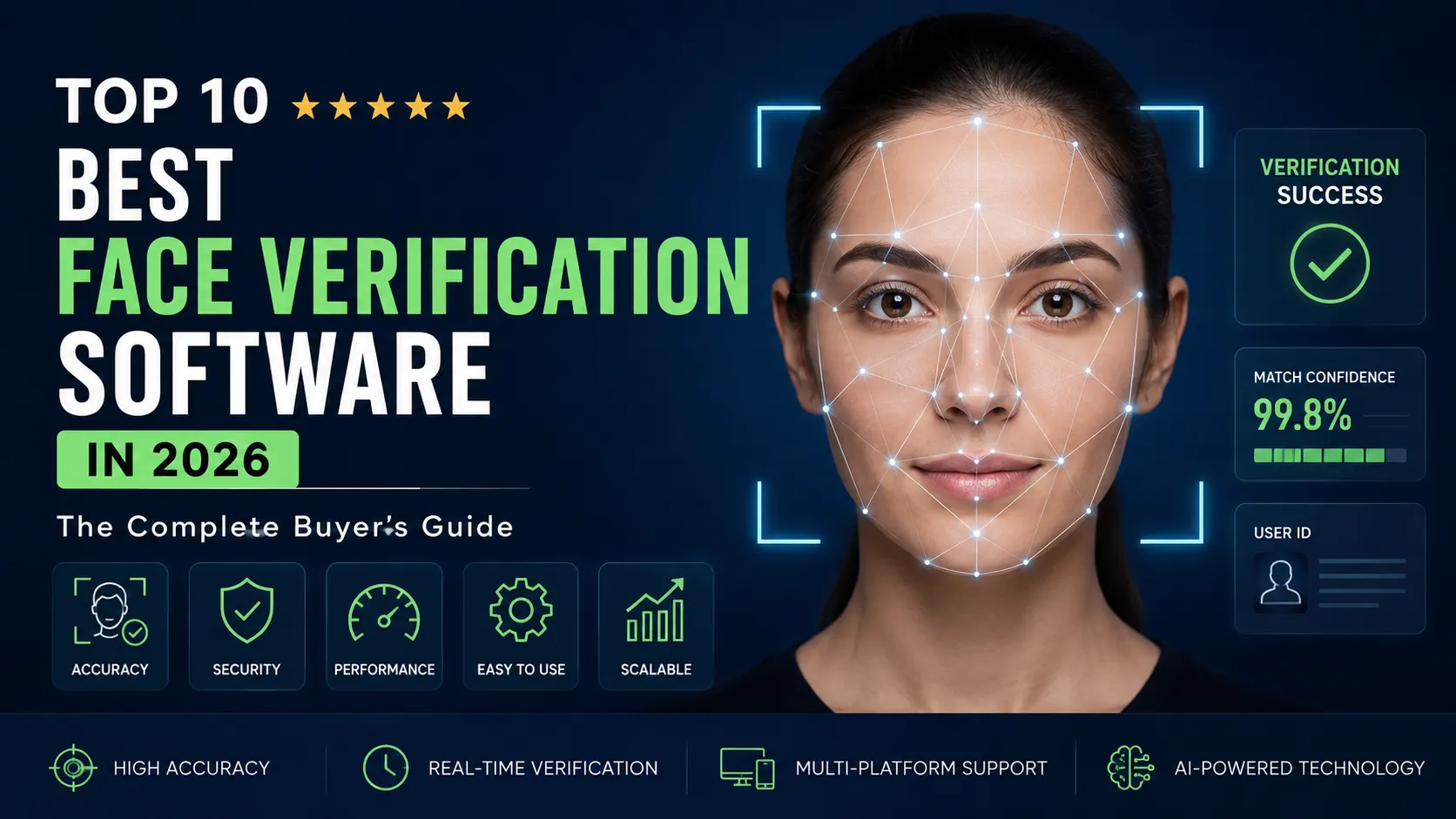
Why Choosing the Right Face Verification Software Matters
Face verification fraud looked simple five years ago, when a printed photo or video replay often tricked a weak system. That era is over. Jumio has reported an eighty-eight percent year-on-year rise in injection attacks, where a synthetic face is fed directly into the video stream. The best face verification software 2026 buyers need is not the flashiest demo, but the one that proves it stops attacks it has never seen.
This guide profiles the ten platforms businesses actually deploy this year, explaining what each vendor is strong at, where it falls short, and who should avoid it. It also clears up a common confusion: whether PimEyes belongs on this list at all.
What Is Face Verification Software and How It Works
Face verification software confirms that the person in front of a camera is a live human and matches the identity they claim, comparing a selfie against a government-issued document. Three layers work together.
Face matching: compares facial geometry between the selfie and ID photo, returning a similarity score.
Liveness detection: confirms a real, present human took the selfie, not a photo or mask.
Injection and deepfake defense: detects a synthetic face inserted directly into the camera feed.
A platform that only matches faces without strong liveness and injection defense gives a false sense of security.
Accuracy claims are worth checking independently. NIST runs the Face Recognition Vendor Test program, the closest thing the industry has to a neutral, government-run accuracy benchmark.
How We Evaluated These Platforms
Rather than repeating vendor marketing claims, this guide weighs each platform against five practical criteria that determine real-world performance and total cost.
Certification: conformance such as ISO/IEC 30107 3 and CEN/TS 18099.
Deepfake resistance: whether the vendor publishes false acceptance rates or audits.
Coverage: document types and countries supported out of the box.
Integration effort: SDK quality, API documentation, and time to launch.
Pricing transparency: usage-based pricing versus sales-led contracts.
The 10 Best Face Verification Software in 2026
These are the ten identity verification companies worth shortlisting this year, ranked by overall strength rather than a single metric.
1.Jumio
Jumio combines document scanning, face matching, and passive liveness in one widely used platform with broad document coverage. The tradeoff is transparency: it does not publish independent false acceptance rates, and some deployments rely on iProov for liveness.
2. iProov
iProov holds some of the strongest injection attack certifications in the industry and serves agencies including the UK Home Office and US DHS. Its Dynamic Liveness uses controlled illumination to confirm a genuine human, though it is a specialist, not a full KYC suite.
3. FaceTec
FaceTec builds an encrypted 3D face map from a short selfie video, comparing that geometry against known patterns of flat images and masks. The approach resists physical spoofing well, though it has shown limits against advanced deepfake swaps.
4. Entrust IDV (formerly Onfido)
Now branded Entrust IDV, this platform supports more than 2,500 document types across 195 countries through its Atlas AI engine, plus sanctions and adverse media screening. Pricing is sales-led, and manual review options trail some rivals.
5. Veriff
Veriff, based in Estonia, built its reputation on speed, with a six-second average decision time and ninety-eight percent automation. It has strong fintech and crypto adoption, though pricing runs higher than some rivals.
6. Sumsub
Sumsub operates less as a single tool and more as a full compliance platform, bundling liveness, document checks, and case management. Liveness is competent rather than best in class, but workflow breadth is the real strength.
7. Persona
Persona takes a modular approach, letting teams assemble a flow from separate building blocks such as document check, selfie match, and watchlist screening rather than a fixed bundle, at the cost of more setup work.
8. AU10TIX
AU10TIX focuses on document forensics, using deep image analysis to catch tampered or synthetic identity documents, then pairs that with face matching. It suits platforms facing fraud rings targeting document quality.
9. Regula
Regula built its name in document forensic hardware before expanding into software verification, and that heritage shows in an authentication engine that checks features many rivals miss. Its biometric layer is solid but secondary.
10. Incode
Incode combines liveness, deepfake detection, camera injection analysis, and device signals in one AI native platform covering more than 211 countries, with agentic monitoring for coordinated fraud patterns across many attempts.
Comparison Table: Features, Certification, and Pricing
Software | Liveness Certification | Pricing Model | Standout Feature |
|---|---|---|---|
Jumio | ISO/IEC 30107 3 Level 2 | Sales-led quote | Wide document coverage |
iProov | Strongest injection attack results | Enterprise quote | Dynamic Liveness illumination |
FaceTec | ISO/IEC 30107 3 Level 2 | Licensing or usage-based | Encrypted 3D face map |
Entrust IDV | Documented internally | Annual contract | 2,500+ document types |
Veriff | Not fully published | Per verification | Six-second average decision |
Sumsub | NIST-aligned methods | Tiered subscription | Built-in case management |
Persona | Varies by module | Usage based | Composable building blocks |
AU10TIX | ISO/IEC 30107 3 Level 2 | Volume based | Deep document forensics |
Regula | Hardware plus software tested | Custom quote | Forensic document checks |
Incode | Independent audits published | Usage based | Agentic fraud monitoring |
Is PimEyes a Face Verification Tool?
PimEyes shows up constantly in searches next to identity verification companies, but it solves a different problem entirely. It is a reverse face search engine: a user uploads a photo, and PimEyes scans public websites for visually similar faces, returning links to where those images appear. It does not confirm identity, compare a selfie against a document, or perform liveness detection.
Businesses researching onboarding or KYC should look at Jumio, Veriff, or Sumsub instead. PimEyes fits a narrower case: individuals monitoring their own online photos, or creators auditing unauthorized reuse. Treating PimEyes as a KYC alternative is a common research mistake that wastes evaluation time on a tool never built for that job.
How to Choose the Right Software for Your Business
The right answer depends on what your business actually protects against, not which vendor has the largest marketing budget.
Fintech and crypto onboarding: prioritize speed and injection resistance. Veriff or Incode fit well.
Regulated finance and government: prioritize certification depth. Entrust IDV, Regula, or AU10TIX suit compliance-heavy environments; pair with a KYC provider comparison for the document and screening side.
Marketplaces and gig platforms: prioritize document forgery detection over the selfie step. AU10TIX or Sumsub work here.
Product teams building a custom flow: prioritize flexibility and API design. Persona fits this best.
Before signing a contract, request the vendor's iBeta or ISO/IEC 30107 3 conformance report directly and ask specifically how they detect camera injection attacks, the fastest-growing fraud vector in 2026.
Common Mistakes Businesses Make When Selecting a Verification Vendor
Judging accuracy from a demo alone. Demos rarely include adversarial testing, so a smooth demo says little about spoof resistance.
Ignoring injection attack defense. Many teams test only printed photos, missing the deepfake attacks causing most fraud losses now. Pairing biometric checks with transaction monitoring software catches fraud slipping past onboarding alone.
Confusing search tools with verification tools. PimEyes and similar engines cannot replace a KYC platform, whatever the marketing claims.
Overlooking data residency. Biometric data falls under GDPR Article 9 as special category data, so confirm where templates are stored first.
Choosing on price alone. A cheaper rate causing higher fraud losses or manual review often costs more within a year.
Conclusion
There is no single best face verification software for every business in 2026. The right choice depends on speed, document forensics, deepfake resistance, or a custom workflow. Jumio and Entrust IDV suit teams wanting one full-stack vendor, iProov and FaceTec lead on pure liveness assurance, and Veriff remains the fastest option for high-volume onboarding. Verify certification claims directly, test against injection attacks, and remember that a search tool like PimEyes solves a different problem than identity verification. Match the tool to the threat.
Frequently Asked Questions
Q: What is the best face verification software for small businesses?
Veriff and Persona offer usage-based pricing with no large upfront contract, suiting smaller teams as volume grows.
Q: What is the difference between face verification and face recognition?
Verification matches a live selfie against a document photo. Recognition tools like PimEyes search broadly across the web.
Q: Is PimEyes safe to use for identity checks?
No. PimEyes does not verify identity or perform liveness detection. It is a search engine for privacy monitoring.
Q: Which face verification software has the strongest deepfake protection?
iProov and Incode currently publish the strongest independent results against injection and deepfake attacks.
Q: Do face verification platforms store biometric data?
Most cloud platforms store an encrypted template, while vendors like FaceTec offer self-hosted options for control.
Q: How much does face verification software cost?
Usage-based vendors often charge roughly one to several dollars per verification, while enterprises use annual contracts.
Q: What certifications should I look for in a verification vendor?
ISO/IEC 30107 3 Level 2 is the current baseline, while CEN/TS 18099 is the newer injection attack standard.
Share this article
Related Articles
10 Best AML Transaction Monitoring Software in 2026: Compare Top Platforms
Discover the best AML transaction monitoring software for 2026, with platform comparisons, pricing, features, and options for banks and accountants.
Top 10 Best KYC Providers in the USA for 2026
Explore the 10 best fintech companies in the UK, including Revolut, Wise, Monzo, Starling Bank, and leading firms for banking, payments, and lending.

10 Best Fintech Companies in the UK You Must Know
Explore the 10 best fintech companies in the UK, including Revolut, Wise, Monzo, Starling Bank, and leading firms for banking, payments, and lending.